Pinyin: Mimenghua
Aliases
Huangfanhua, Menghuazhu, Nuomihua.
Source
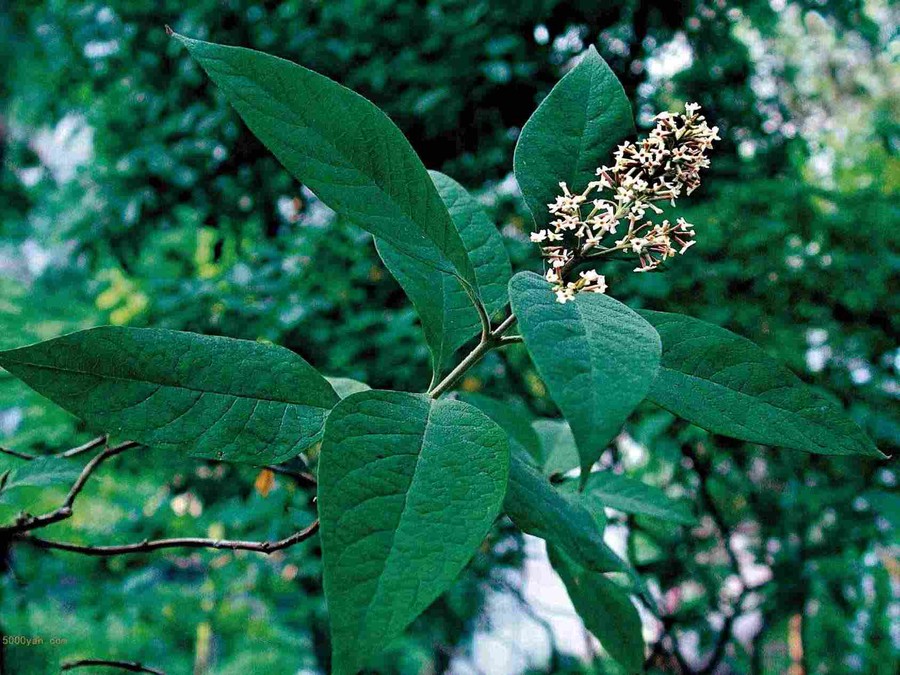
Plant belonging to the Loganiaceae family, Buddleja officinalis (Buddleja flower).Buddleja officinalisDried flower buds and inflorescences of *Wikstroemia indica* (L.) C.A. Mey.
Botanical Description
Deciduous shrub, approximately 3 m tall, up to 6 m or more. Branchlets grayish-brown, slightly 4-angled; branches, petioles, leaf abaxial surfaces, and inflorescences densely covered with white stellate hairs and tomentum, hairs on stems gradually shedding. Leaves simple, opposite; leaf blade broadly lanceolate, 5-12 cm long, 1-4 cm wide, apex acuminate, base cuneate, margin entire or minutely serrate. Large panicles composed of cymes, terminal and axillary; involucre, calyx tube, and corolla densely covered with grayish-white tomentum; calyx campanulate, apex 4-lobed; corolla tubular, apex 4-lobed, tube purplish-blue, throat orange-yellow, both surfaces pubescent; stamens 4, inserted at middle of corolla tube; ovary superior, 2-locular, pubescent, style short, stigma enlarged, oblong-ovoid. Capsule oblong-ovoid, 2-6 mm long, 2-valved, exocarp with stellate hairs, base with persistent perianth. Seeds minute, winged at both ends. Flowering February to March, fruiting May to August.
Habitat and Distribution
Growing at an altitude of 200-2800 m on hillsides, hills, riversides, village edges in shrublands and forest margins. Distributed in Central and South China, Southwest China, and Shaanxi, Gansu, Anhui, Fujian, and Xizang (Tibet) regions.
Harvesting and Processing
Harvested in spring before the flowers open, remove impurities, and dry.
Medicinal Properties
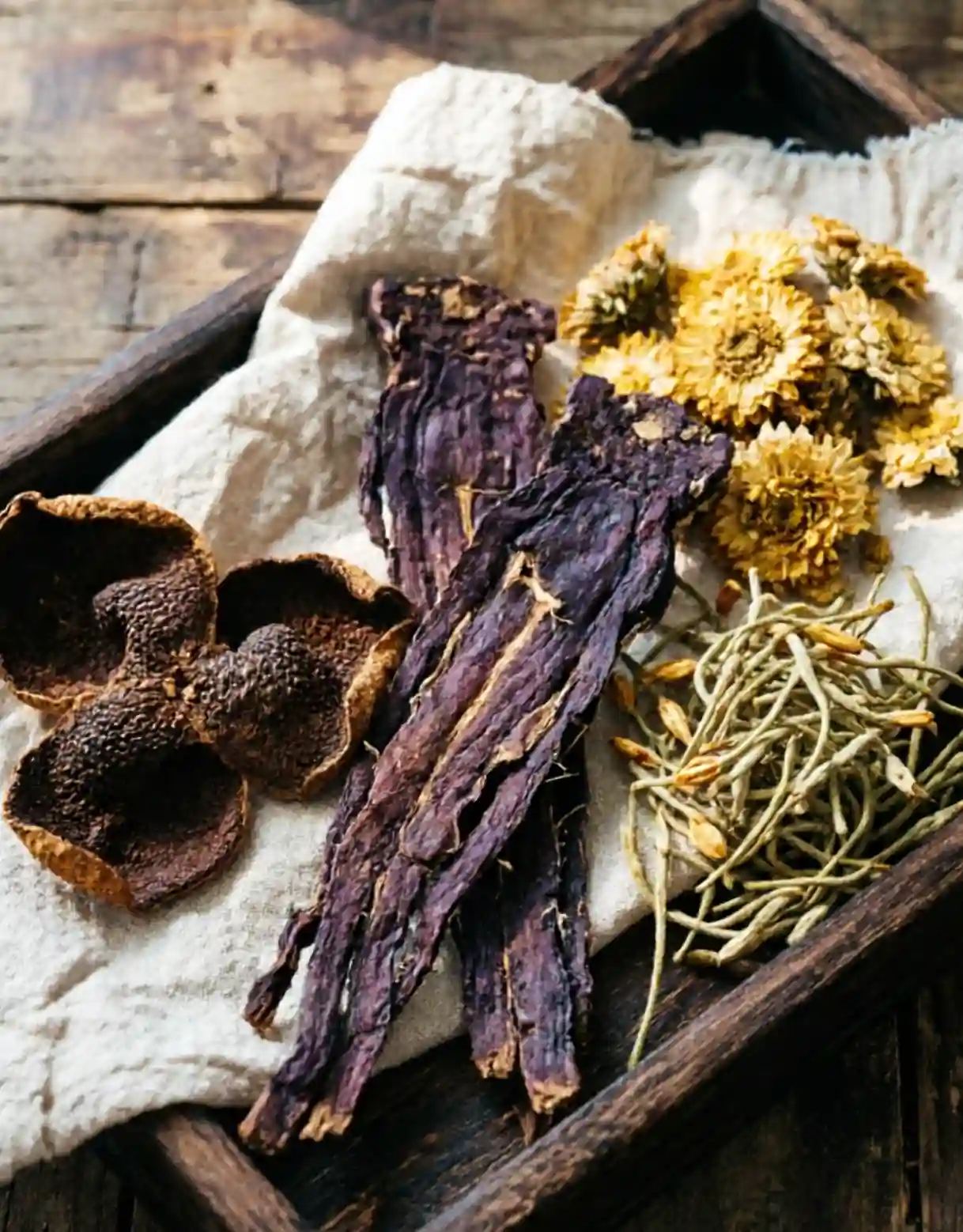
This product is mostly the small branches of inflorescences densely packed with flower buds, appearing irregularly conical, 1.5-3 cm long. The surface is gray-yellow or brown-yellow, densely covered with fine hairs. The flower buds are short rod-shaped, slightly larger at the upper end, 0.3-1 cm long, 0.1-0.2 cm in diameter; the calyx is bell-shaped, with 4 teeth at the apex; the corolla is tubular, equal to or slightly longer than the calyx, with 4 lobes at the apex, the lobes ovate; there are 4 stamens, attached to the middle of the corolla tube. The texture is soft. The odor is faintly fragrant, and the taste is slightly bitter and acrid.
Chemical Constituents
This product contains buddleoside, acteoside, mimengoside A, mimengoside B, and other constituents.
Pharmacology
Has an inhibitory effect on cytotoxins; anti-inflammatory; antispasmodic; diuretic; promotes bile secretion.
Properties and Channel Entry
Sweet, slightly cold. Enters the Liver channel.
Functions and Indications
Clears Heat and drains Fire, nourishes the Liver and brightens the eyes, removes nebula
Dosage and Administration
Oral administration: decoction, 6-15 g; or made into pills or powder.
Prescriptions
1. For blepharitis with dampness and excessive tearing: Mimenghua 9 g, Baizhu 6 g, Weirui 15 g. Decoct in water and take orally. (Bencao Huiyan) 2. For corneal opacity: Mimenghua and Huangbai root (washed, sliced) 30 g each. Grind the two ingredients into powder, mix with refined honey to form pills the size of wutong seeds. Take 10-15 pills after meals and before bedtime with boiled water or boiled malt sugar water. (Shengji Zonglu, Mimenghua Pills) 3. For all eye diseases caused by prolonged close reading, straining the eyes, leading to blurred vision, swelling, pain, and unclear vision: Mimenghua 15 g, Ganjuhua 6 g, Maimendong (remove core) 24 g, Danggui body 4.5 g, Yuzhu 12 g. Decoct in water and take orally. (Bencao Huiyan) 4. For liver deficiency and decreased vision: Mimenghua 12 g, Gouqi 12 g, Juhua 12 g, Shengdihuang 12 g, Chushizi 12 g, Mugua 6 g, Qinpi 6 g. Mix with honey to form pills. Take 9 g per dose, 3 times daily. (Sichuan Zhongyao Zhi, 1982 edition) 5. For whooping cough: Steam Mimenghua with rice-washing water oil, honey, or sugar. Alternatively, stuff Mimenghua into a Baozhu pear (with cap and core removed) and steam with honey. (Kunming Minjian Changyong Caoyao) 6. For night blindness: Mimenghua 15 g, Qingxiangzi 15 g, Caojueming 12 g. Grind each into fine powder. Place in pig liver, cook until done, then dry. Add Cheqianzi, Wuzeigu, and Yemingsha 9 g each. Combine into fine powder. Take 9 g each morning and evening with boiled water. Continue for 3 courses. (Gansu Zhongyi Yian Jijin)