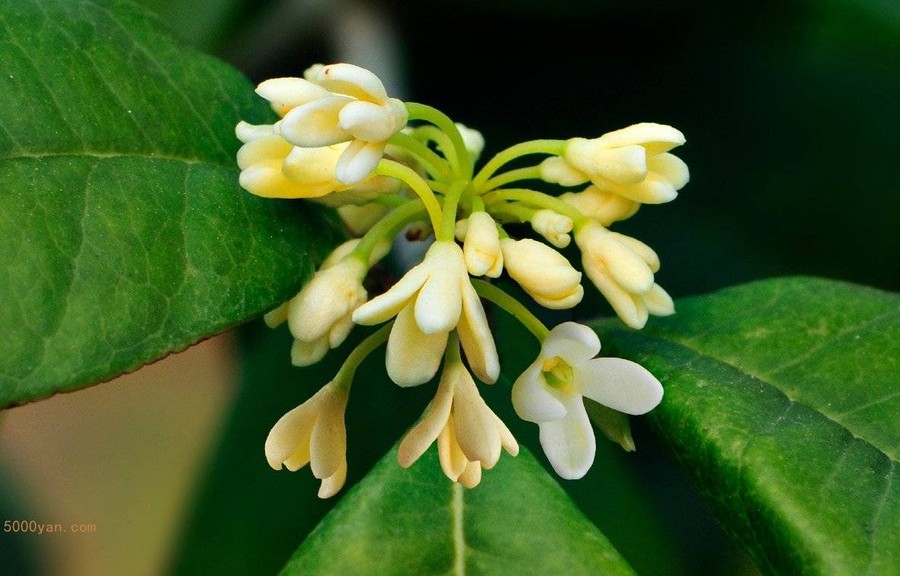
Pinyin: Guihua
Aliases
Muxihua
Source
Oleaceae plant *Osmanthus fragrans* Lour.Osmanthus fragransDried flower of (Thunb.) Lour.
Botanical Description
Evergreen tree or shrub, up to 18 m tall. Bark grayish-brown. Branchlets yellowish-brown, glabrous. Leaves opposite, petiole 0.8-1.2 cm long; leaf blade leathery, elliptic, apex acuminate, base gradually narrowed to cuneate or broadly cuneate, margin entire or usually with fine serrations in the upper half, glandular dots forming small blister-like protrusions on both surfaces. Cymes clustered in leaf axils or nearly broom-shaped, with many flowers per axil; bracts 2, broadly ovate, thick, 2-4 mm long, with a small tip, base connate; pedicels slender; flowers very fragrant; calyx campanulate, 4-lobed, about 1 mm long, lobes slightly irregular; corolla lobes 4, yellowish-white, pale yellow, yellow, or orange-red, 3-4 mm long, corolla tube only 0.5-1 mm long; stamens 2, inserted at middle of corolla tube, filaments very short, connective slightly extended at anther apex forming an indistinct small tip; pistil about 1.5 mm long, style about 0.5 mm long. Fruit oblique, elliptic, 1-1.5 cm long, purplish-black. Flowering September to October, fruiting March of the following year.
Habitat and Distribution
Cultivated in many regions across the country, originally produced in the southwestern part of China.
Harvesting and Processing
Harvested during flowering from September to October, remove impurities, dry in the shade, and store in a sealed container.
Medicinal Properties
Flowers small, with fine stalks; flower tube small, shallowly 4-lobed, membranous; corolla 4-lobed, lobes oblong, mostly wrinkled, 3-4 mm long, pale yellow to yellowish-brown. Odor: aromatic; Taste: mild. Those with dry texture, pale yellow color, and fragrant aroma are considered superior.
Chemical Constituents
This product contains ocimene, linalool, norterpene, and other components.
Properties and Channel Entry
Acrid, warm. Enters the Lung, Spleen, and Kidney channels.
Functions and Indications
Warm the Lungs and transform Phlegm-Fluids, disperse Cold and alleviate pain
Dosage and Administration
Oral: decoct in water, 3-9 g; or steep as tea. External use: appropriate amount, decoct for gargling or steam hot for external hot compress.
Prescriptions
1. For halitosis: Appropriate amount of Guihua (Sweet Osmanthus), decoct in water and use as a mouth rinse. (Anhui Herbal Medicine) 2. For stomach cold with abdominal pain: Guihua (Sweet Osmanthus) 4.5 g, Gaoliangjiang (Alpinia officinarum) 4.5 g, Xiaohuixiang (Fennel) 3 g. Decoct and take orally. (Anhui Herbal Medicine) 3. For stomach cold with gastric pain: Guihua (Sweet Osmanthus) 3 g, Xiangfu (Cyperus) 9 g, Gaoliangjiang (Alpinia officinarum) 9 g, Sharen (Amomum) 6 g. Decoct in water and take orally. (Qingdao Chinese Herbal Medicine Manual) 4. For amenorrhea with abdominal pain: Guihua (Sweet Osmanthus) 12 g, Duiyuecao (Hypericum) 12 g, Daozhusan (Lysimachia) 12 g, Yimucao (Leonurus) 12 g, Aiye (Artemisia argyi) 9 g, Yuejihua (Rosa chinensis) 6 g. Decoct in water and take orally. (Wanxian Chinese Herbal Medicine)