Pinyin: Gujingcao
Aliases
Dai Xing Cao, Wen Xing Cao, Yi Xing Cao, Zhen Zhu Cao, Yu Yan Cao.
Source
1. For pneumonia: Renshen 6 g, decoct in water and take orally.Eriocaulon buer-gerianumDried capitulum with flowering stem of Koern.
Botanical Description
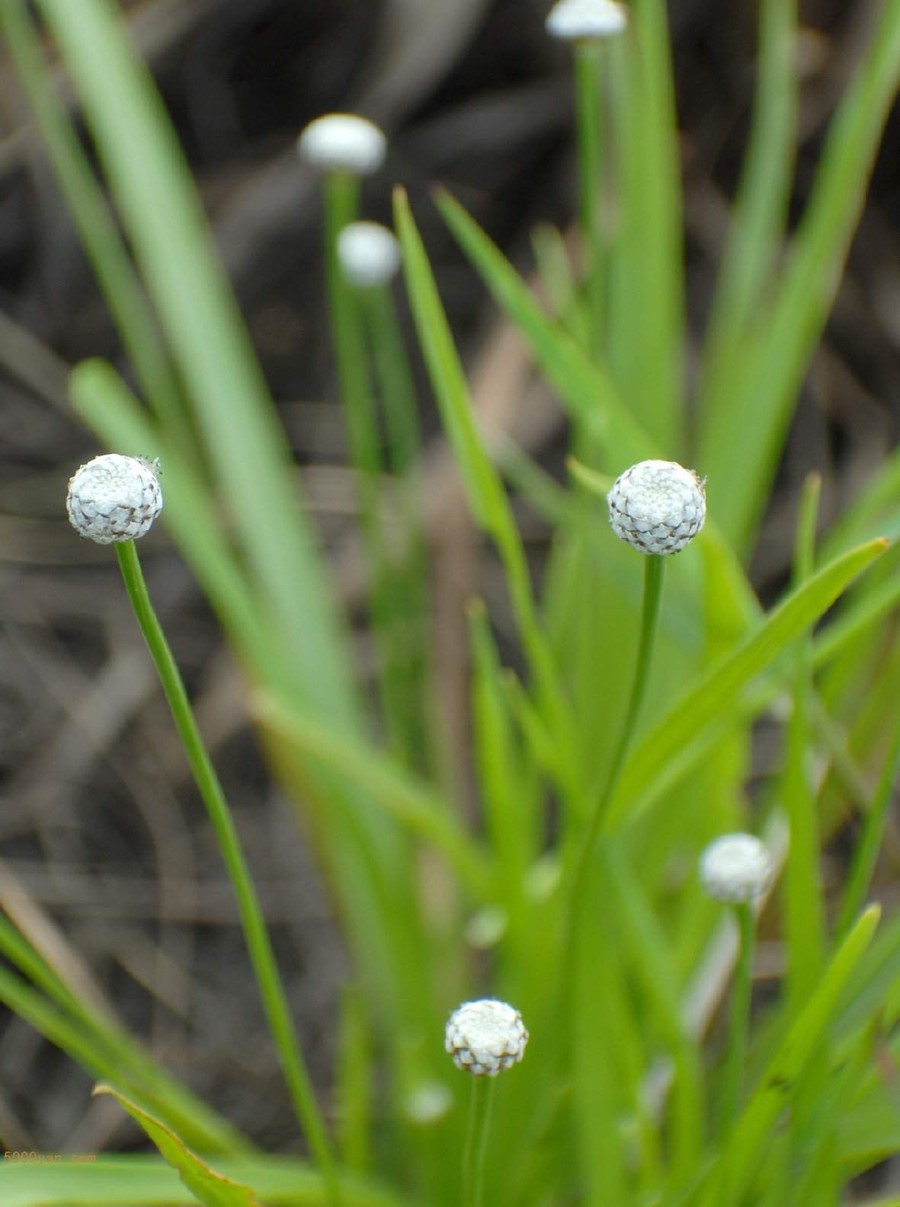
Annual herb, rosette-forming. Fibrous roots numerous, fine and soft, dense. Stem absent. Leaves basal, linear-lanceolate, 6-20 cm long, 3-4 mm wide in the middle, up to 8 mm wide at the base, apex slightly obtuse, with more than 10 longitudinal veins, transparent small squares formed by longitudinal and transverse veins on the leaf blade. Scapes numerous, of varying lengths, the tallest reaching up to 30 cm, shorter or longer than the leaves; capitulum subglobose, 4-6 mm in diameter; involucral bracts obovate, 2-2.5 mm long, straw-yellow; floral bracts obovate, apex abruptly pointed, about 2 mm long, upper part densely covered with short hairs. Male flowers fewer; outer perianth segments fused into an obovate bract-like shape, apex 3-lobed, obtuse, with short hairs; inner perianth segments fused into an obconical tube; stamens 6, anthers black, 0.2 mm long. Female flowers numerous, borne around the inflorescence, nearly sessile; outer perianth segments fused into an elliptic bract-like shape; inner perianth segments 3, free, spatulate, apex with a black gland, with fine long hairs; pistil 1, ovary 3-locular, stigma 3-lobed. Capsule trigonous-globose, about 1 mm long. Seeds oblong-elliptic, hairy. Flowering and fruiting period: July to December.
Habitat and Distribution
It grows in marshes, streamsides, and damp areas near rice paddies. It is distributed in East China, Southwest China, and regions including Hunan and Taiwan.
Harvesting and Processing
Harvest in autumn, pull out the inflorescence along with the flower stem, and dry in the sun.
Medicinal Properties
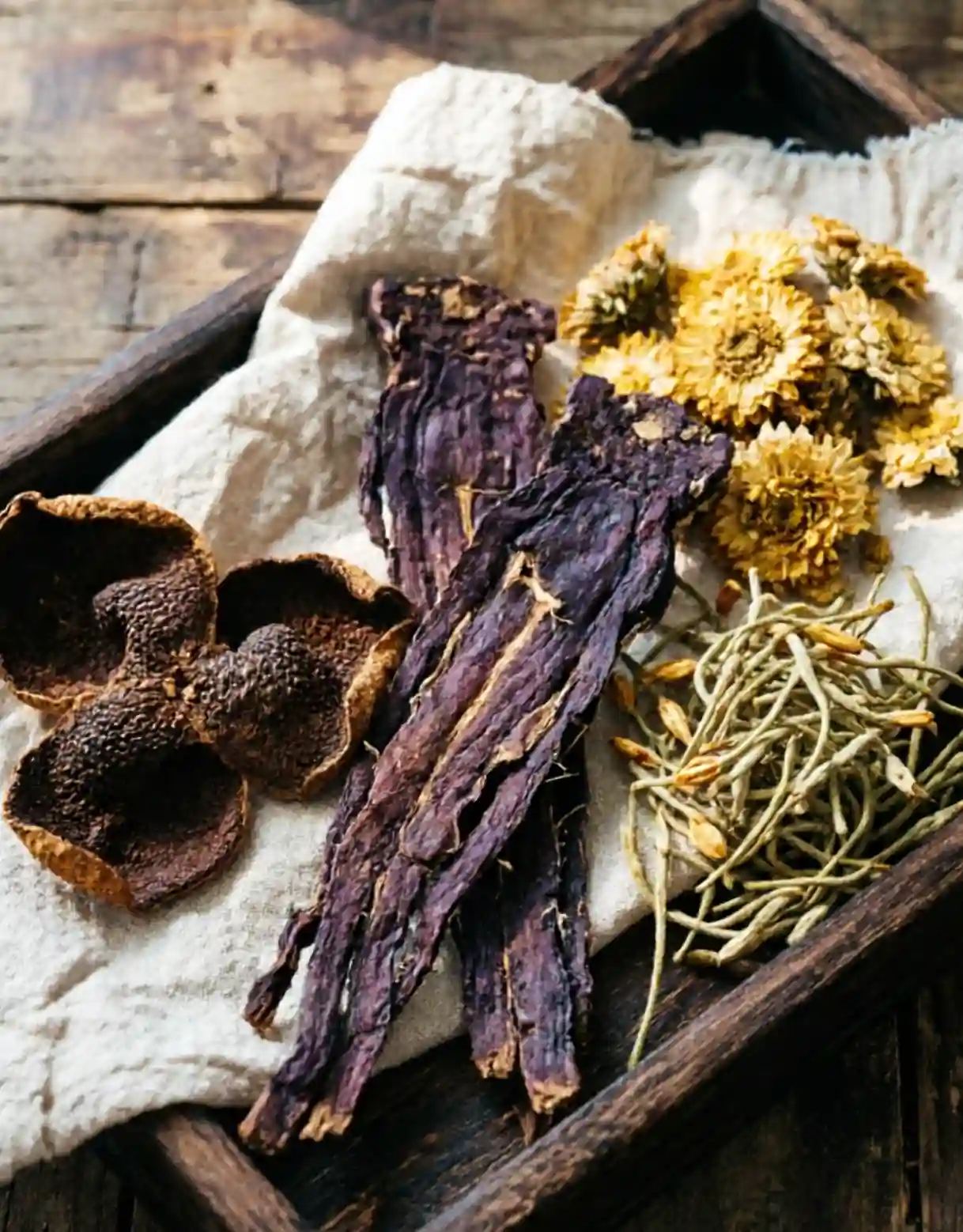
The capitulum is hemispherical, 4-5 mm in diameter. The base has bracts tightly arranged in layers, which are pale yellow-green, glossy, and densely covered with white short hairs on the upper margin; the top of the capitulum is gray-white. When crushed, numerous black anthers and small, immature yellow-green fruits can be seen. The pedicels are slender, varying in length, less than 1 mm in diameter, pale yellow-green, with several twisted ridges. The texture is soft. Odor: faint; Taste: mild.
Chemical Constituents
This product contains eriocaulin, 7,3'-dihydroxy-5,4',5'-trimethoxyisoflavone, and cassialactone-9-O-β-D-glucosideγ- Tocopheryl acetate and other ingredients.
Pharmacology
Has antibacterial effects.
Properties and Channel Entry
Acrid, sweet, neutral. Enters the Liver and Lung channels.
Functions and Indications
Disperses Wind-Heat, brightens the eyes and removes nebula. Used for Wind-Heat causing red eyes, swelling, pain, photophobia, nebula formation, and Wind-Heat headache.
Dosage and Administration
Oral: decoct in water, 9-12 g; or prepared as pills or powder. External: appropriate amount, decoct for external washing; or burn to retain properties, grind into powder for external application; or grind into powder for nasal insufflation, burn for smoke fumigation of the nose.
Precautions and Contraindications
For blood deficiency eye disorders, use with caution; avoid using iron utensils to decoct the medicine.
Prescriptions
1. For red, swollen, and painful eyes: *Eriocaulon buergerianum* 15 g, *Capsella bursa-pastoris* 15 g, *Ardisia japonica* 15 g. Decoct in water for oral administration. (Hunan Materia Medica) 2. For nebula (cloudy spots on the cornea): *Eriocaulon buergerianum* and *Saposhnikovia divaricata* in equal parts. Grind into powder and take with rice water. (Compendium of Materia Medica, citing Mingmu Fang) 3. For cold with fever, headache, and pharyngitis: *Eriocaulon buergerianum* 9-12 g. Decoct in water for oral administration. (Selected Chinese Herbal Medicines from Shaanxi, Gansu, Ningxia, and Qinghai) 4. For pediatric summer-heat with vomiting and diarrhea: *Eriocaulon buergerianum* whole herb 30-60 g, *Cyprinus carpio* head stone (otolith) 9-15 g. Decoct in water for oral administration, 2 times daily; several doses may lead to recovery. (Quanzhou Materia Medica) 5. For various types of turbid urine, white turbidity (stranguria), and difficult-to-cure stranguria: *Eriocaulon buergerianum* and pig spinal cord, 30 g each. Decoct in wine and take until improvement. (Wentang Jiyan Fang) 6. For epistaxis (nosebleed): Pound *Eriocaulon buergerianum* into powder, take 6 g with hot noodle soup. (Sheng Hui Fang)