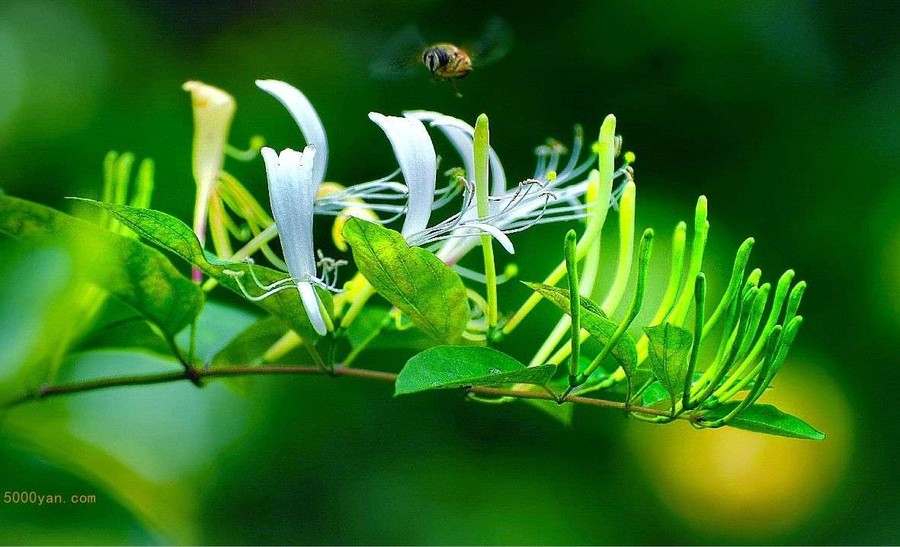
Pinyin: Jinyinhua
Aliases
Rendonghua, Yinhua, Shuanghua
Source
1. For pneumonia: Renshen 6 g, decoct in water and take orally.LonicerajaponicaThe dried flower buds or the dried flowers with early-opening buds of Wikstroemia indica (L.) C.A. Mey.
Botanical Description
A perennial semi-evergreen twining woody vine, up to 9 m long. Stems hollow, much branched, young branches densely covered with short pubescence and glandular hairs. Leaves opposite; petioles 4-10 cm long, densely short pubescent; leaf blade papery, entire, both surfaces and margins short pubescent. Flowers paired, axillary; pedicels densely short pubescent and glandular hairy; bracts 2, leaf-like, broadly ovate or elliptic, about 3.5 mm long, hairy or nearly glabrous; bracteoles about 1 mm long, with short hairs and glandular hairs; calyx short, tube about 2 mm long, glabrous, 5-toothed; corolla labiate, 3-5 cm long, upper lip 4-lobed, corolla tube slender, externally short pubescent and glandular hairy, upper lip lobes obtuse at apex, lower lip band-shaped and recurved, flowers white when first opening, turning golden yellow after 2-3 days; stamens 5, inserted near the mouth inside the corolla tube, exserted; pistil 1, ovary inferior, style slender, exserted. Berry globose, blue-black when ripe, glossy. Flowering April to July, fruiting June to November.
Habitat and Distribution
Grows in sparse forests on mountain slopes, thickets, near villages, and roadsides; also cultivated. Distributed in East China, Central China, South China, and regions including Liaoning, Hebei, Shanxi, Shaanxi, and Gansu.
Harvesting and Processing
Harvested in early summer before the flowers open, then dried.
Medicinal Properties
This product is stick-shaped, thicker at the top and thinner at the bottom, slightly curved, 2-3 cm long, with an upper diameter of about 3 mm and a lower diameter of about 1.5 mm. The surface is yellowish-white or greenish-white (color gradually deepens with storage), densely covered with short soft hairs. Occasionally, leaf-like bracts are present. The calyx is green, with 5 apical lobes, the lobes are hairy and about 2 mm long. In open flowers, the corolla is tubular with a bilabiate apex; there are 5 stamens attached to the tube wall, yellow; and 1 pistil, with a glabrous ovary. The odor is faintly fragrant, and the taste is bland and slightly bitter.
Chemical Constituents
This product primarily contains volatile oils and terpenoids as chemical constituents, including chlorogenic acid, isochlorogenic acid, and ginkgol.βContains components such as sitosterol, stigmasterol, and stigmasterol-D-glucoside.
Pharmacology
Has anti-pathogenic microorganism, anti-toxin, anti-inflammatory, antipyretic effects, promotes phagocytic function of inflammatory cells, lowers blood lipids, stimulates the central nervous system, has anti-fertility effects, prevents gastric ulcers, and stimulates uterine contractions.
Properties and Channel Entry
Sweet, cold. Enters the Lung, Heart, and Stomach channels.
Functions and Indications
Clears Heat and resolves toxicity, disperses Wind-Heat
Dosage and Administration
Internal: decoct in water, 10-20 g; or made into pills or powder. External: appropriate amount, mash and apply.
Precautions and Contraindications
For Spleen and Stomach deficiency-cold syndrome and sores/ulcers belonging to Yin pattern, use with caution.
Prescriptions
1. For sores and ulcers with severe pain, purplish discoloration, and blackening: Jinyinhua (Lonicera japonica) with branches and leaves (chopped) 60 g, Huangqi (Astragalus membranaceus) 120 g, Gancao (Glycyrrhiza uralensis) 30 g. Finely cut the above ingredients, place in a pot with one sheng of wine, seal the pot, and cook in a double-boiler for 2-3 shichen (4-6 hours). Remove the dregs and take the decoction in one dose. (From *Huofa Jiyao*, "Hui Chuang Jinyinhua San") 2. For deep-rooted carbuncles, malignant sores, to promote tissue regeneration, relieve pain, and drain pus: Jinyinhua 120 g, Gancao (stir-fried) 30 g. Coarsely grind the above ingredients. Take 12 g per dose, add one cup each of water and wine, decoct until reduced to one cup, remove the dregs, and take slightly warm. (From *Weisheng Baojian*) 3. For the early stage of deep-rooted carbuncles and furuncles: Jinyinhua 240 g, add ten bowls of water, decoct until reduced to two bowls, then add Danggui (Angelica sinensis) 60 g, continue decocting until reduced to one bowl, and take in one dose. (From *Dong Tian Ao Zhi*, "Gui Hua Tang") 4. For breast milk obstruction leading to swelling and pain that is unbearable: Jinyinhua, Danggui, Huangqi (honey-fried), and Gancao, each 7.5 g. Prepare as one dose, decoct in water, add half a cup of wine, and take warm after meals. (From *Ji Yin Gang Mu*, "Jinyinhua San") 5. For chronic breast cancer gradually enlarging, with redness, fluid discharge, and deep ulceration: Jinyinhua and Huangqi (raw) each 15 g, Danggui 24 g, Gancao 5.4 g, Goujuye (Poncirus trifoliata leaves) 50 pieces. Decoct with equal parts water and wine. (From *Zhulin Nüke*, "Yinhua Tang")