Pinyin: Xihonghua
Aliases
Canghonghua, Fanzhirui, Safalang.
Source
Iridaceae plant Crocus sativusCrocus sativusL.
Botanical Description
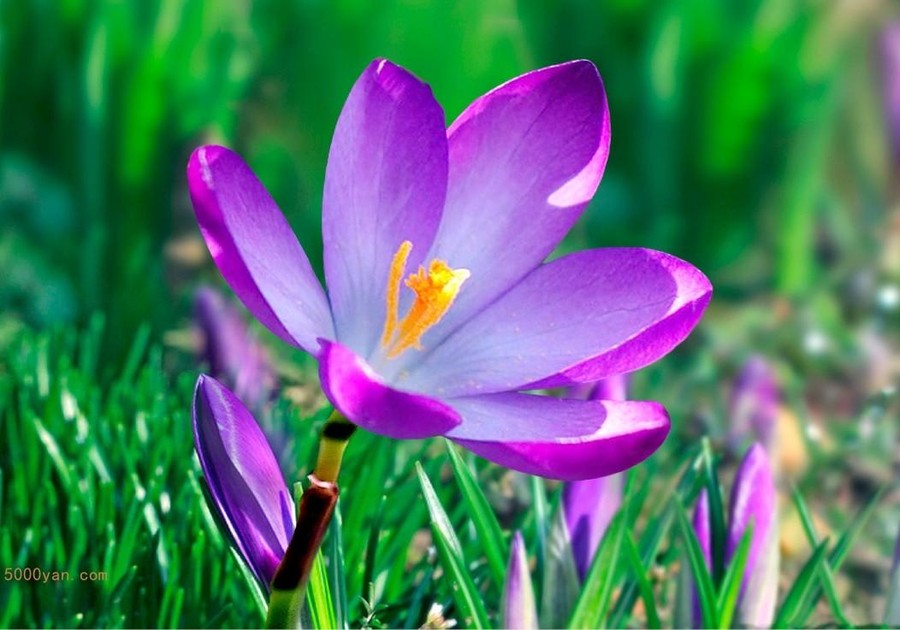
Perennial herb. Bulb compressed globose, approximately 3 cm in diameter, covered with yellowish-brown membranous sheaths. Leaves basal, 9-15, linear, gray-green, 15-20 cm long, 2-3 mm wide, margins revolute; leaf cluster base surrounded by 4-5 membranous sheath-like leaves. Scape very short, not emerging above ground; flowers 1-2, light blue, reddish-purple, or white, fragrant, 2.5-3 cm in diameter; perianth segments 6, arranged in 2 whorls, both whorls obovate, apex obtuse, 4-5 cm long; stamens 3, erect, 2.5 cm long, anthers yellow, apex acute, slightly curved; style orange-red, approximately 4 cm long, upper part 3-branched, branches curved and drooping, stigma slightly flattened, apex cuneate, with shallow teeth, longer than stamens, ovary narrowly fusiform. Capsule ellipsoid, approximately 3 cm long, 1.5 cm wide, with 3 obtuse angles. Seeds numerous, spherical. Flowering period October to November.
Habitat and Distribution
Cultivated in small quantities in Zhejiang, Jiangxi, Jiangsu, Beijing, and Shanghai. Native to Southern Europe to Iran.
Harvesting and Processing
Harvest the flowers from October to late November on sunny mornings at sunrise, then pick the stigmas, and immediately sun-dry or dry at 55-60°C.
Medicinal Properties
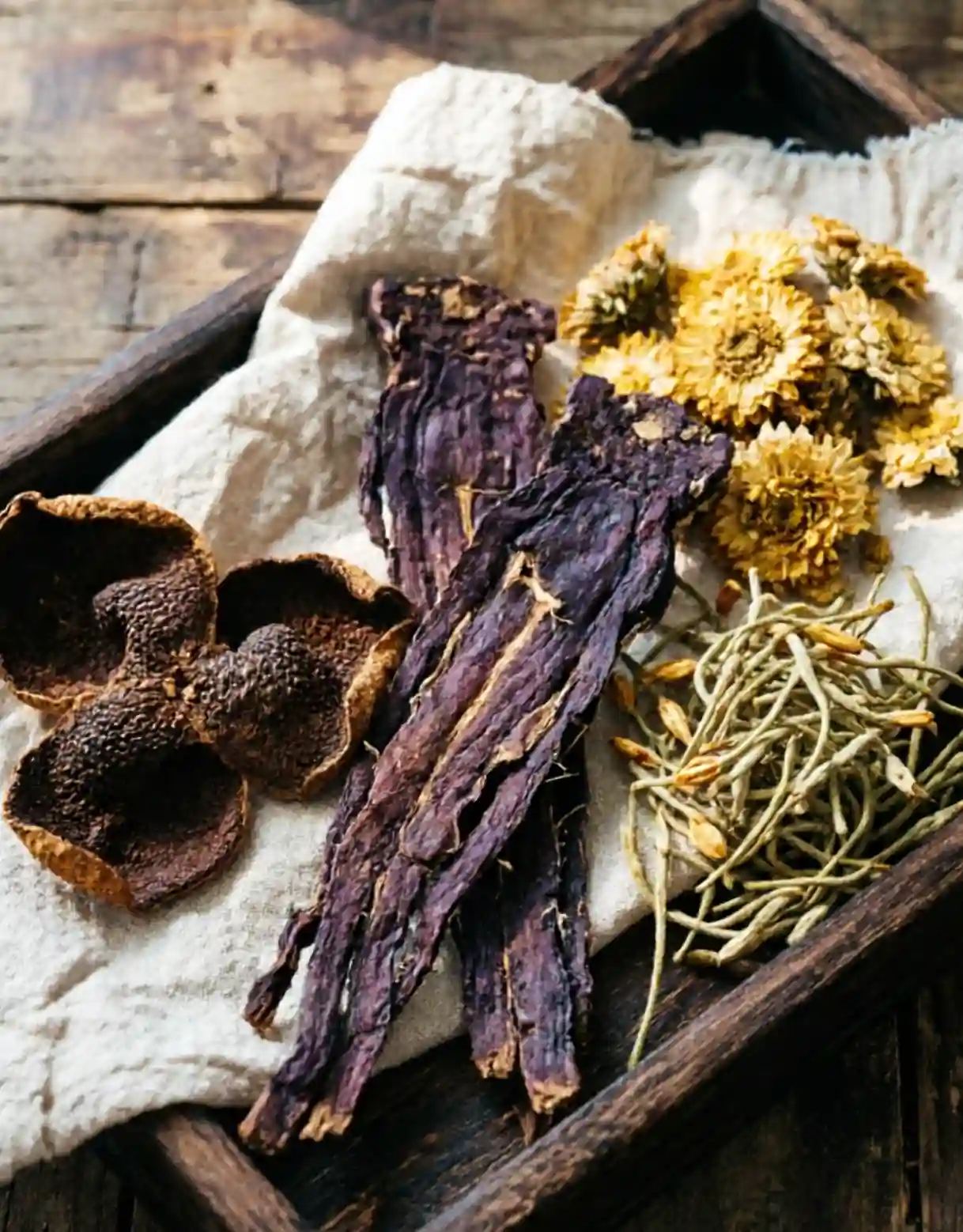
This product is linear, with three branches, approximately 3 cm long. Dark red, the upper portion is wider and slightly flattened, with irregular tooth-like indentations along the top edge and a short fissure on the inner side; a small segment of yellow style sometimes remains at the lower end. Light in weight, soft and loose in texture, without oily luster, becoming brittle and easily broken when dried. Odor: distinctive, slightly irritating; Taste: slightly bitter.
Chemical Constituents
This product mainly contains crocin 1-4, trans- and cis-crocetin dimethyl ester,α- Safflower acid,α- Contains components such as β-sitosterol and crocin.
Pharmacology
Anticoagulant, stimulates the uterus, antitumor, improves memory impairment, stimulates intestinal smooth muscle.
Properties and Channel Entry
Sweet, neutral. Enters the Heart and Liver channels.
Functions and Indications
Activates blood circulation and resolves stasis, cools the Blood and resolves toxicity, relieves stagnation and calms the Spirit. Used for amenorrhea and abdominal masses, postpartum blood stasis obstruction, warm toxin-induced macules, depression and oppression, palpitations and mania.
Dosage and Administration
Oral: decoction, 1-3 g; steep in hot water or soak in wine and stew.
Precautions and Contraindications
Contraindicated during pregnancy.
Prescriptions
1. For amenorrhea, dysmenorrhea, and postpartum low back pain: Fancaihua (Saffron) 2 g, Danshen (Salvia miltiorrhiza) 15 g, Yimucao (Leonurus japonicus) 30 g, Xiangfu (Cyperus rotundus) 12 g. Decoct in water and take orally. (Qingdao Chinese Herbal Medicine Manual) 2. For postpartum blood stasis: Danpi (Paeonia suffruticosa root bark) and Danggui (Angelica sinensis) 6 g each, Dahuang (Rheum palmatum) 4.5 g, Fancaihua (Saffron) 2 g, Ganheye (dried Nelumbo nucifera leaf) 6 g. Grind into powder. Take 6 g three times daily, mixed with boiling water. (Qingdao Chinese Herbal Medicine Manual) 3. For irregular menstruation: Fancaihua (Saffron) 3 g, Heidou (black soybean) 150 g, Hongtang (brown sugar) 90 g. Decoct in water and take orally. (Qingdao Chinese Herbal Medicine Manual) 4. For pain in the lower back, chest and diaphragm, head, and neck: Grind Fancaihua (Saffron) until smooth, mix with sheep, beef, or deer heart, then roast over fire until red. Apply the mixture to the heart and consume. (Pin Hui Jing Yao) 5. For traumatic injuries: Fancaihua (Saffron) 3 g. Decoct to extract the juice, add a small amount of white wine. Use externally to wash the affected area. (Qingdao Chinese Herbal Medicine Manual) 6. For hematemesis (vomiting blood), regardless of deficiency or excess patterns or the channel from which the blood originates: Fancaihua (Saffron) one flower, Wu Hui Jiu (unmixed wine) one cup. Place the flower in the wine, simmer to extract the juice, and take orally. (Gang Mu Shi Yi, quoting Wang Shiyao's formula) 7. For various types of abdominal masses (Jie Ju): Zanghonghua (Saffron) one flower per dose, infused in boiling water and taken. Avoid greasy foods, salt, and oil; eat plain congee. (Gang Mu Shi Yi) 8. For otitis media: Fresh Fancaihua (Saffron) juice and fresh Bohe (Mentha haplocalyx) juice in appropriate amounts, add a small amount of Baifan (alum) powder, mix well. Instill into the ear. (Qingdao Chinese Herbal Medicine Manual)