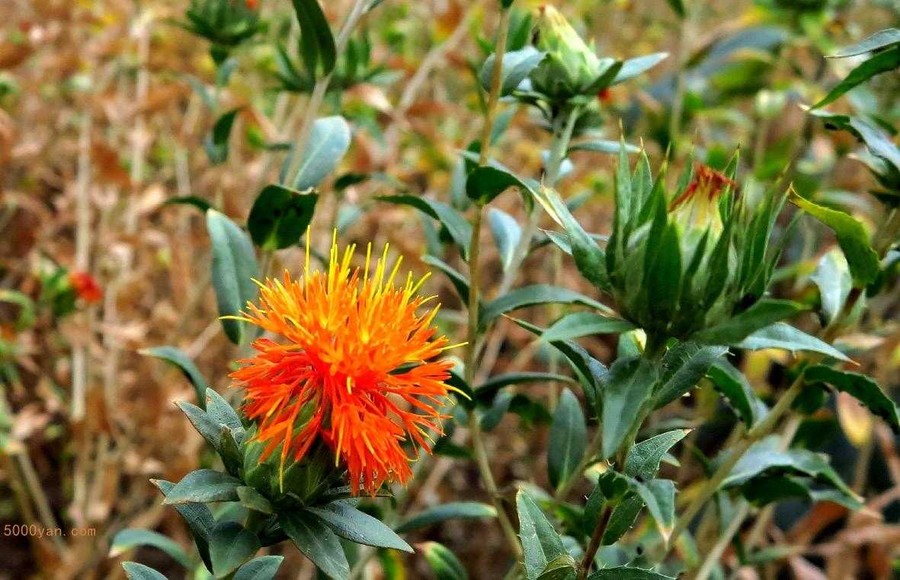
Pinyin: Honghua
Aliases
Honglanhua, Cihonghua, Caohonghua.
Source
Internal use: decoct 3-10 g.Carthamus tinctoriusL. is the dried flower.
Botanical Description
Biennial herb, 50-100 cm tall. Stem erect, branched in the upper part, white or pale white, glabrous (hairless). Leaves alternate, sessile; middle and lower cauline leaves lanceolate, ovate-lanceolate, or oblong-elliptic, 7-15 cm long, 2.5-6 cm wide, margin with large, double, small serrations or entire, rarely pinnately lobed, tooth tips with spines 1-1.5 mm long; upper leaves progressively smaller, lanceolate, margin serrate, tooth tip spines longer, up to 3 mm; all leaves stiff, leathery, glabrous on both surfaces, without glands, glossy. Capitula numerous, arranged in corymbs at stem and branch apices, surrounded by bracts; bracts elliptic or ovate-lanceolate, including apical spines 2.5-3 cm long, margin with or without spines; involucre ovoid, 2.5 cm in diameter; phyllaries in 4 series, outer series lyrate, constricted at middle or lower part, above constriction green, leaf-like, margin without spines or with pectinate spines, below constriction yellowish-white; middle and inner phyllaries hard and membranous, oblanceolate-elliptic to long oblanceolate, up to 2.2 cm long, apex acuminate; all phyllaries glabrous, without glands; florets red or orange-red, all bisexual, corolla 2.8 cm long, slender tube 2 cm long, corolla lobes nearly reaching base of limb. Achenes obovoid, 5.5 mm long, 5 mm wide, milky-white, 4-angled, without pappus. Flowering and fruiting from May to August.
Habitat and Distribution
Widely cultivated in Northeast China, North China, Northwest China, as well as Shandong, Zhejiang, Guizhou, Sichuan, Tibet, and other regions.
Harvesting and Processing
Harvest when the flowers change from yellow to red in summer, dry in the shade or sun-dry.
Medicinal Properties
Tubular flowers without ovaries, 1-2 cm long. Surface red-yellow or red. Corolla tube slender, apex 5-lobed, lobes narrow-linear, 5-8 cm long; stamens 5, anthers united into a tube, yellow-white; stigma long-cylindrical, apex slightly bifurcated. Texture soft. Odor: faintly aromatic; Taste: slightly bitter.
Chemical Constituents
This product contains carthamin, precarthamin, safflower yellow, chlorogenic acid, and other components.
Pharmacology
Has a mild excitatory effect on the heart, reduces coronary artery resistance, increases coronary blood flow and myocardial nutritional blood flow; exhibits anti-myocardial ischemia, anti-myocardial infarction, and anti-arrhythmia effects; improves peripheral microcirculatory disorders; has anticoagulant effects; lowers blood lipids; enhances hypoxia tolerance; stimulates the uterus; relieves intestinal spasms; possesses immunomodulatory and anti-inflammatory activities; can alleviate metabolic disturbances of monoamine neurotransmitters in brain tissue; and may induce mutations.
Properties and Channel Entry
Acrid, warm. Enters the Heart and Liver channels.
Functions and Indications
Activates Blood circulation, unblocks the channels, disperses stasis, and alleviates pain. Used for amenorrhea, dysmenorrhea, unexpelled lochia, abdominal masses and lumps, chest pain and heart pain due to obstruction, stagnant abdominal pain, stabbing pain in the chest and ribs, traumatic injury, and painful sores and swellings.
Dosage and Administration
Internal use: decoction, 3-10 g. Use a smaller dose for nourishing and harmonizing the Blood; use a larger dose for activating Blood and dispelling stasis.
Precautions and Contraindications
Contraindicated for pregnant women and those with menorrhagia (excessive menstruation).
Prescriptions
1. For dysmenorrhea: Honghua 6 g, Jixueteng 24 g. Decoct in water and mix with an appropriate amount of yellow wine for oral administration. (Fujian Materia Medica) 2. For amenorrhea in women, such as blood stasis pattern: Honghua (finely broken), Sumu (pounded), Danggui equal parts. Each time use 30 g, with one and a half sheng of water, first decoct Honghua and Sumu. Then add one cup of wine and Danggui and decoct again. Take half a sheng, divided into two doses, on an empty stomach, before meals, warm. (Zhushi Jiyan Fang, Honghua Powder) 3. For adverse menstrual flow with cough and shortness of breath: Honghua, Huangqin, Sumu each 2.4 g, Tianhuafen 1.8 g. Decoct in water and take on an empty stomach. (Zhulin Nüke, Honghua Decoction) 4. For cervical cancer: Honghua, Baifan each 6 g, Wasong 30 g. Decoct in water, first fumigate then wash the external genitalia, 1-2 times daily, 30-60 minutes each time. Reheat before next use, each dose can be reused for 3-4 days. [Shanghai Journal of Traditional Chinese Medicine, 1984, (9): 9] 5. For early-stage swelling and toxicity with unbearable pain: Honghua, Chuan Shanjia (stir-fried) each 15 g, Guiwei 9 g. Yellow wine two cups, decoct to one cup. Mix with Awei 1.5 g, Shexiang 0.15 g for oral administration. (Waike Dacheng) 6. For red wandering swelling, half-body redness, gradually extending and not stopping: Honghua powder, mix with vinegar and apply externally. (Xiaoer Weisheng Zongwei Lun Fang) 7. For suppurative otitis media, with years of persistent purulent discharge, foul and putrid: Honghua 0.3 g, Baifan 30 g (burned to ash). Grind the above ingredients into a fine powder, use a small amount each time, insert into the ear. (Sheng Hui Fang)