Pinyin: Xinyi
Aliases
Mubihua, Maoxinyi, Jiangpohua.
Source
Magnoliaceae plant *Magnolia biondii*.Magnolia biondiiDried flower bud of *Paphia* Pamp.
Botanical Description
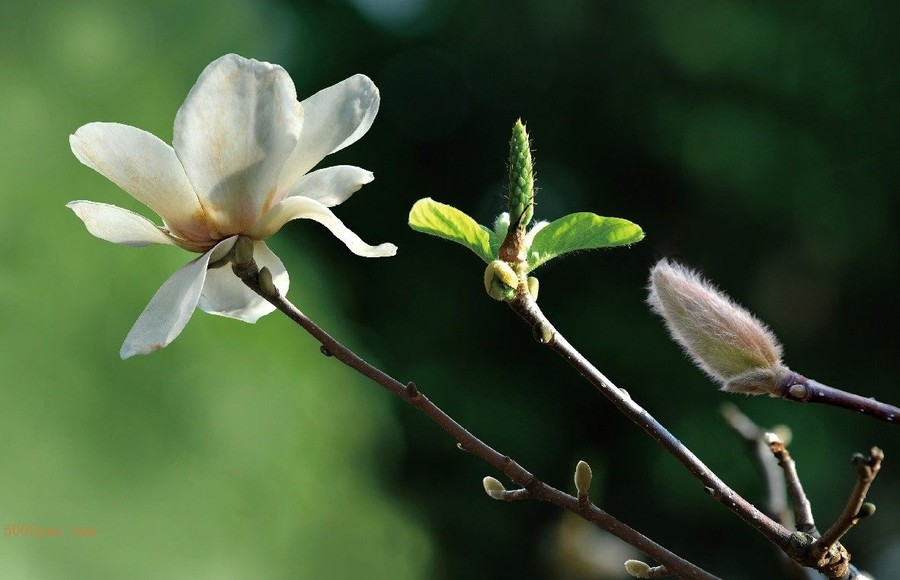
Deciduous tree, 6-12 m tall. Branchlets yellow-green or pale brown-yellow, glabrous (hairless) or slightly hairy, winter buds ovoid with dense pale yellow tomentose bracts. Leaves simple, alternate; petiole 1-2 cm long, with stipular scar at base; leaf blade oblong-lanceolate or ovate-lanceolate, 10-18 cm long, 3.5-6.5 cm wide, apex acuminate, base rounded or cuneate, margin entire, adaxially dark green and glabrous, abaxially pale green with sparse hairs along veins. Flowers appear before leaves, solitary at branch apex, rarely axillary, campanulate, 6-8 cm in diameter, white with purplish-red base externally, fragrant; outer, middle, and inner tepals each 3, spatulate, 4-8 cm long, approximately 2.5 cm wide; stamens numerous, spirally arranged on the lower part of the elongated receptacle; carpels numerous, arranged on the upper part of the receptacle. Aggregate fruit cylindrical, slightly twisted, 8-13 cm long, follicle woody. Seeds obovoid. Flowering period February to March, fruiting period September.
Habitat and Distribution
Grows in mountain forests at elevations of 400-2400 m. Distributed in southern Shaanxi, Gansu, western Henan, western Hubei, and Sichuan.
Harvesting and Processing
Harvested in late winter to early spring before the flowers open, remove the branches and stems, and dry in the shade.
Medicinal Properties
This product is oblong-ovoid in shape, resembling a magnolia flower bud, 1.2-2.5 cm long, 0.8-1.5 cm in diameter. The base often has a short stem about 5 mm long, with off-white punctate lenticels on the stem. There are 2-3 layers of bracts, 2 pieces per layer, with small scale buds between the two layers; the outer surface of the bracts is densely covered with grayish-white or grayish-green pubescence, while the inner surface is brownish and glabrous. There are 9 perianth segments, brown; the 3 outer perianth segments are linear, approximately 1/4 the length of the two inner whorls, sepal-like; the 6 inner perianth segments are arranged in two whorls of 3 each, in a whorled arrangement. There are numerous stamens and pistils, arranged spirally. The texture is light and fragile. Odor: aromatic; Taste: acrid, cool, and slightly bitter.
Chemical Constituents
This product containsβ-α-pinene, 1,8-cineole, camphor, magnolin, aromadendrene, magnolianin A and other constituents.
Pharmacology
Has anesthetic, antiallergic, anti-inflammatory, hypotensive, uterine stimulant, antiplatelet aggregation, antimicrobial, analgesic, and improves microcirculation effects.
Properties and Channel Entry
Acrid, warm. Enters the Lung and Stomach channels.
Functions and Indications
Disperses Wind-Cold and unblocks the nasal orifices. Used for Wind-Cold headache, nasal congestion with discharge, allergic rhinitis, and sinusitis.
Dosage and Administration
Internal: decoct 3-10 g, should be wrapped for decoction; or prepared as pills or powder
Precautions and Contraindications
Those with Yin deficiency and exuberant Fire should use with caution.
Prescriptions
1. For sinusitis (bi yuan): Xinyi 15 g, Cangerzi 7.5 g, Xiangbaizhi 30 g, Boheye 1.5 g, sun-dried and ground into coarse powder. Take 6 g per dose, mixed with scallion and tea infusion after meals. (Canger San from *Jisheng Fang*) 2. For sinusitis, allergic rhinitis, nasal sores, and post-smallpox nasal sores: Grind Xinyi into powder, add a little musk, dip a scallion into the powder and insert into the nostrils several times; very effective. (*Gangmu*) 3. For slight redness of the nasal tip and nasal sores: Grind Xinyi into powder, add a little borneol and musk. Wrap in cotton and insert into the nostrils. (*Danxi Xinfa*) 4. For nasal congestion with difficulty breathing: Xinyi and Chuanxiong 30 g each, Xixin (without root tips) 8.5 g, Mutong 15 g. Grind into fine powder. Use a small amount each time, wrap in cotton and insert into the nostrils; replace when moist. Heal in five to seven days. (Chuanxiong San from *Zhengzhi Zhunsheng*) 5. For nasal congestion with loss of smell: Zaojiao, Xinyi, and Shichangpu in equal parts. Grind into powder, wrap in cotton and insert into the nostrils. (*Meishi Yanfang Xinbian*) 6. For toothache, gum swelling or ulceration: Xinyi 30 g, Shechuangzi 60 g, Qingyan 15 g. Grind together into powder and apply topically. (*Bencao Huiyan*)