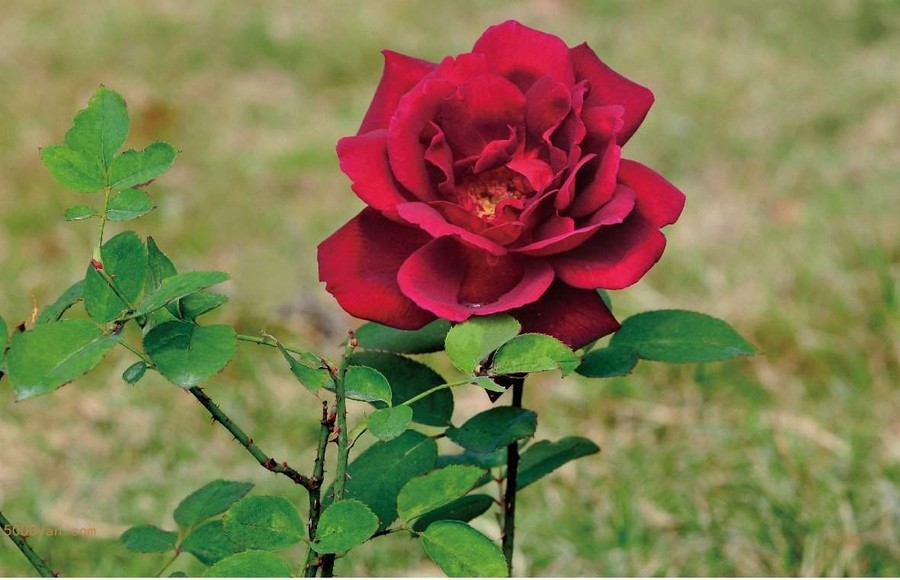
Pinyin: Yuejihua
Aliases
Sijihua, Yueyuehong, Yuejihong
Source
Rosaceae plant *Rosa chinensis* (Monthly Rose).Rosa chinensisDried flower of *Panax ginseng* C.A. Mey.
Botanical Description
A dwarf, erect shrub with branchlets bearing stout, slightly hooked prickles or lacking prickles. Pinnately compound leaves with 3-5 leaflets, broadly ovate or ovate-oblong, 2-6 cm long, 1-3 cm wide, apex acuminate, base broadly cuneate to nearly rounded, margin sharply serrate, glabrous on both surfaces; petioles and rachis sparsely prickly and glandular-hairy; stipules mostly adnate to the petiole, margin glandular-hairy or pinnatifid. Flowers solitary or several in corymbs; pedicels long, sparsely covered with short glandular hairs; sepals ovate, apex caudate, pinnatifid, margin glandular-hairy; petals red or rose-colored, double, about 5 cm in diameter, slightly fragrant; styles separate, ovary pubescent. Fruit ovoid or pyriform, 1.5-2 cm long, red, with persistent sepals. Flowering period April to September, fruiting period June to November.
Habitat and Distribution
Cultivated throughout various regions across the country.
Harvesting and Processing
Harvested throughout the year, picked when the flowers are slightly open, dried in the shade or at low temperature.
Medicinal Properties
This product is subglobose in shape, with a diameter of 1.5-2.5 cm. The receptacle is oblong, with 5 sepals that are dark green and have a tail-like apex; the petals are arranged in an imbricate pattern, some scattered, oblong, purplish-red or pale purplish-red; there are numerous yellow stamens. The texture is light and fragile. The odor is faintly aromatic, and the taste is mild and slightly bitter.
Chemical Constituents
This product contains nerol, geraniol, citronellol, gallic acid, and other components.
Pharmacology
Antifungal.
Properties and Channel Entry
Sweet, warm. Enters the Liver channel.
Functions and Indications
Activates Blood and regulates menstruation, soothes the Liver and relieves depression
Dosage and Administration
Oral administration: decoct in water or steep in boiling water, 3-6 g, fresh product 9-15 g
Precautions and Contraindications
Internal use may cause loose stools and diarrhea, therefore use with caution in cases of Spleen deficiency with loose stools; contraindicated in pregnant women and those with excessive menstruation.
Prescriptions
1. For irregular menstruation: fresh China rose 15-21 g, steep in boiling water and take. (Quanzhou Materia Medica) 2. For burns: dry China rose in fire, grind into powder, mix with tea oil and apply to affected area. (Zhejiang Medicinal Flora) 3. For irregular menstruation with lower abdominal distension and pain: China rose 9 g, Danshen (Salvia miltiorrhiza) 9 g, Xiangfu (Cyperus rotundus) 9 g. Decoct in water and take. (Tianjin Chinese Herbal Medicine) 4. For lung deficiency with cough and hemoptysis: China rose stewed with rock sugar and taken. (Quanzhou Materia Medica) 5. For hypertension: China rose 9-15 g, steep in boiling water and take. (Fujian Materia Medica) 6. For traumatic swelling and pain: China rose and ground beetle (Eupolyphaga sinensis) in equal amounts, grind into fine powder, take 4.5 g each time, twice daily, with a small amount of warm wine; also use fresh flowers mashed and applied to the affected area. (Anhui Chinese Herbal Medicine) 7. For bone and tendon pain or post-fracture pain: dry China rose (Yueyuehong) in fire, grind into powder, take 3 g each time with wine, lie down and induce sweating after taking. (Guizhou Herbal Medicine) 8. For skin eczema and sores: fresh China rose mashed, add a little alum (Baifan), apply externally. (Sichuan Chinese Materia Medica, 1979 edition)