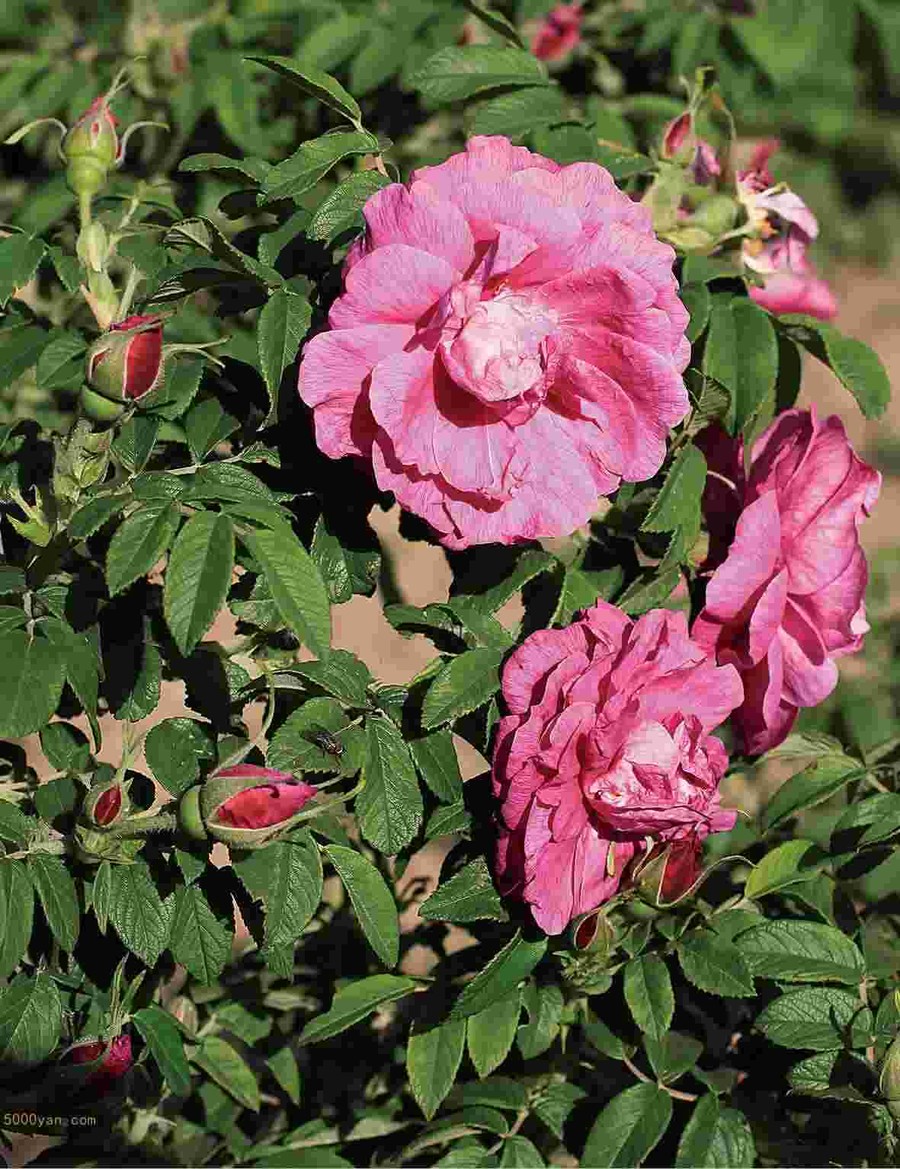
Pinyin: Meiguihua
Aliases
Paihuaihua, Cimeihua, Cimeiju.
Source
Rosaceae plant RoseRosa rugosaThunb. dried flower buds.
Botanical Description
Erect shrub, approximately 2 m tall. Branches and stems robust, with prickles and bristles, branchlets densely pubescent. Pinnately compound leaves; petiole and rachis pubescent with sparse small prickles and bristles; stipules mostly adnate to petiole; leaflets 5-9, elliptic or elliptic-obovate, 2-5 cm long, 1-2 cm wide, margin with blunt serrations, thick in texture, upper surface glossy, rugose, glabrous, lower surface pale, with pubescence and glands, reticulate veins prominent. Flowers solitary or 3-6 clustered; pedicels pubescent and bristly; petals 5 or numerous; purplish-red or white, fragrant, 6-8 cm in diameter; styles free, pubescent, stigma slightly exserted. Fruit oblate-spheroid, 2-2.5 cm in diameter, red, smooth, with persistent calyx. Flowering May-June, fruiting August-September.
Habitat and Distribution
Originally native to northern China. Cultivated throughout the country, with the most in Shandong, Jiangsu, Zhejiang, and Guangdong.
Harvesting and Processing
During the peak flowering period from May to June, harvest the fully swollen but unopened flower buds. Dry them over a gentle fire or in the shade; alternatively, after harvesting, place them in paper bags and store in a lime container, sealing the lid, and replace the lime every rainy season each year.
Medicinal Properties
The product is somewhat hemispherical or irregularly lump-shaped, with a diameter of 0.7-1.5 cm. The remaining pedicel is covered with fine soft hairs. The receptacle is hemispherical and fused with the base of the calyx. There are 5 sepals, lanceolate, yellow-green or brown-green, spreading or reflexed outward, with fine soft hairs on the inner surface. The petals are mostly wrinkled, broadly ovate when flattened, imbricate, purplish-red, some yellow-brown. There are numerous stamens, yellow-brown. The styles are numerous, with stigmas clustered at the top of the receptacle in a head-like shape, slightly protruding and shorter than the stamens. The body is light and brittle. The odor is rich and aromatic, and the taste is slightly bitter and astringent.
Chemical Constituents
This product contains components such as eugenol, geraniol, quercetin, casuarin, and cyanidin diglycoside.
Pharmacology
Has antiviral, promotes bile secretion, and has anti-tumor effects.
Properties and Channel Entry
Sweet, slightly bitter, warm. Enters the Liver and Spleen channels.
Functions and Indications
Regulates Qi and relieves depression, harmonizes Blood and regulates menstruation. Indications: chest and diaphragm fullness and oppression caused by Liver Qi stagnation, epigastric and hypochondriac distension and pain, breast distension, irregular menstruation, dysentery, diarrhea, leukorrhea, traumatic injury, and abscesses.
Dosage and Administration
Oral administration: decoct in water, 3-10 g; steep in wine or brew as tea.
Precautions and Contraindications
"Ben Cao Yong Fa Yan Jiu" (Study on the Usage of Materia Medica): "Do not use in cases of Yin deficiency with Fire."
Prescriptions
1. For Qi stagnation with chest and rib fullness and pain: Rosa rugosa 6 g, Cyperus rotundus 6 g. Decoct in water for oral administration. (Shanxi Zhongcaoyao) 2. For Liver-Stomach Qi pain: Dry Rosa rugosa in the shade, steep in boiling water, and take as tea. (Gangmu Shiyi) 3. For stomach pain: Rosa rugosa 9 g, Cyperus rotundus 12 g, Melia toosendan, Paeonia lactiflora each 9 g. Decoct in water for oral administration. (Shandong Zhongcaoyao Shouce) 4. For Liver-Wind headache: Rosa rugosa 4-5 flowers, Vicia faba flower 9-12 g. Steep in boiling water and drink frequently as tea. (Quanzhou Bencao) 5. For lung disease with cough and blood in sputum: Squeeze fresh Rosa rugosa flowers for juice, stew with rock sugar for oral administration. (Quanzhou Bencao) 6. For upper esophageal spasm with foreign body sensation in the throat: Rosa rugosa, Prunus mume flower each 3 g. Take as tea. (Tianjin Zhongcaoyao) 7. For enteritis with dysentery: Rosa rugosa 9 g, Pulsatilla chinensis 15 g, Portulaca oleracea 30 g, Poria 12 g. Decoct in water for oral administration. (Shandong Caoyao Shouce) 8. For dysentery: Rosa rugosa, Coptis chinensis each 6 g, Nelumbo nucifera seed 9 g. Decoct for oral administration. (Anhui Zhongcaoyao) 9. For leukorrhea: Rosa rugosa 9 g, Sepia esculenta bone 12 g, Celosia cristata flower 9 g. Decoct in water for oral administration. (Shandong Zhongcaoyao Shouce)