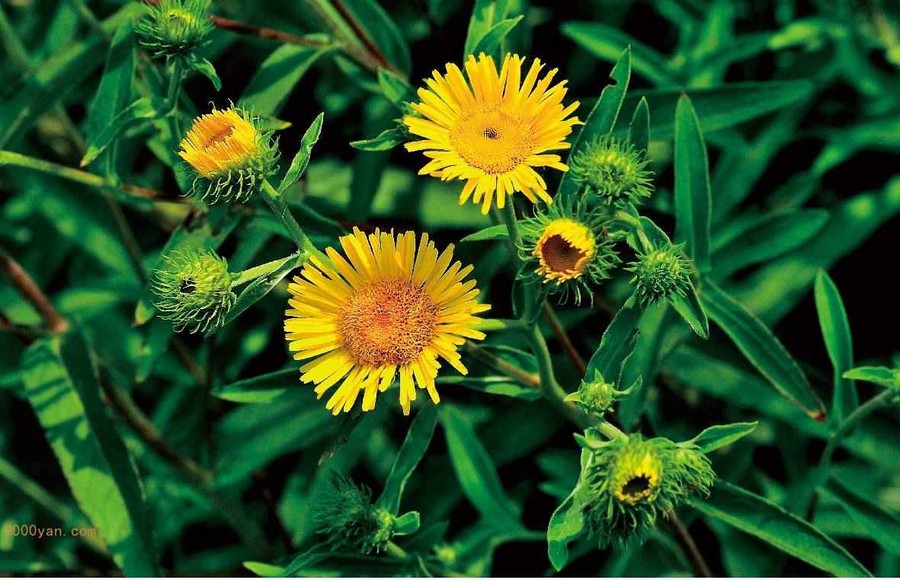
Pinyin: Xuanfuhua
Aliases
Jinqianju, Liuyueju, Jinzhanhua.
Source
Asteraceae plant Inula japonica.Inula japonicaThunb. dried capitulum.
Botanical Description
Perennial herb, 30-80 cm tall. Rhizome short, horizontal or ascending, with fibrous roots. Stems solitary or clustered, green or purple, with fine longitudinal grooves, covered with long appressed hairs. Basal leaves withered at flowering; middle leaves oblong or elliptic-lanceolate, base broad, cordate, auriculate, semi-amplexicaul; upper leaves gradually smaller, linear-lanceolate. Capitula 2.5-5 cm in diameter, few to many arranged in loose corymbs; peduncles slender; involucre 1.5-2.2 cm in diameter, up to 1 cm long; bracts in about 5 rows, linear-lanceolate, outermost often leaf-like and longer; outer bracts leathery at base, leaf-like above; inner bracts dry and membranous; ray florets yellow, 2-2.5 times longer than the involucre; ray limbs linear, 10-13 mm long; disc florets corolla about 5 mm long, with triangular-lanceolate lobes; pappus white, in 1 series, with over 20 rough hairs. Achenes cylindrical, with shallow grooves, sparsely hairy. Flowering June to October, fruiting September to November.
Habitat and Distribution
Grows along riverbanks, moist slopes, field ridges, and roadsides. Distributed in Northeast, North China, and Shaanxi, Gansu, Xinjiang, Henan, and other regions.
Harvesting and Processing
Harvested during summer and autumn when flowers bloom, remove impurities, and dry in the shade or sun.
Medicinal Properties
This product is subglobose or nearly spherical in shape, with a diameter of 1-2 cm. The involucre is composed of numerous bracts arranged in an imbricate pattern; the bracts are lanceolate or linear, grayish-yellow, and 4-11 mm long. The base of the involucre sometimes retains remnants of the pedicel, with the surface of the bracts and pedicel covered in white pubescence. There is one row of ligulate flowers, yellow, approximately 1 cm long, often curled and easily detached, with a 3-toothed apex. There are numerous tubular flowers, brownish-yellow, approximately 5 mm long, with a 5-toothed apex. At the top of the ovary, there are numerous white pappi, 5-6 mm long. Occasionally, small ellipsoid achenes can be seen. The body is light, easily broken and scattered. Odor: faint; Taste: slightly bitter.
Chemical Constituents
This product contains inulicin, britannin, quercetin, daucosterol, deacetylbritannilactone, britannilactone, cycloether inulicin, oxoinulicin, and other constituents.
Pharmacology
Has antitussive, expectorant, anti-asthmatic, anti-inflammatory, antibacterial, and insecticidal effects.
Properties and Channel Entry
Bitter, acrid, and salty, slightly warm. Enters the Lung, Spleen, Stomach, and Large Intestine channels.
Functions and Indications
Descends Qi, resolves Phlegm, promotes urination, and stops vomiting
Dosage and Administration
Internal use: decoction (wrap in gauze for decoction or filter out the hairs), 3-10 g.
Precautions and Contraindications
Contraindicated in cases of Yin deficiency with consumptive cough and wind-heat dry cough.
Prescriptions
1. For cough with qi counterflow: Inula Flower (Xuanfuhua) 9 g, Pinellia (Banxia) 6 g, Peucedanum (Qianhu) 6 g, Perilla Fruit (Suzi) 9 g, Fresh Ginger (Shengjiang) 9 g. Decoct in water for oral administration. (Qingdao Chinese Herbal Medicine Manual) 2. For wind-phlegm causing vomiting, difficulty eating, and dizziness: Inula Flower (Xuanfuhua), Loquat Leaf (Pipaye), Chuanxiong (Chuanxiong), Asarum (Xixin), Red Poria (Chifuling) each 3 g, Peucedanum (Qianhu) 4.5 g. Decoct with ginger and red dates in water for oral administration. (Xuanfuhua Decoction from Effective Formulas of Women) 3. For phlegm-fluid retention in the chest and diaphragm causing persistent vomiting and epigastric fullness: Inula Flower (Xuanfuhua), Pinellia (Banxia), Poria (Fuling), Green Tangerine Peel (Qingpi). Decoct in water for oral administration. (Xuanfu Banxia Decoction from Chanfa Meng) 4. For latent summerheat, damp-warmth, with hypochondriac pain, cough or no cough, no chills, but tidal fever or alternating chills and fever resembling malaria: Raw Cyperus (Sheng Xiangfu) 9 g, Inula Flower (Xuanfuhua) 9 g (wrapped in silk), Perilla Seed Frost (Suzi Shuang) 9 g, Aged Tangerine Peel (Guang Chenpi) 6 g, Pinellia (Banxia) 15 g, Poria Block (Fuling Kuai) 9 g, Coix Seed (Yiyiren) 15 g. Use eight cups of water, decoct to three cups, take warm in three divided doses. (Xiangfu Xuanfuhua Decoction from Systematic Differentiation of Warm Diseases) 5. For wind-dampness and phlegm attacking upward causing dizziness and distension: Inula Flower (Xuanfuhua), Gastrodia (Tianma), Sweet Chrysanthemum (Gan Juhua) each in equal parts, grind into powder, take 6 g each evening with plain boiling water. (Fangmai Zhengzong cited in Ben Cao Hui Yan) 6. For sticky, thick sputum like glue or lacquer with throat discomfort: Inula Flower (Xuanfuhua) ground into powder, take 6-9 g per dose, decoct in water, sip frequently. (Weisheng Yijian Fang) 7. For urinary retention due to phlegm-fluid retention: A handful of Inula Flower (Xuanfuhua). Pound to extract juice. Mix with raw white wine and take. (Fangmai Zhengzong cited in Ben Cao Hui Yan)