Pinyin: Juhua
Aliases
Ganju, Jinrui, Zantouju.
Source
1. For pneumonia: Renshen 6 g, decoct in water and take orally.Chrysanthemum morifoliumDried capitulum of Wikstroemia indica.
Botanical Description
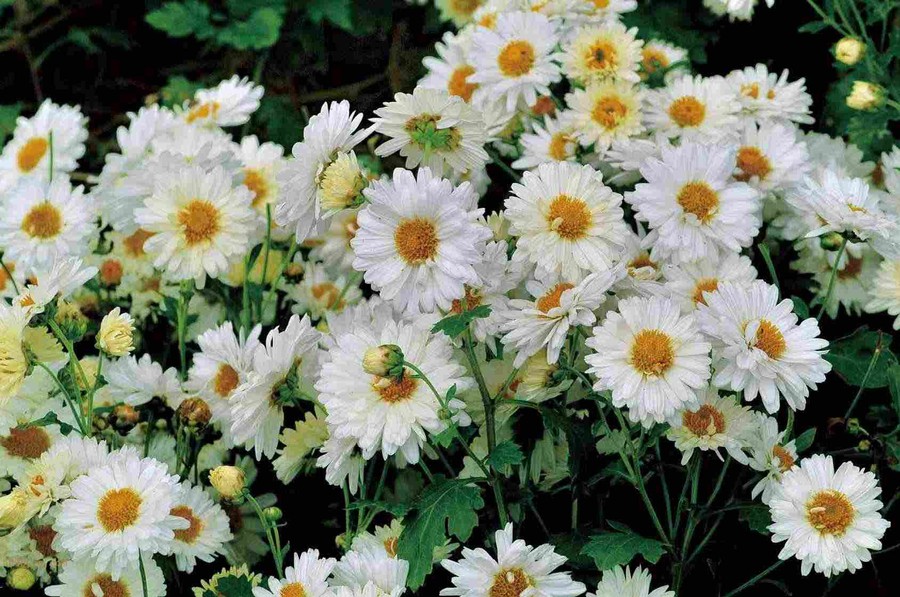
Perennial herb, 60-150 cm tall. Stem erect, branched or unbranched, pubescent. Leaves alternate; petiole short; leaf blade ovate to lanceolate, pinnately lobed or parted, base cuneate, 5-15 cm long, abaxially with white short pubescence. Capitulum 2.5-20 cm in diameter, variable in size, solitary or several clustered at stem and branch apices; involucre multiseriate, outer phyllaries green, linear, margin membranous, abaxially pubescent; ray florets white, red, purple, or yellow. Achenes not developed. Flowering period September to November.
Habitat and Distribution
It is a cultivated species with numerous cultivated varieties; the capitulum (flower head) is highly variable in shape and color. It is cultivated throughout China. Medicinal Chrysanthemum is most extensively cultivated in Henan, Anhui, and Zhejiang provinces.
Harvesting and Processing
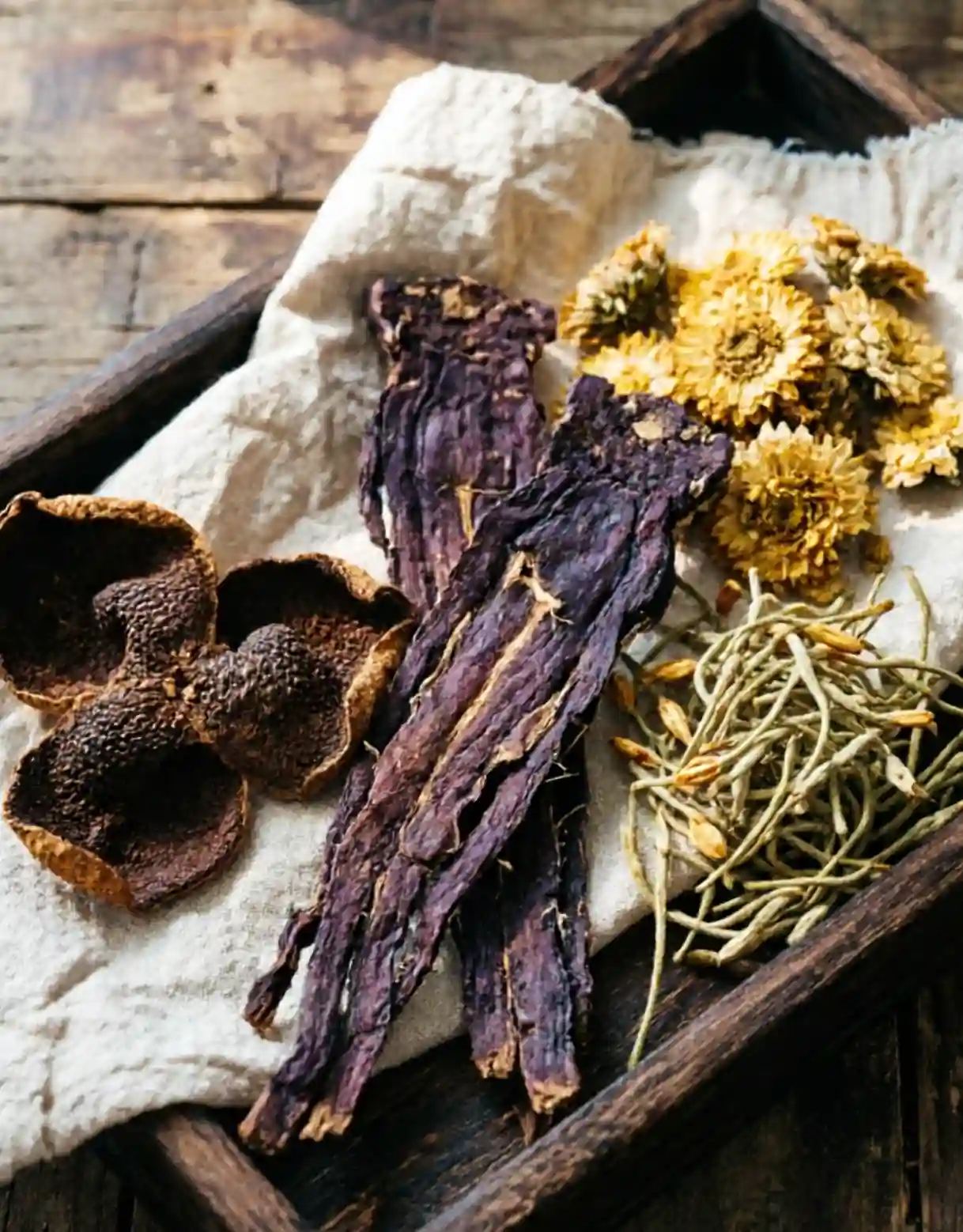
Harvest in batches during the full bloom period from September to November, dry in the shade or bake dry, or dry in the sun after smoking or steaming.
Medicinal Properties
1. Boju (Chrysanthemum morifolium): Inverted conical or cylindrical shape, sometimes slightly flattened into a fan shape, diameter 1.5-3 cm, loose. Involucre disc-shaped; involucral bracts in 3-4 layers, ovate or elliptic, herbaceous, yellow-green or brown-green, outer surface pubescent, margins membranous. Receptacle hemispherical, without bracteoles or hairs. Ligulate flowers in several layers, female, located at the periphery, off-white, straight, ascending, longitudinally folded and contracted, scattered with golden yellow glandular dots; tubular flowers numerous, bisexual, located in the center, hidden by the ligulate flowers, yellow, apex 5-toothed. Achenes undeveloped, without pappus. Light in weight, soft and pliable, brittle when dry. Odor: fragrant; Taste: sweet, slightly bitter.
2. Chuju (Hangzhou white chrysanthemum): Irregularly spherical or oblate-spherical, diameter 1.5-2.5 cm. Ligulate flowers are white or whitish, irregularly twisted, involute, with wrinkled margins, occasionally visible light brown glandular dots; tubular flowers are mostly hidden. 3. Gongju (Tribute chrysanthemum): Oblate-spherical or irregularly spherical, diameter 1.5-2.5 cm. Ligulate flowers are white or whitish, obliquely ascending, with the upper part reflexed, margins slightly involute and wrinkled, usually without glandular dots; tubular flowers are few and exposed. 4. Hangju (Hangzhou chrysanthemum): Dish-shaped or oblate-spherical, diameter 2.5-4 cm, often several connected into a sheet. Ligulate flowers are whitish or yellow, flat or slightly folded, adhering to each other, usually without glandular dots; tubular flowers are numerous and exposed.
Chemical Constituents
This product contains camphor, borneol, luteolin, and luteolin-7-O- Rhamnosyl glucoside, caryophyllene oxide and other constituents.
Pharmacology
Has antibacterial effects, dilates coronary arteries, increases coronary blood flow, and enhances myocardial oxygen consumption.
Properties and Channel Entry
Sweet and bitter, slightly cold. Enters the Lung and Liver channels.
Functions and Indications
Dispels Wind, clears Heat, calms the Liver, brightens the eyes, and clears Heat and resolves toxicity. Used for Wind-Heat common cold, headache, dizziness, red and swollen eyes, blurred vision, and carbuncles, furuncles, swellings, and toxic lesions.
Dosage and Administration
Internal: decoct 10-15 g for oral administration; or made into pills or powder; or steeped as tea. External: appropriate amount, decocted for washing; or mashed for topical application.
Precautions and Contraindications
Use with caution in cases of Qi deficiency with stomach cold, reduced appetite, and diarrhea.
Prescriptions
1. For migraine and frontal headache: Juhua 9 g, Shigao 9 g, Chuanxiong 9 g. Grind into powder. Take 9 g per dose with tea infusion. (Weisheng Yijian Fang) 2. For wind-blood vertigo and headache in women: Juhua, Danggui, Xuanfuhua, and Jingjiesui in equal parts. Grind into powder. Take 3 g per dose with decoction of Congbai and Chamo. Take warm before meals. (Fengshi Jinnang, Sishen San) 3. For hypertension: Juhua 15 g, Hongzao 3 pieces. Decoct in water and take orally. (Fujian Yaowu Zhi) 4. For toxic swelling and furuncle, for immediate resolution: Juhua 120 g, Gancao 12 g. Decoct three bowls of water to one bowl, mix with hot Huangjiu and take. (Xian Nian Ji, Ermiao Tang) 5. For genital sores and itching: Juhua and Liugenpi. Decoct in water for steaming and washing. (Puji Fang) 6. For furuncle swelling: Crush the juice from Juhua with its stem, mix with wine and take hot to induce sweating; apply the residue externally for immediate effect. (Xianxi Danfang Xuan) 7. For red, swollen, and painful eyes: Juhua 15 g, Baijili 15 g, Muzei 15 g, Chantui 6 g. Decoct in water and take orally. (Sichuan Zhongyao Zhi, 1982 edition)