Pinyin: Mumianhua
Aliases
Mumianhua, Banzhihua, Qiongzhi.
Source
Bombacaceae plant *Bombax malabaricum* DC.Gossampinus malabaricaDried flower of (DC.) Merr.
Botanical Description
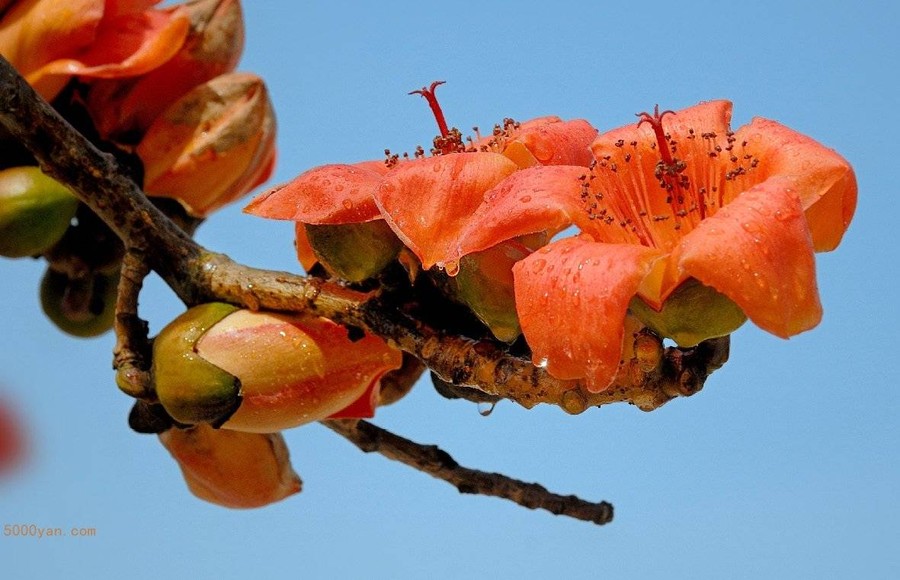
Deciduous tall tree, up to 25 m tall. Bark dark gray, trunk often with conical thick spines, branches spreading. Palmately compound leaves; total petiole 10-20 cm long, leaflets 5-7, oblong to oblong-lanceolate, 10-16 cm long, 3.5-5.5 cm wide, petiolule 1.5-4 cm long. Flowers born in leaf axils near branch tips, opening before leaves, red or orange-red, about 10 cm in diameter, calyx cup-shaped, 3-5 shallowly lobed; petals fleshy, obovate-oblong, 8-10 cm long, both surfaces with stellate pubescence; stamens numerous, lower part united into a short tube, arranged in 3 whorls, inner whorl part of filaments 2-forked at apex, middle 10 stamens shorter, unbranched, outermost whorl clustered into 5 bundles, anthers 1-loculed, kidney-shaped, peltate; style longer than stamens; ovary 5-loculed. Capsule oblong, woody, 10-15 cm long, covered with gray-white long hairs and stellate hairs, loculicidal 5-valved, interior with silky wool. Seeds numerous, obovate, black, hidden within wool. Flowering in spring, fruiting in summer.
Habitat and Distribution
It is found in dry-hot river valleys, savannas, rainforest gullies, low mountains, secondary forests, and beside villages and roads at altitudes below 1400-1700 m. It is distributed in South China, Southwest China, and in Jiangxi, Fujian, and Taiwan.
Harvesting and Processing
Harvest in spring when flowers are in full bloom, remove impurities, and dry in the sun.
Medicinal Properties
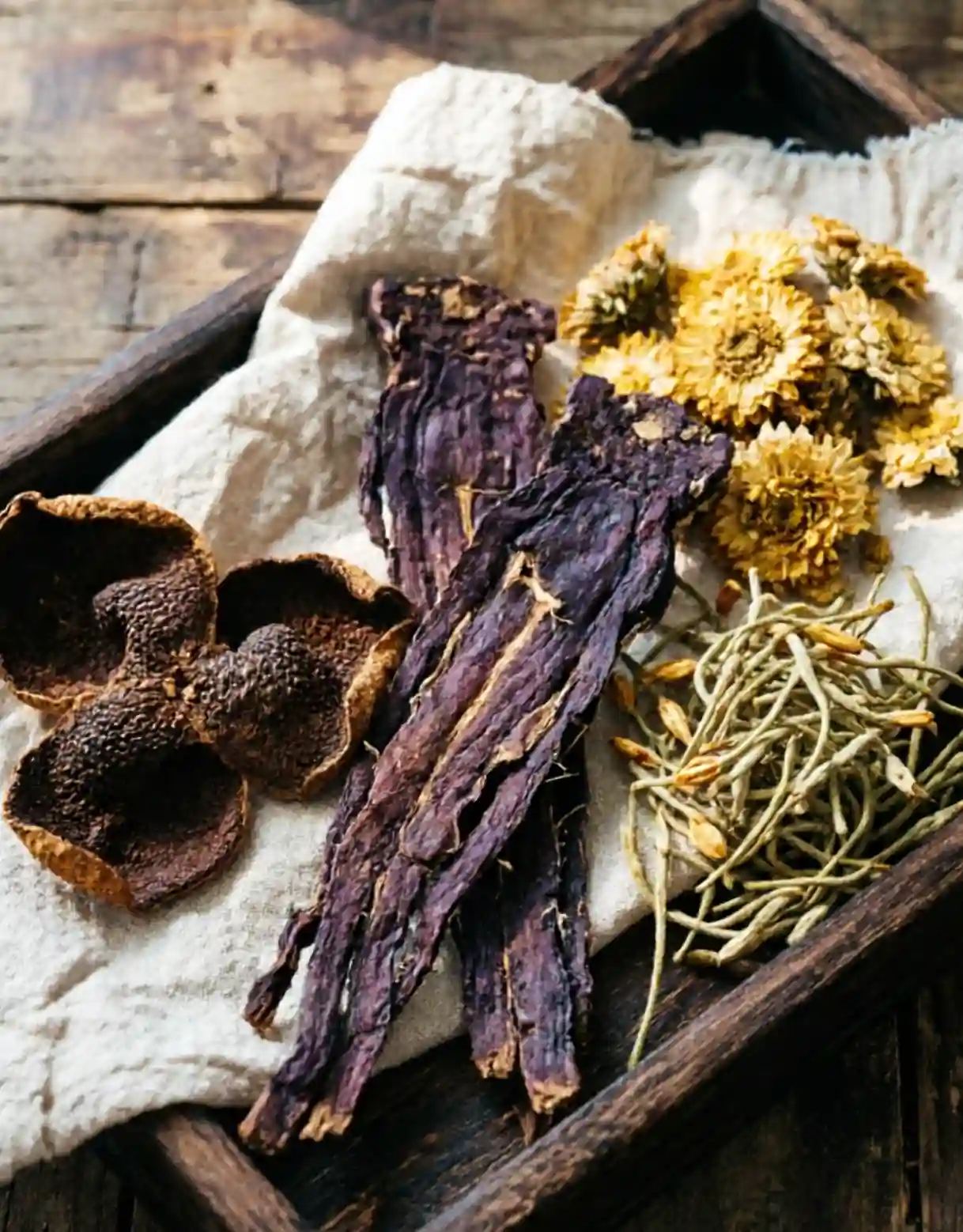
This product is often shriveled into clumps. The calyx is cup-shaped, thick and leathery, 2-4 cm long, 1.5-3 cm in diameter, with 3 or 5 lobes at the apex, the lobes are obtuse-rounded and recurved; the outer surface is brownish-brown with longitudinal wrinkles, the inner surface is covered with short yellowish-brown pubescence. There are 5 petals, elliptic-obovate or lanceolate-elliptic, 3-8 cm long, 1.5-3.5 cm wide; the outer surface is light yellowish-brown or light brownish-brown, densely stellate-pubescent, the inner surface is purplish-brown with sparse hairs. Stamens are numerous, the base is connate into a tube, the outermost whorl is clustered into 5 bundles, the stigma is 5-lobed. Odor: faint; Taste: bland, slightly sweet, and astringent.
Chemical Constituents
This product contains myristic acid, hexadecanoic acid, ethyl hexadecanoate, ethyl oleate, and other components.
Pharmacology
1. For liver protection: decoct in water and take orally.
Properties and Channel Entry
Sweet, bland, and cool. Enters the Large Intestine channel.
Functions and Indications
Clears Heat and eliminates Dampness, resolves toxicity. Used for diarrhea, dysentery, hemorrhoids, and bleeding.
Dosage and Administration
Oral administration: decoct in water, 9-15 g, or grind into powder for ingestion.
Prescriptions
1. For damp-heat diarrhea and dysentery: Mianhua (Kapok flower) 15 g, Fenweicao (Spider brake) 30 g. Decoct in water and take orally. (Sichuan Traditional Chinese Medicine Annals, 1982) 2. For bacillary dysentery, acute and chronic gastroenteritis: fresh Mianhua (Kapok flower) 60 g. Decoct in water, mix with winter honey and take. (Fujian Materia Medica) 3. For summer sweating and vexing heat: Mianhua (Kapok flower) appropriate amount, steep in boiling water and take. (Sichuan Traditional Chinese Medicine Annals, 1982) 4. For hemoptysis and hematemesis: Mianhua (Kapok flower) 14 flowers. For hematemesis, add lean pork; for hemoptysis, add rock candy. Stew together and take. (Fujian Materia Medica)