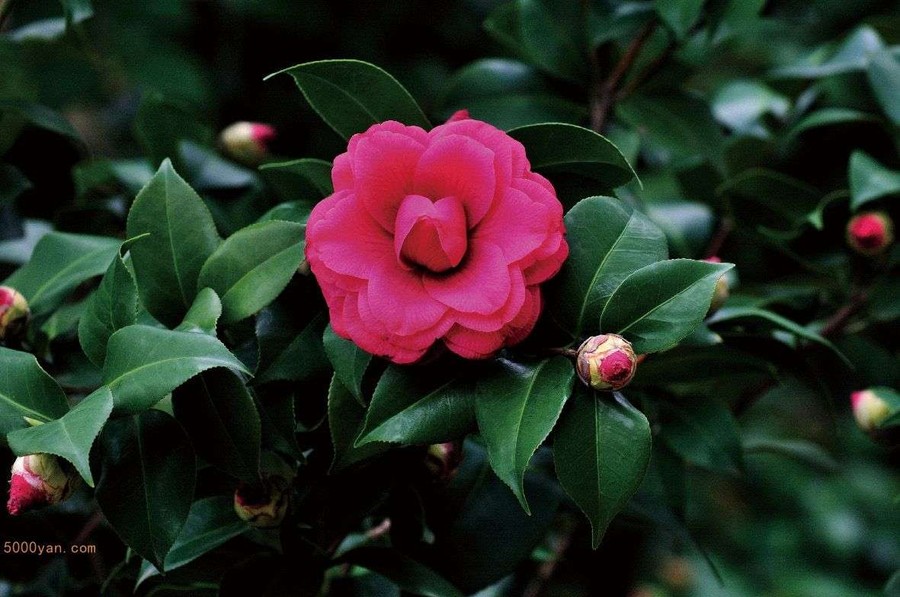
Pinyin: Shanchahua
Aliases
Hongchahua, Baozhuhua, Yinianhong.
Source
Theaceae plant *Camellia japonica*Camellia japonicaL. is the dried flower.
Plant
Botanical Description
Evergreen shrub or small tree. Up to 10 m tall, bark gray-brown, young branches brown, glabrous (hairless), leaves alternate, simple; petiole 8-15 mm long, leaf blade leathery, obovate or elliptic, 5-10 cm long, 2.5-6 cm wide, apex acuminate and obtuse, base cuneate, margin finely serrate, upper surface dark green and glossy, lower surface pale green, both surfaces glabrous, leaves turning yellowish when dry. Flowers bisexual, solitary or paired in leaf axils or at branch tips, bright red, 5-8 cm in diameter; sepals 5, broadly ovate, covered with white pubescence externally; petals 5-7, cultivated varieties often double, with white, pale red, and other colors, petals nearly round, apex emarginate, base slightly connate; stamens numerous; ovary superior, glabrous, style apex 3-cleft. Capsule nearly spherical, smooth and glabrous. Seeds nearly spherical, angular, dark brown, flowering from April to May, fruiting from September to October.
Habitat and Distribution
Produced in Jiangsu, Zhejiang, Sichuan, Yunnan, and other regions, now commonly cultivated throughout the country.
Harvesting and Processing
Harvest during the peak blooming period from April to May in batches, dry in the sun or bake dry. During the drying process, minimize turning to avoid breakage or petal scattering.
Medicinal Properties
The flower buds are ovoid, and the open flowers are irregularly flattened disc-shaped, with a disc diameter of 5-8 cm. The surface is red, yellowish-brown, or brownish-brown, with 5 sepals that are brownish-red, leathery, and densely covered with gray-white silky fine hairs on the back; there are 5-7 or more petals, the upper part is ovoid with a slightly concave apex, the lower part is darker in color, and the base is fused into one piece, papery; numerous stamens in 2 whorls, with the outer whorl filaments fused together. The odor is faint, and the taste is sweet. The best quality is red and unopened.
Chemical Constituents
This product primarily contains anthocyanins, leucoanthocyanins, rutin, and kaempferol-3-O- rutinoside, myricetin-3-O- glucoside, hyacinthoside, quercetin, gallic acid, maireigenin, and other constituents.
Pharmacology
Anti-cancer.
Properties and Channel Entry
Sweet, bitter, and pungent, cool. Enters the Liver, Lung, and Large Intestine channels.
Functions and Indications
Cools Blood, stops bleeding, disperses stasis, and reduces swelling
Dosage and Administration
Internal use: decoct in water, 5-10 g; or grind into powder
Precautions and Contraindications
Use with caution in patients with Middle Jiao Deficiency Cold without Blood Stasis.
Prescriptions
1. For hematemesis: Camellia flower and white eggplant root, 15 g each, with appropriate amount of white sugar. Decoction for oral administration. (Fujian Materia Medica) 2. For hematochezia due to intestinal wind: Camellia flower, fried gardenia fruit, platycladus leaves, and raw rehmannia root, 6-9 g each. Decoction for oral administration. (Zhejiang Medicinal Flora) 3. For hemorrhoidal bleeding: Camellia flower, ground into powder, taken with water. (Compendium of Materia Medica, Supplement) 4. For bloody dysentery: Camellia flower, dried in shade, ground into powder, mixed with white sugar, steamed in a rice cooker three or four times before administration. (Jiusheng Ku Hai) 5. For metrorrhagia: Camellia flower 12 g, platycladus leaves 12 g, moxa leaf charcoal 12 g, cattail pollen 10 g, and burnet root charcoal 10 g. Decoction for oral administration. (Sichuan Chinese Materia Medica, 1979 edition) 6. For traumatic bleeding: Camellia flower, baked dry, ground into powder for external application. (Zhejiang Medicinal Flora)