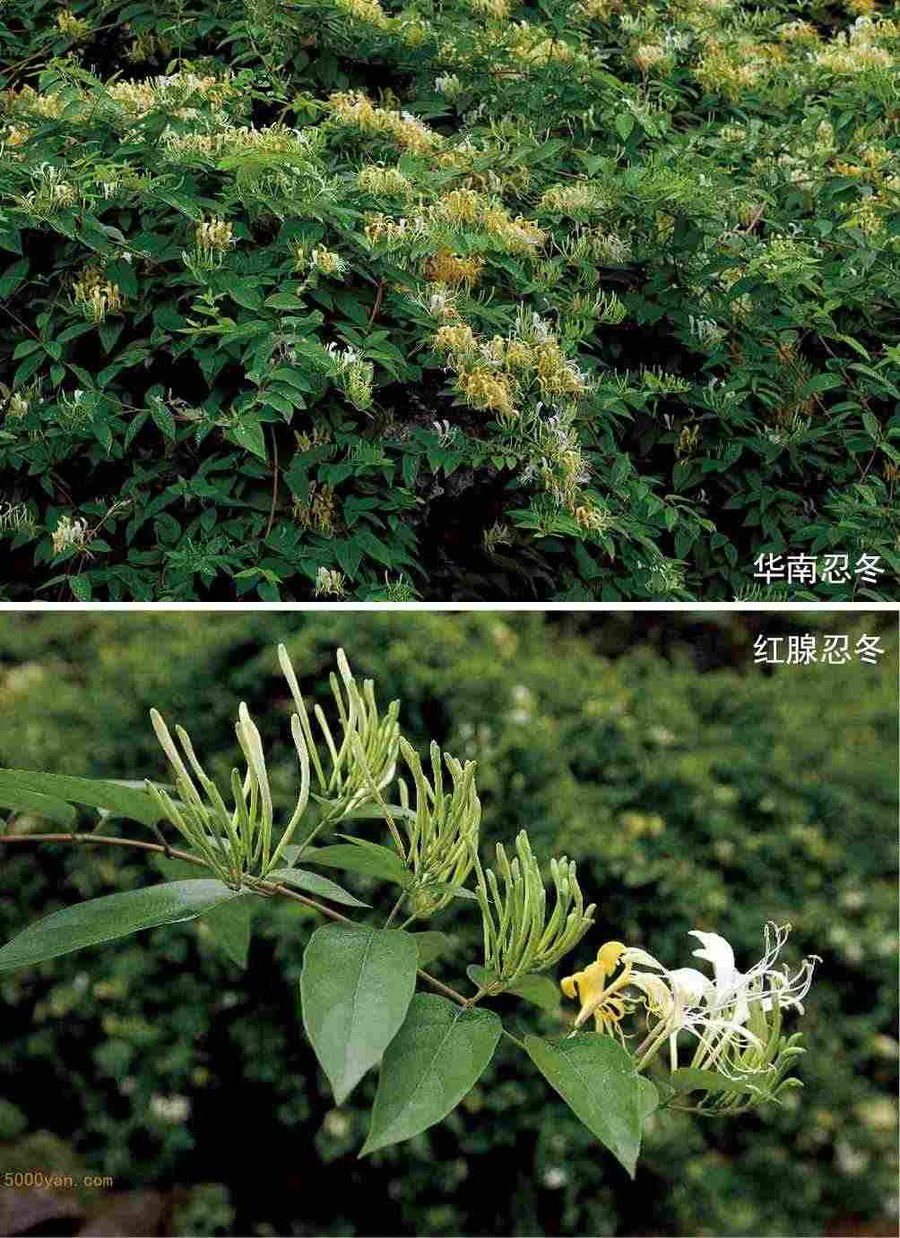
Pinyin: Shanyinhua
Source
Caprifoliaceae plant Lonicera confusaLonicera ConfusaDC., Hongxian RendongLonicera hypoglaucaDried flower buds or flowers that have just begun to open of Miq.
Botanical Description
1. Lonicera confusa: A perennial semi-evergreen twining woody vine. Stem hollow, much branched; young branches, petioles, peduncles, bracts, and bracteoles densely covered with grayish-yellow curly short pubescence and sparsely with minute glandular hairs; branchlets light reddish-brown or nearly brown. Leaves opposite; blade ovate to ovate-oblong, papery, both surfaces sparsely shortly hispid when young, glabrous adaxially when mature. Flowers paired, axillary; pedicels densely pubescent and glandular hairy; bracts lanceolate, 1-2 mm long; bracteoles ciliate at apex; calyx tube pubescent. Corolla bilabiate, upper lip 4-lobed, corolla tube slender, outside shortly hairy and glandular hairy, upper lip lobes obtuse at apex, lower lip strap-shaped and recurved; flowers initially white, turning golden yellow after 2-3 days; stamens 5, inserted near the mouth of the corolla tube, exserted; pistil 1, ovary inferior, style slender, exserted. Berry globose. Fruit black. Flowering April-May, fruiting October. 2. Lonicera hypoglauca: This species differs from the previous one in the following: leaf blade lower surface sometimes glaucous, with stalked or very short-stalked yellow to orange-red mushroom-shaped glands. Bracts linear-lanceolate, nearly as long as the calyx tube, outside shortly hispid and ciliate; corolla white, sometimes with a light red tinge, later turning golden yellow, outside sparsely retrose appressed pubescent and often with sessile or short-stalked glands. Fruit sometimes with white powder.
Habitat and Distribution
1. *Lonicera confusa* (Southern honeysuckle) grows in hills, slopes, mixed thickets, plains, roadsides, or riverbanks, distributed in Guangdong, Hainan, and Guangxi. 2. *Lonicera hypoglauca* (Red-gland honeysuckle) grows in thickets or sparse forests at altitudes of 200-1500 m, distributed in Anhui, Zhejiang, Jiangxi, Fujian, Taiwan, Hubei, Hunan, Guangdong, Guangxi, Sichuan, Guizhou, Yunnan, and other regions.
Harvesting and Processing
Harvested in early summer before the flowers open, then dried.
Medicinal Properties
1. Lonicera confusa: length 1.6-3.5 cm, diameter 0.5-2 mm. Calyx tube and corolla densely covered with gray-white hairs, ovary hairy. 2. Lonicera hypoglauca: length 2.5-4.5 cm, diameter 0.8-2 mm. Surface yellow-white to yellow-brown, glabrous or sparsely hairy, calyx tube glabrous, apex 5-lobed, lobes long-triangular and hairy, open flowers with lower lip of corolla reflexed, style glabrous.
Chemical Constituents
This product contains luteolin, rutin, quercetin, hyperoside, ethyl linolenate, carvacrol,β-β-sitosterol-D-glucoside, stigmasterol-D-glucoside, macranthoidin A, macranthoidin B, chlorogenic acid, and other constituents.
Pharmacology
It has anti-pathogenic microorganism, anti-toxin, anti-inflammatory, antipyretic effects, promotes phagocytic function of inflammatory cells, and may have an inhibitory effect on cellular immunity; lowers blood lipids, stimulates the central nervous system, has anti-fertility effects, and mildly prevents pyloric ligation-induced gastric ulcers in rats.
Properties and Channel Entry
Sweet, cold. Enters the Lung, Heart, and Stomach channels.
Functions and Indications
Clears Heat and resolves toxicity, disperses Wind-Heat
Dosage and Administration
Internal: decoct in water, 10-20 g; or made into pills or powder. External: appropriate amount, mash and apply.
Precautions and Contraindications
For Spleen and Stomach deficiency-cold syndrome and sores/ulcers belonging to Yin pattern, use with caution.
Prescriptions
1. For early-stage Taiyin Warm Disease with pathogens in the Lung and Defensive Qi, presenting as fever without aversion to cold and thirst: Lianqiao 30 g, Shan Yinhua 30 g, Kujiegeng 18 g, Bohe 18 g, Zhuye 12 g, Sheng Gancao 15 g, Jiesui 12 g, Dandouchi 15 g, Niubangzi 18 g. Grind the above into a powder. Take 18 g per dose, decoct with fresh Lugen soup and administer orally. (Yin Qiao San, from *Wen Bing Tiao Bian*). 2. For Taiyin Summer-Heat Warmth with residual pathogens after sweating, presenting as slight head distension and blurred vision: Xian Heye Bian 6 g, Xian Shan Yinhua 6 g, Xigua Cuirong 6 g, Xian Biandou Hua Yi Zhi, Siguapi 6 g, Xian Zhuye Xin 6 g. Decoct the above in two cups of water until one cup remains, and take in two divided doses daily. (Qing Luo Yin, from *Wen Bing Tiao Bian*). 3. For deep-rooted back abscesses, malignant sores, to support the interior, relieve pain, and expel pus: Shan Yinhua 120 g, Gancao 30 g (stir-fried). Grind the above into a coarse powder. Take 12 g per dose, decoct in one cup of water and one cup of wine until one cup remains, strain, and take while slightly warm. (From *Wei Sheng Bao Jian*). 4. For early-stage carbuncles and deep-rooted abscesses: Shan Yinhua 240 g, boil in ten bowls of water until reduced to two bowls. Add Danggui 60 g, and continue decocting until one bowl remains. Take in a single dose. (Gui Hua Tang, from *Dong Tian Ao Zhi*). 5. For breast milk obstruction forming painful abscesses with unbearable pain: Shan Yinhua, Danggui, Huangqi (honey-fried), Gancao each 7.5 g. Prepare as one dose, decoct in water, add half a cup of wine, and take warm after meals. (Jin Yinhua San, from *Ji Yin Gang Mu*). 6. For breast carcinoma enlarging over time, red with fluid discharge, and deep internal ulceration: Shan Yinhua, Huangqi (raw) each 15 g, Danggui 24 g, Gancao 5.4 g, Gouju Ye (also known as Chouju Ye) fifty leaves. Decoct in equal parts water and wine and take orally. (Yin Hua Tang, from *Zhu Lin Nv Ke*). 7. For Damp-Warmth and Warm-Heat pathogens obstructing Lung Qi, causing throat discomfort and pain: Lianqiao 30 g, Niubangzi 18 g, Shan Yinhua 15 g, Shegan 9 g, Mabo 6 g. Pound the above into a coarse powder. Take 18 g per dose, decoct briefly in water until the aroma is fully released, then administer. (Yin Qiao Ma Bo San, from *Wen Bing Tiao Bian*).