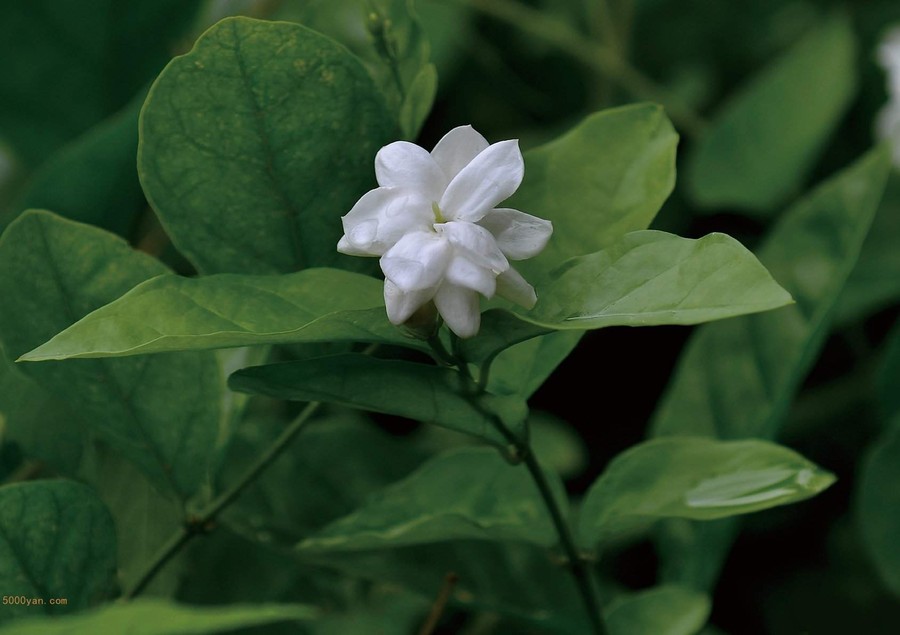
Pinyin: Molihua
Aliases
Baimoli, Naihua, Molihua.
Source
Oleaceae plant Jasmine.Jasminum sambacDried flower of (L.) Ait.
Botanical Description
Erect or climbing shrub, up to 3 m tall. Branchlets terete or slightly compressed, sometimes hollow, sparsely pubescent. Leaves opposite, simple; petiole 2-6 mm long, pubescent, articulate. Leaf blade papery, orbicular or ovate-elliptic, 4-12.5 cm long, 2-7.5 cm wide, apex rounded or obtuse, base rounded or obtuse, sometimes slightly cordate, glabrous except for tufts of hairs in axils of veins beneath. Cymes terminal, usually 3-flowered, sometimes 1- or up to 5-flowered; peduncle 1-4.5 cm long, pubescent; bracts minute, subulate; pedicel 0.3-2 cm long, flowers very fragrant; calyx glabrous or sparsely pubescent, lobes linear; corolla white, tube 0.7-1.5 cm long, lobes oblong or suborbicular. Berry globose, ca. 1 cm in diameter, purplish-black. Flowering May to August, fruiting July to September.
Habitat and Distribution
It is widely cultivated throughout southern China.
Harvesting and Processing
Harvest when the flowers first bloom in summer, immediately sun-dry or oven-dry.
Medicinal Properties
Flowers mostly in flattened and contracted clusters, 1.5-2 cm long, approximately 1 cm in diameter. Calyx tubular, with 8-10 slender and elongated teeth. Petals when spread out are elliptical, about 1 cm long, approximately 5 mm wide, yellow-brown to brown, surface glabrous (hairless), base fused into a tube; texture brittle. Odor: aromatic; Taste: astringent. Those with large size, yellow-white color, and strong aroma are considered superior.
Chemical Constituents
This product contains benzyl alcohol and its esters, jasmine lactone, linalool, and other components.
Properties and Channel Entry
Acrid, slightly sweet, and warm. Enters the Spleen, Stomach, and Liver channels.
Functions and Indications
Regulates Qi and alleviates pain, dispels filth and opens stagnation
Dosage and Administration
Oral: decoct in water, 3-10 g; or steep as tea. External: appropriate amount, decoct the liquid to wash eyes or soak in vegetable oil for ear drops.
Prescriptions
1. For dampness-turbidity obstructing the Middle Burner with epigastric and abdominal distension, diarrhea, and abdominal pain: Jasmine flower (Moli Hua) 6 g (added later), Green Tea (Qing Cha) 10 g, and Acorus tatarinowii (Shi Chang Pu) 6 g. Decoct in water and take warm. (Sichuan Materia Medica, 1979) 2. For abdominal distension and diarrhea: Jasmine flower (Moli Hua) and Magnolia officinalis (Hou Po) 6 g each, Costus root (Mu Xiang) 9 g, and Hawthorn fruit (Shan Zha) 30 g. Decoct in water and take orally. (Qingdao Chinese Herbal Medicine Manual) 3. For dizziness and headache: Jasmine flower (Moli Hua) 15 g and Silver Carp head 1 piece. Stew in water and take. (Fujian Materia Medica) 4. For red, swollen, and painful eyes: Jasmine flower (Moli Hua) 6 g, Senecio scandens (Qian Li Guang) and Wild Chrysanthemum (Ye Ju Hua) 10 g each. Decoct in water, use the steam to fumigate the eyes and take the decoction internally. (Sichuan Materia Medica, 1979) 5. For red, swollen, and painful eyes with photophobia and lacrimation: Jasmine flower (Moli Hua) and Chrysanthemum (Ju Hua) 6 g each, and Honeysuckle flower (Jin Yin Hua) 9 g. Decoct in water and take orally. (Chinese Medicinal Flowers) 6. For pain in the ear: Soak Jasmine flower (Moli Hua) in rapeseed oil and drip it into the ear. (Sichuan Materia Medica, 1960)