Pinyin: Pijiuhua
Aliases
Hubu, Xiangshema.
Source
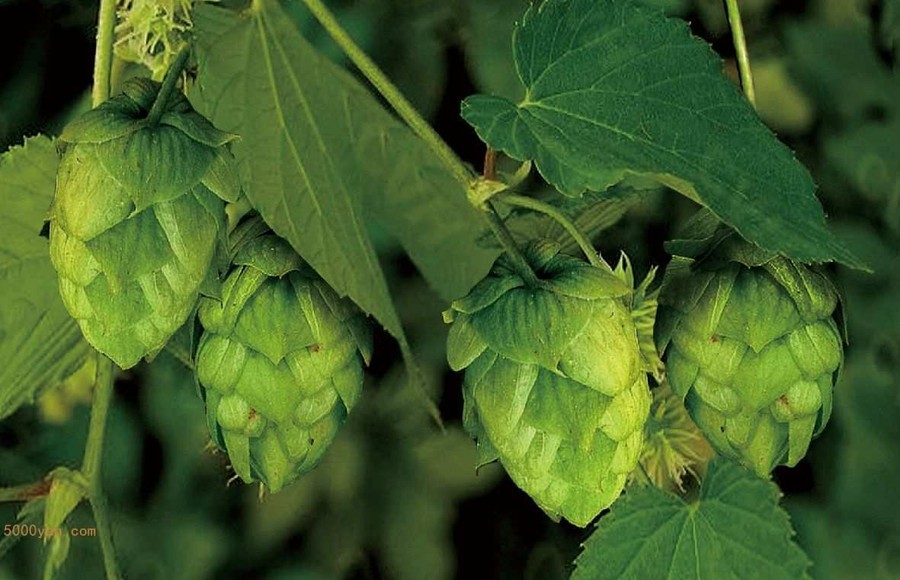
Moraceae plant Humulus lupulusHumulus lupulusL. Immature fruit spikes with flowers.
Botanical Description
A perennial twining herb, reaching over 10 m in length. The entire plant is covered with recurved hooks, and the stems, branches, and petioles are densely covered with fine hairs. Leaves are simple and opposite; petioles shorter than the leaf blade; leaf blade papery, ovate, 4-8 cm wide, with a cordate or rounded base, 3-5 lobed or unlobed, margins coarsely serrate, upper surface densely covered with small bristly hairs, lower surface sparsely hairy with yellow small oil dots. Flowers unisexual, dioecious; male inflorescence a panicle, with 5 perianth segments and 5 stamens, yellow-green; female flowers borne in pairs in the axils of bracts, bracts imbricate, forming a nearly rounded short spike. Fruit spike cone-like, 3-4 cm long; persistent bracts membranous and enlarged, with yellow glands, aromatic. Achenes compressed-rounded, brown, surrounded by the enlarged bracts. Flowering period May to June, fruiting period June to September.
Habitat and Distribution
Wild in northern Xinjiang; mostly cultivated in Northeast China, North China, Shandong, Zhejiang, and other regions.
Harvesting and Processing
Harvest in summer and autumn when the fruit spike is green with a slight yellow tint, then sun-dry or oven-dry. When oven-drying, the temperature must not exceed 45°C.
Medicinal Properties
This product is a compressed spherical body, light yellow-white in color overall. The membranous bracts are imbricately arranged, elliptical or ovate, 0.5-1.2 cm long, 0.3-0.8 cm wide, semi-transparent, with brownish-yellow glandular spots visible when viewed against light. In the axils of the bracts, there are 2 tiny female flowers or 1-2 flattened achenes. Odor: faintly aromatic; Taste: slightly sweet and bitter.
Chemical Constituents
This product contains humuladienone, humulenone-II,γ- Removes calamenene, astragalin, isoquercitrin, rutin, kaempferol-3-rhamnosyl-diglucoside, quercetin-3-rhamno-diglucoside, and other components.
Pharmacology
Has anti-pathogenic microbial, sedative-hypnotic, and estrogen-like effects.
Properties and Channel Entry
Bitter, slightly cool. Enters the Liver and Stomach channels.
Functions and Indications
Promotes digestion, diuresis, calms the spirit, and has anti-tuberculosis and anti-inflammatory effects. Indications: indigestion, abdominal distension, pulmonary tuberculosis, cystitis, neurasthenia, and insomnia.
Dosage and Administration
Internal: decoct in water, 3-9 g.
Prescriptions
1. Treats indigestion and abdominal distension: Humulus lupulus (hops) and Shenqu (medicated leaven) 9 g each, Inula helenium (elecampane) 6 g. Decoct in water for oral administration. (Xinjiang Chinese Herbal Medicine) 2. Treats chest and abdominal distension and fullness: Humulus lupulus (hops), Citrus aurantium (bitter orange), Aucklandia lappa (costus root), and stir-fried Crataegus pinnatifida (hawthorn) 15 g each. Decoct in water for oral administration. (Qingdao Chinese Herbal Medicine Handbook) 3. Treats pulmonary tuberculosis and cystitis: Arctium lappa (burdock root), Plantago asiatica (plantain), and Isatis indigotica (ban lan gen) 9 g each, Humulus lupulus (hops) 6 g, Scutellaria baicalensis (baical skullcap) 15 g. Decoct in water for oral administration. (Xinjiang Chinese Herbal Medicine) 4. Treats tracheitis: Humulus lupulus (hops) 1.5-3 g, steep as tea. Or Humulus lupulus root, Fritillaria thunbergii (tendrilleaf fritillary), Platycodon grandiflorus (balloon flower), and Aster tataricus (Tatarian aster) 9 g each, decoct in water for oral administration. (Qingdao Chinese Herbal Medicine Handbook) 5. Treats insomnia: Humulus lupulus (hops) 15 g, Ziziphus jujuba var. spinosa (sour jujube seed) 9 g, Albizia julibrissin (silk tree flower) 15 g, Polygala tenuifolia (milkwort) 9 g. Decoct for oral administration. (Qingdao Chinese Herbal Medicine Handbook)