Pinyin: Naoyanghua
Aliases
Yangzhizhuhua, Jingyanghua, Shitanghua, Huanglabahua
Source
Ericaceae family plant Rhododendron molleRhododendron molleG.Don's dried flowers.
Botanical Description
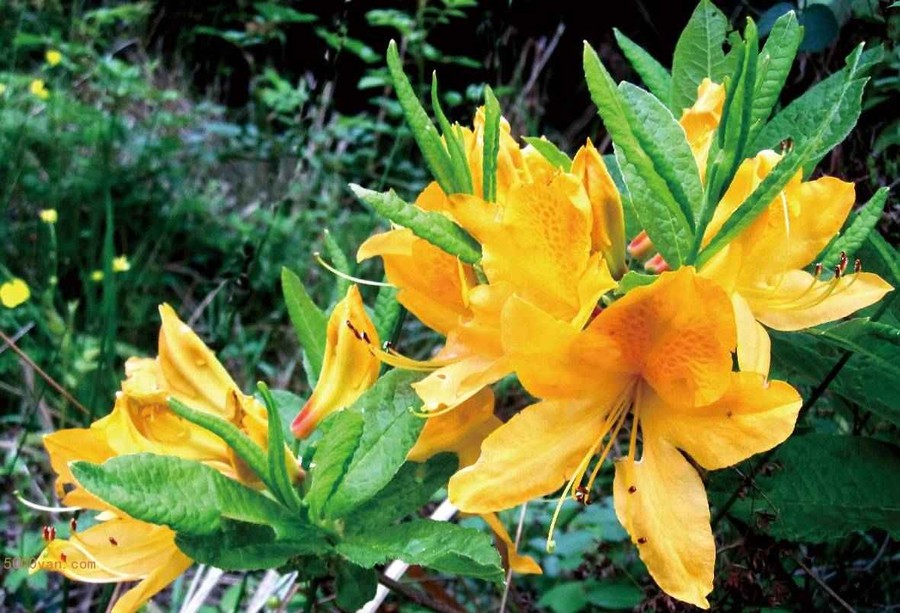
Deciduous shrub, 1-2 m tall. Old branches smooth, glabrous, brown; young branches with short pubescence and bristles. Flower buds ovoid, with 9-12 broadly ovate scales. Leaves simple, alternate; petioles short, 2-6 mm long; leaf blades papery, often clustered at branch tips, elliptic to elliptic-obovate, 6-15 cm long, 3-6 cm wide, apex obtuse with a short tip, base cuneate. Margins ciliate, both surfaces densely covered with gray-white pubescence. Flowers numerous, arranged in short racemose umbels, terminal, opening before or simultaneously with leaves; calyx small, 5-lobed, semiorbicular, persistent, sparsely hairy; corolla broadly campanulate, golden yellow, 5-lobed at apex, lobes elliptic to ovate, the upper lobe larger with pale green spots; stamens 5, equal to or slightly exserted from corolla, anthers opening by pores; pistil 1, ovary superior, 5-loculed, externally covered with gray long hairs, style slender, glabrous, longer than stamens, stigma capitate. Capsule long-elliptic, up to 2.5 cm long, deep brown when mature, with fine pubescence and sparse bristles, dehiscing loculicidally. Seeds numerous, small, gray-brown, flat-ovate, with membranous wings on margins. Flowering period April to May, fruiting period June to August.
Habitat and Distribution
It grows on hillside slopes, in rock crevices, thickets, or grasslands. It is distributed in Jiangsu, Anhui, Zhejiang, Jiangxi, Fujian, Henan, Hubei, Hunan, Guangdong, Guangxi, Sichuan, and Guizhou.
Harvesting and Processing
Harvest when flowers first bloom in April and May, dry in the shade or sun-dry.
Medicinal Properties
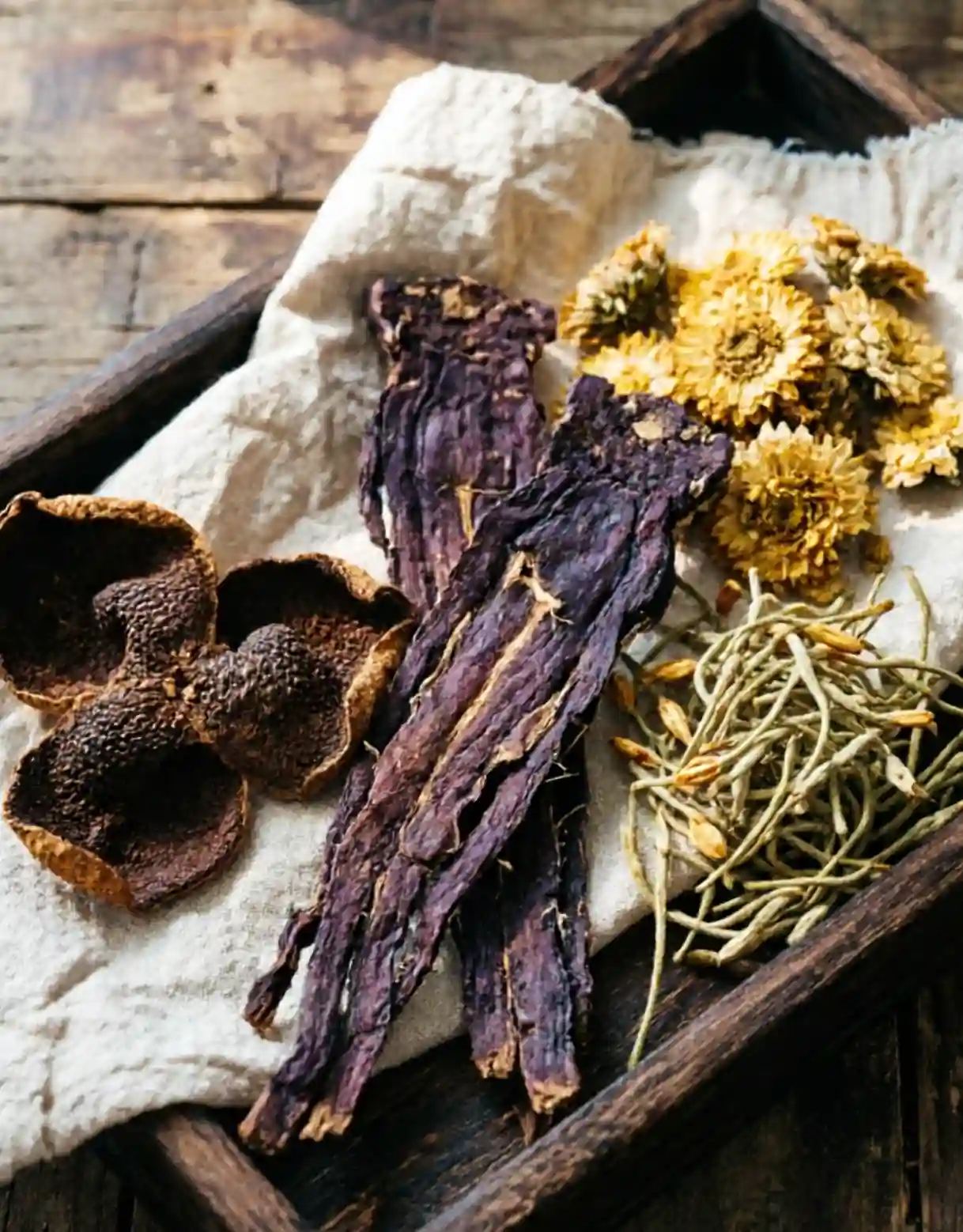
Several flowers clustered on a single peduncle, mostly detached as single florets; grayish-yellow to yellowish-brown, wrinkled. Calyx 5-lobed, lobes semi-circular to triangular, margins with long fine hairs; corolla campanulate, tube relatively long, approximately 2.5 cm, apex reflexed and folded, 5-lobed, petals broadly ovate, apex obtuse or slightly emarginate; stamens 5, filaments coiled, equal to or slightly longer than the corolla, pubescent below the middle, anthers reddish-brown, dehiscing by apical pores; pistil 1, stigma capitate; pedicel 1-2.8 cm long, brownish, with short pubescence. Odor: faint; Taste: slightly numbing.
Chemical Constituents
This product mainly contains andromedotoxin, ericolin, rhododendrin III, rhodojaponin III, rhodotoxin III, grayanotoxin III, and kalmanol.
Pharmacology
Has significant analgesic effects; has strong antibacterial and insecticidal effects; on the cardiovascular system, it has notable blood pressure-lowering effects, can counteract certain arrhythmias, and has no direct inhibitory effect on the heart; on striated muscle, it exhibits initial stimulation followed by paralysis, and has an anesthetic effect on higher nerve centers, but has no significant effect on the spinal cord; on the vagus nerve endings, it also shows initial stimulation followed by paralysis, and can stimulate rabbit bronchial and intestinal smooth muscle; additionally, it has central emetic effects and depolarizing effects on squid giant axon membranes.
Properties and Channel Entry
Acrid, warm; highly toxic. Enters the Liver channel.
Functions and Indications
Expels Wind and eliminates Dampness, disperses stasis and alleviates pain. Used for rheumatic arthralgia, unilateral or bilateral headache, traumatic swelling and pain, and stubborn tinea.
Dosage and Administration
Internal use: grind into powder, 0.3-0.6 g; decoct in water, 0.3-0.6 g; or prepare into pills or powder; or steep in wine. External use: appropriate amount, grind into powder and mix for topical application, or mash fresh product for external application.
Precautions and Contraindications
This product is toxic and should not be taken in large doses or for prolonged periods; it is contraindicated in individuals with weak constitution and in pregnant women.
Prescriptions
1. For neuropathic headache and migraine: fresh Naoyanghua (Rhododendron molle) pounded into a paste, applied externally to the back of the head or painful area for 2-3 hours. (Zhejiang Folk Commonly Used Herbs) 2. For traumatic injury: Naoyanghua 6 g, Xiao Bugu (Gendarussa vulgaris) 30 g, Zeyan (Lycopus lucidus) 60 g. Pound together, stir-fry with wine until hot, and apply to the affected area. (Guangxi Chinese Herbal Medicine) 3. For dental caries and toothache: Naoyanghua 3 g, Caowutou (Aconitum kusnezoffii) 7.5 g. Grind into powder, mix with melted wax to form pills the size of mung beans. Wrap one pill in gauze, bite down on it. Induces salivation. (Haishang Xianfang) 4. For early-stage scrofulous sores: Naoyanghua (mixed with wine, steamed, and sun-dried), Caowu (soaked in wine, stir-fried), Baifan (alum), Huangla (beeswax, melted) in equal parts. Grind into powder, add a little honey, form pills the size of radish seeds. Take 50-60 pills with wine. (Jiewei Yuansou) 5. For male and female headache, whether unilateral or bilateral, new or chronic, especially those that require heavy wrapping even in summer: Naoyanghua (pure powder) 3 g, Jinshuhua (Hibiscus syriacus flower, pure powder) 3 g, Dafengzi (Hydrocarpus anthelmintica, white flesh, oil removed) 1.5 g. Grind together. Take 1.8 g per dose, mixed with scallion and wine, then bathe to induce sweating for recovery. (Waike Zhengzong, San Sheng San) 6. For chronic skin tinea and itching: fresh Naoyanghua 15 g, pounded and applied to the affected area. (Mingdong Bencao) 7. For tinea capitis (scalp ringworm): rub fresh Naoyanghua on the affected area; or dry and grind into powder, mix with sesame oil and apply. (Zhejiang Folk Commonly Used Herbs) 8. For malaria: Naoyanghua 0.3 g, tender pine twigs 15 g. Decoct in water and take orally. (Hunan Materia Medica)