Pinyin: Yingchunhua
Aliases
Jinyaodai, Qingminghua, Jinmeihua.
Source
Oleaceae plant Jasminum nudiflorumJasminum nudiforumThe dried flower of Lindl.
Botanical Description
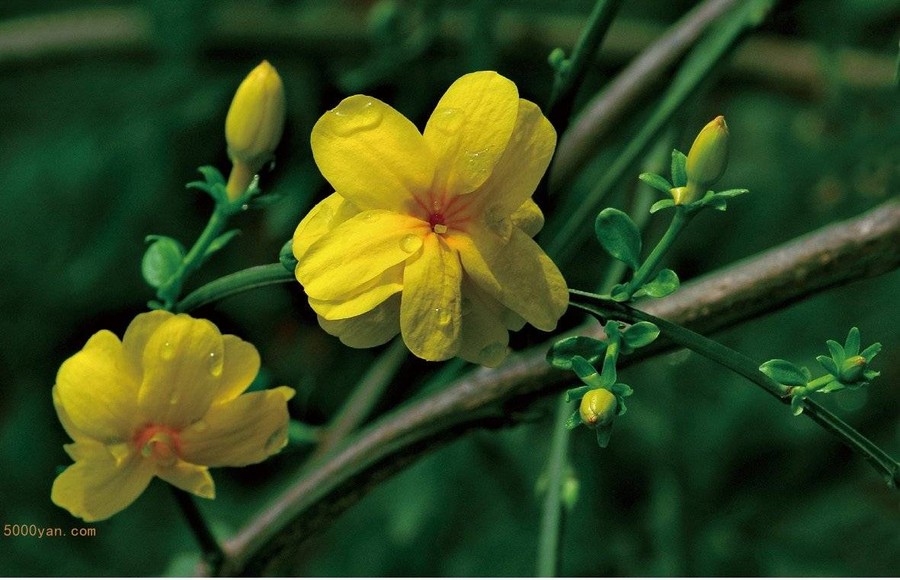
Deciduous shrub, erect or prostrate, 0.3-5 m tall. Branchlets quadrangular, with narrow wings on the angles. Leaves opposite, trifoliolate, often with simple leaves at the base of branchlets; rachis narrowly winged, petiole 3-10 mm long; leaflets ovate, ovate-oblong, or elliptic, narrowly elliptic, rarely obovate, apex acute or obtuse with a short mucro, base cuneate, margin revolute; terminal leaflet larger, 1-3 cm long, 0.2-1.1 cm wide, sessile or with a short petiole extending from the base; lateral leaflets 0.6-2.3 cm long, 0.2-1.1 cm wide, sessile or with a short petiole extending from the base; simple leaves ovate or elliptic, sometimes nearly orbicular. Flowers solitary in leaf axils of previous year's branchlets, rarely at branchlet apex; bracts leaf-like, lanceolate, ovate, or elliptic; pedicel 2-3 mm long; calyx green, lobes 5-6, narrowly lanceolate, apex acute; corolla yellow, 2-2.5 cm in diameter, corolla tube 0.8-2 cm long, 3-6 mm wide, gradually expanding upward, lobes 5-6, oblong or elliptic, 0.8-1.3 cm long, 3-6 mm wide, apex acute or obtuse; stamens 2, inserted in the corolla tube; ovary 2-locular. Flowering period: April-May.
Habitat and Distribution
It grows in thickets on mountain slopes. It is distributed in Shaanxi, Gansu, Sichuan, Yunnan, and Tibet. It is cultivated in various regions.
Harvesting and Processing
Harvest during the flowering period from April to May, use fresh or dry in the shade.
Medicinal Properties
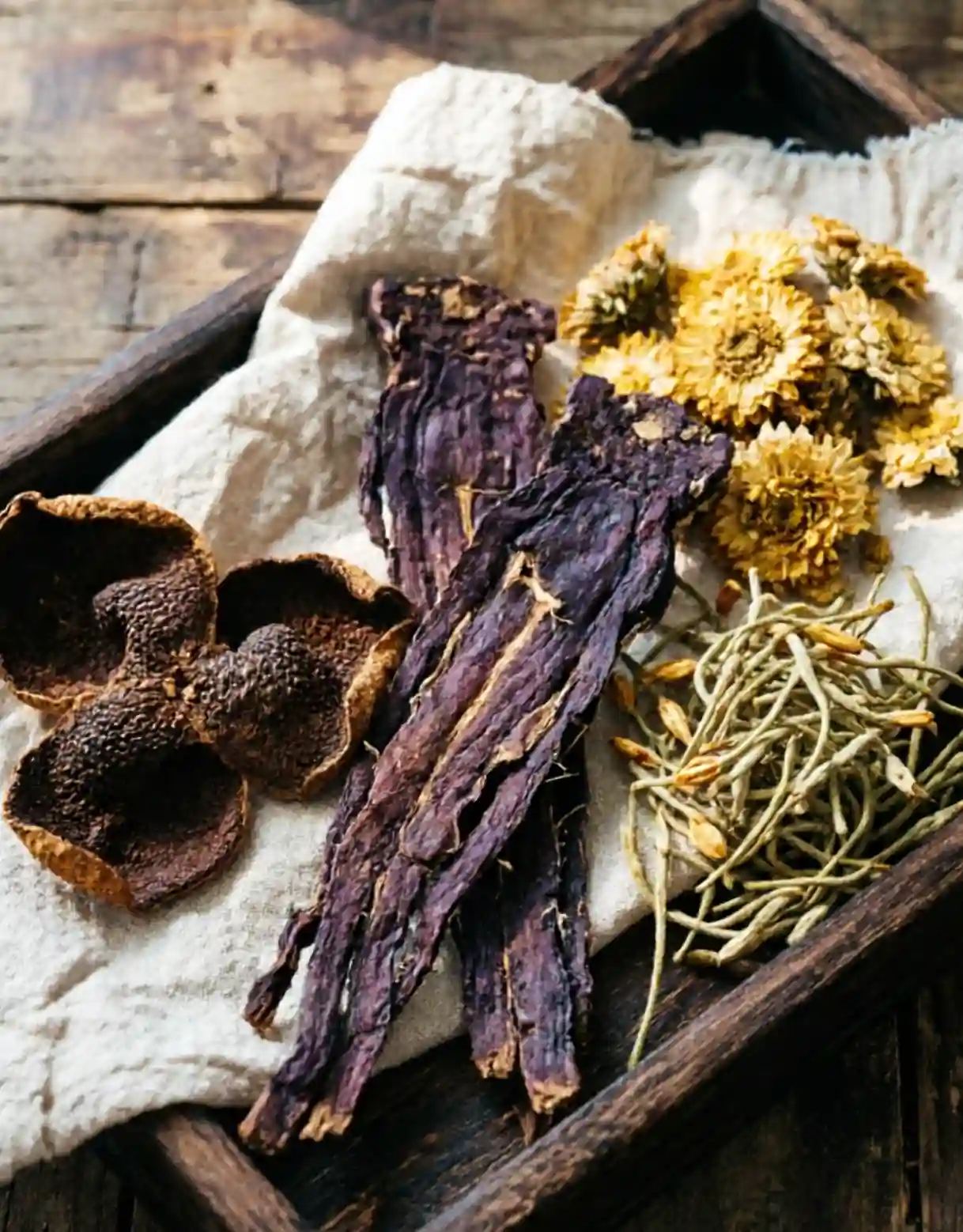
The flowers are wrinkled into clusters; when spread open, narrow yellow-green leaf-like bracts are visible; sepals 5-6, linear or oblong-lanceolate, equal to or longer than the calyx tube; corolla brownish-yellow, approximately 2 cm in diameter; corolla tube 1-1.5 cm long, lobes usually 6, obovate or elliptical, about half the length of the corolla tube; odor: faintly aromatic; taste: slightly astringent.
Chemical Constituents
This product primarily contains chemical constituents such as secoiridoids, flavonoids, jasmine yellow pigment, volatile oils, and fatty acids.
Properties and Channel Entry
Bitter and slightly acrid in taste, neutral in nature.
Functions and Indications
Clears Heat, resolves toxicity, activates Blood circulation, and reduces swelling
Dosage and Administration
Oral: decoct in water, 10-15 g; or grind into powder. External use: appropriate amount, mash for application or mix with sesame oil for topical application.
Prescriptions
1. For fever with headache: Yingchunhua (Winter Jasmine) 15 g, decoct in water and take orally. (Guizhou Folk Medicinal Herbs) 2. For sore throat: Yingchunhua 15 g, Diandimei (Androsace) and Gancao (Licorice) 3 g each, decoct in water and take orally. (Wanxian Chinese Herbal Medicine) 3. For painful urination with heat sensation: Yingchunhua and Cheqiancao (Plantain) 15 g each, decoct in water and take orally. (Guizhou Folk Medicinal Herbs) 4. For toxic boils and malignant sores: Grind Yingchunhua into powder, take with wine to induce sweating for recovery. (Weisheng Yijian Fang) 5. For unnamed toxic swellings with high fever: Yingchunhua 30 g, decoct in water and take orally. (Guizhou Herbal Medicine) 6. For chronic leg ulcer (lichen): Appropriate amount of Yingchunhua, grind into powder, mix with sesame oil for external application. (Qingdao Chinese Herbal Medicine Handbook) 7. For traumatic injuries and knife wounds with bleeding: Appropriate amount of Yingchunhua, mash and apply externally to the affected area. (Chinese Medicinal Flowers and Plants)