Pinyin: Jianlianhua
Aliases
Handiliàn, Jīnfúróng, Hànjīnlián, Jīngēda.
Source
Internal use: decoct 3-6 g.Trollius chinensisThe dried flower of Bunge.
Plant
Morphology
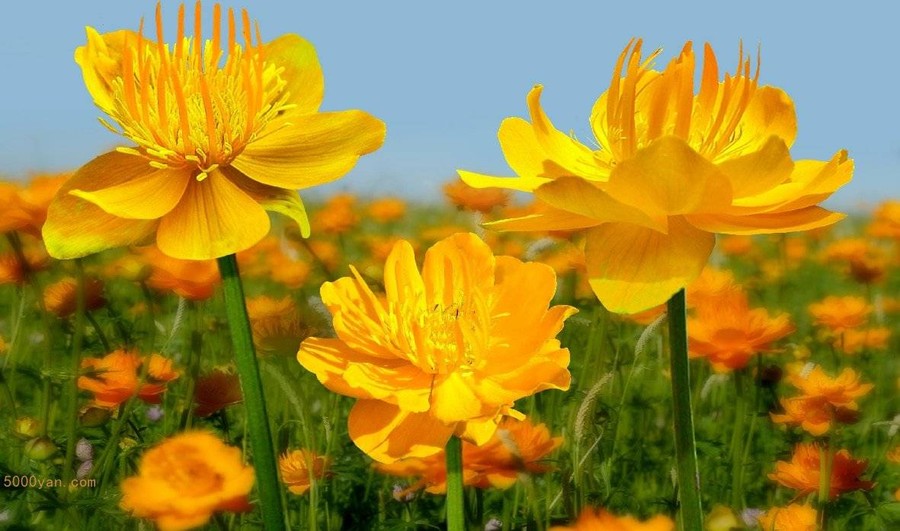
Perennial herb, 30-70 cm tall. Entire plant glabrous (hairless). Stem erect, unbranched, sparsely bearing 2-4 leaves. Basal leaves 1-4, 16-36 cm long, with long petioles 12-30 cm long, base with narrow sheath; leaf blade pentagonal, 3.8-6.8 cm long, 6.8-12.5 cm wide, 3-parted, central segment rhombic, apex acute, 3-lobed to or slightly beyond the middle, margin with unequal triangular sharp serrations; lateral segments obliquely fan-shaped, 2-deeply divided near the base, upper deep lobe similar to central segment, lower deep lobe smaller, obliquely rhombic; cauline leaves alternate, shape similar to basal leaves, lower stem leaves with long petioles, upper leaves smaller, with short petioles or sessile. Flowers bisexual, solitary terminal or 2-3 arranged in sparse cymes, 3.8-5.5 cm in diameter; pedicel 5-9 cm long; bracts 3-lobed; sepals usually 10-15, golden yellow, not turning green when dry, elliptic-ovate or obovate, 1.5-2.8 cm long, 7-16 mm wide, apex sparsely with triangular teeth, sometimes with 3 small lobes or indistinct small teeth; petals (nectary leaves) 18-21, narrowly linear, slightly longer than or equal to sepals, 1.8-2.2 cm long, 1.2-1.5 mm wide, apex attenuate, with a nectary groove near base; stamens numerous, 5-11 mm long, spirally arranged, filaments linear, anthers dehiscing laterally, 3-4 mm long; carpels 20-30. Follicles, 1-1.2 cm long, about 3 mm wide, with reticulate veins, beak about 1 mm long. Flowering June-July, fruiting August-September.
Habitat and Distribution
1. For pneumonia: Renshen 6 g, decoct in water and take orally. Internal use: decoct 3-10 g, large dose 10-30 g.
Harvesting and Processing
Harvest in summer when flowers bloom, and air-dry.
Medicinal Properties
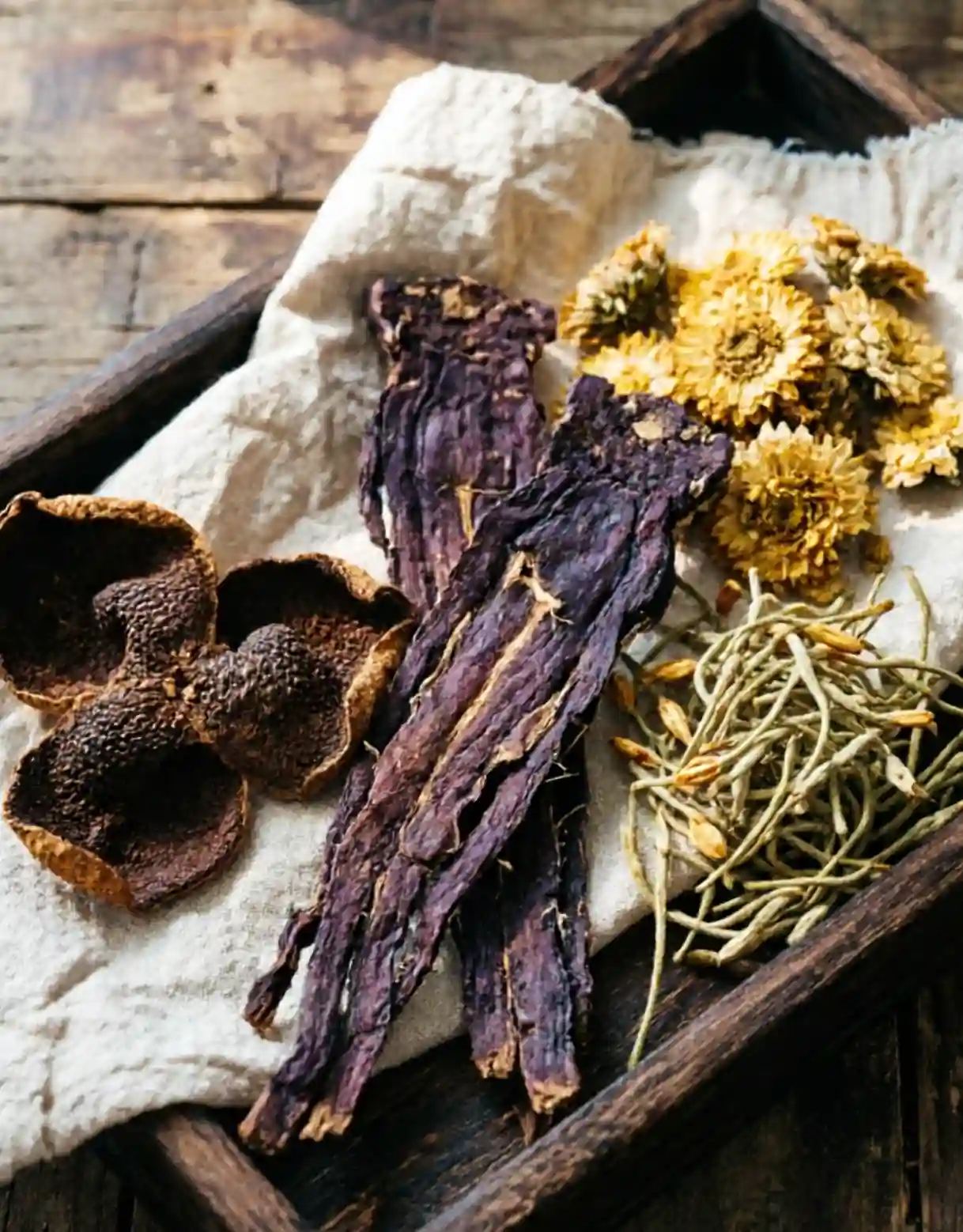
Flowers wrinkled, diameter 2-5.2 cm after flattening; sepals 8-19, golden yellow, obovate or elliptic-ovate, outer ones sparsely triangular-toothed at apex; petals 13-22, brown, linear, about as long as sepals; stamens numerous; ovaries more than 20, aggregated, styles awl-shaped. Odor: faint; Taste: bitter.
Chemical Constituents
This product mainly contains veratric acid, orientin, vitexin, veratramide, palmitic acid and other components.
Pharmacology
Has antibacterial effects; also has anticancer, antihypertensive, anti-inflammatory, and antispasmodic effects.
Properties and Channel Entry
Bitter, slightly cold. Enters the Lung and Stomach channels.
Functions and Indications
Clears Heat and resolves toxicity, reduces swelling, and brightens the eyes. Clears Heat and resolves toxicity, reduces swelling, and brightens the eyes. Indications: colds with fever, sore throat, mouth sores, swollen and painful gums, bleeding gums, red and swollen eyes, furuncles and toxic swellings, acute tympanitis, and acute lymphangitis.
Dosage and Administration
Internal use: decoct 3-6 g in water, or steep in hot water as a tea. External use: an appropriate amount, decoct in water for gargling.
Prescriptions
1. For chronic tonsillitis: Jinlianhua (Trollius chinensis) 3 g, steep in boiling water, drink as tea frequently and also use as a gargle. For acute cases, double the dosage, or add an equal amount of Yaxincao (Commelina communis). (From *Hebei Chinese Herbal Medicine Handbook*) 2. For acute otitis media, acute tympanitis, acute conjunctivitis (fire eye), and acute lymphangitis (red thread furuncle): Jinlianhua (Trollius chinensis) 9 g, Juhua (Chrysanthemum morifolium) 9 g, Sheng Gancao (raw Glycyrrhiza uralensis) 3 g. Decoct in water and take orally. (From *Hebei Chinese Herbal Medicine Handbook*) 3. For acute and chronic tonsillitis: Jinlianhua (Trollius chinensis) 6 g, Pugongying (Taraxacum mongolicum) 15 g. Steep in boiling water, drink as tea, and also use as a gargle. (From *National Compendium of Chinese Herbal Medicine*)