Pinyin: Jidanhua
Aliases
Danhuanghua, Fanhuazai, Mianzhizi.
Source
Apocynaceae plant *Plumeria rubra* L.Plumeria rubraL. cv. Acutifolia dried flowers.
Botanical Description
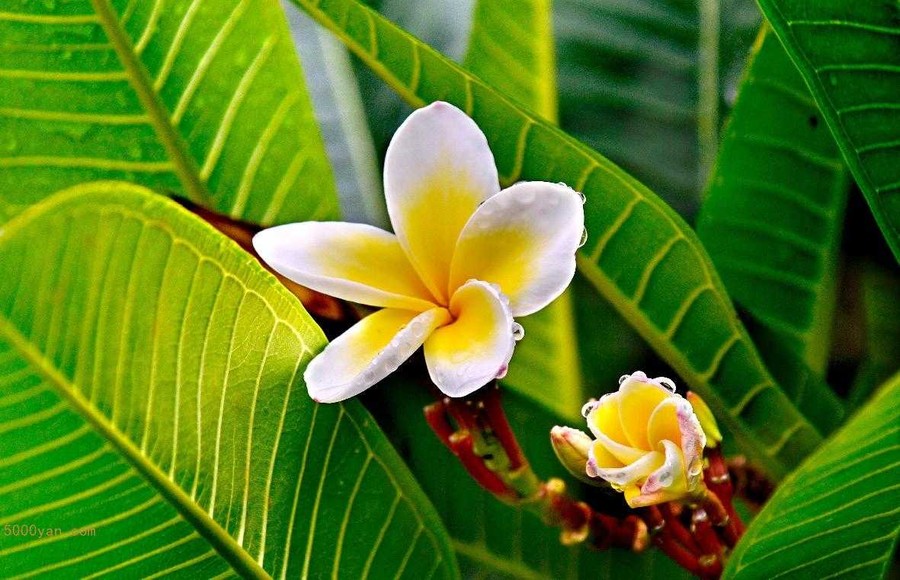
Deciduous small tree, up to 5 m tall. Branches thick, fleshy, and succulent. Entire plant contains abundant latex. Leaves alternate; petiole 4-7.5 cm long, with glands at the base on the upper side; leaf blade thickly papery, often clustered at the upper part of branches, oblong-obovate or oblong-elliptic, 20-40 cm long, 7-11 cm wide, apex shortly acuminate, base narrowly cuneate, glabrous on both surfaces; lateral veins 30-40 on each side, anastomosing into marginal veins before reaching the leaf margin. Terminal cymes, 16-25 cm long, about 15 cm wide; peduncle trichotomous, 11-18 cm long, fleshy, green; pedicels light red; calyx 5-lobed, lobes small, ovate, not spreading but tightly appressed to the corolla tube; corolla white outside, yellow inside, tube cylindrical, densely pubescent inside, throat without scales; stamens 5, inserted at the base of the corolla tube, filaments very short, anthers oblong; carpels 2, free, style short, stigma oblong, constricted in the middle, apex 2-lobed. Follicles twin, widely divergent, cylindrical, gradually tapering toward the apex, about 11 cm long. Seeds obliquely oblong, flattened, apex with an oblong membranous wing, wing about 2 cm long. Flowering period May to October, fruiting period generally July to December. Cultivated plants rarely bear fruit.
Habitat and Distribution
Cultivated in Fujian, Taiwan, Guangdong, Hainan, Guangxi, and Yunnan in China.
Harvesting and Processing
Harvest the stem bark in summer and autumn, and collect the flowers during bloom, then dry in the sun or use fresh.
Medicinal Properties
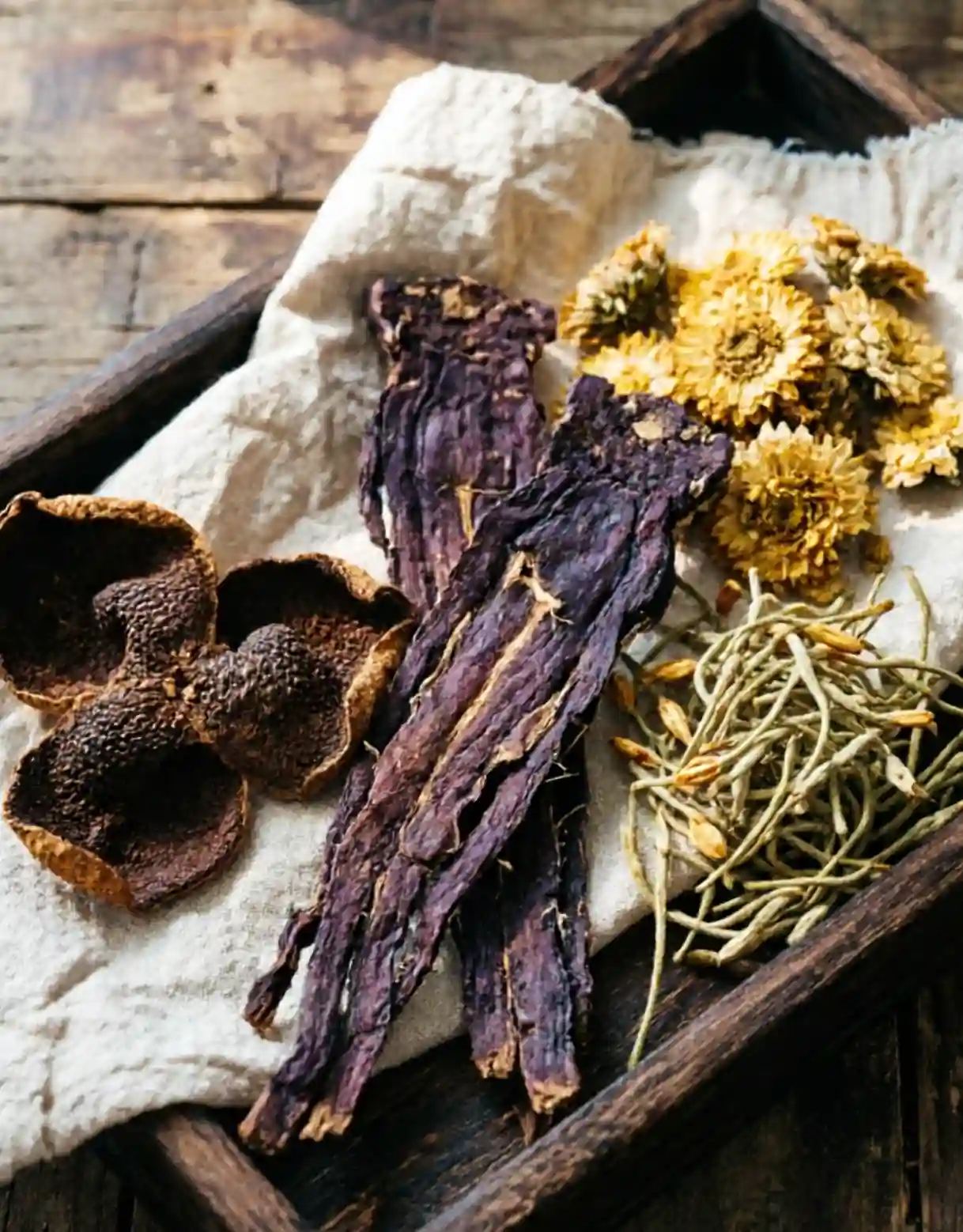
Flowers mostly wrinkled into strips or flat triangular shapes, pale brownish-yellow or yellowish-brown. After moistening and flattening, the calyx is relatively small. The corolla has 5 lobes, obovate, about 3 cm long and 1.5 cm wide, arranged in a spiral; the lower part fuses into a thin tube about 1.5 cm long. There are 5 stamens with very short filaments. Occasionally an ovoid ovary can be seen. Aroma: fragrant; Taste: slightly bitter. The best quality is characterized by intact flowers, yellowish-brown color, and strong aromatic fragrance.
Chemical Constituents
This product mainly containsα-α-amyrin,β-α-amyrin, plumieride, scopoletin, 13-deoxyplumieride and other constituents.
Pharmacology
Antifungal, local anesthesia, antispasmodic.
Properties and Channel Entry
Sweet, slightly bitter, cool.
Functions and Indications
Clears Heat, promotes diuresis, and relieves summerheat
Dosage and Administration
Internal: decoct in water, flower 5-10 g; stem bark 10-15 g. External: appropriate amount, mash for application.
Prescriptions
1. For fever due to cold: 15-30 g of Plumeria rubra leaves. Decoct in water for oral use. ("Selected Medicinal Herbs of Guangxi") 2. For whooping cough and tracheitis: 3-9 g of Plumeria rubra flowers or stem bark, combined with Alstonia scholaris leaves. Decoct in water for oral use. ("Selected Medicinal Herbs of Simao, Yunnan") 3. For infectious hepatitis: 3-9 g of Plumeria rubra flowers or stem bark. Decoct in water for oral use. ("Selected Medicinal Herbs of Simao, Yunnan") 4. For bacillary dysentery: 9 g each of Plumeria rubra, Urena lobata, and Lonicera japonica. Decoct in water for oral use. ("National Compendium of Chinese Herbal Medicine") 5. For urinary tract stones: 25 g of Plumeria rubra stem bark (or combined with Clerodendrum indicum). Decoct in water for oral use. ("Xishuangbanna Dai Materia Medica") 6. For mastitis: Fresh Plumeria rubra stem bark, pounded and applied externally. ("Xishuangbanna Dai Materia Medica")