Pinyin: Yejuhua
Aliases
Shanjuhua, Qiancengju, Huangjuhua
Source
Asteraceae family plant Chrysanthemum indicumChrysanthemum indicumL. of the dried capitulum (flower head).
Botanical Description
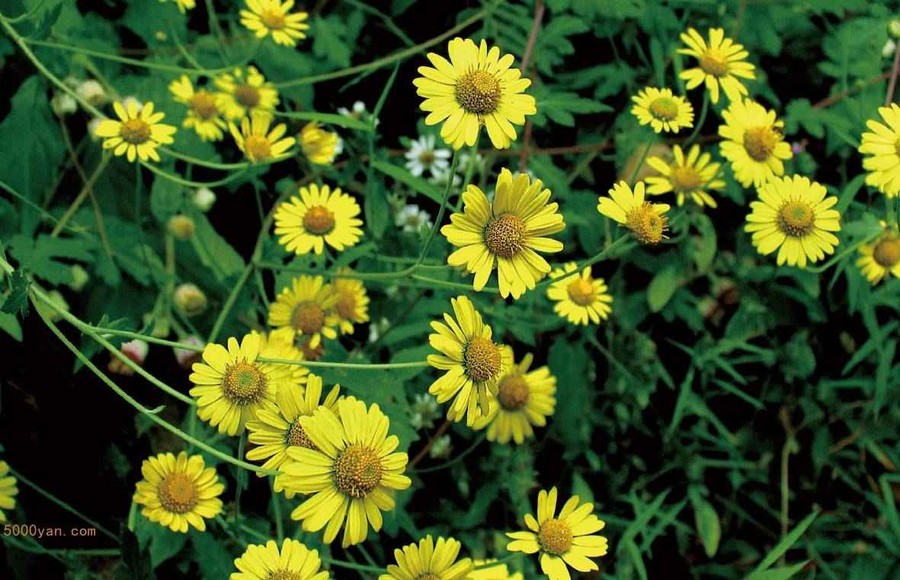
Perennial herb, 25-100 cm tall. Rhizome thick, branched, with long or short underground stolons. Stem erect or spreading at base. Basal leaves deciduous; stem leaves ovate or oblong-ovate, 6-7 cm long, 1-2.5 cm wide, pinnately divided or indistinctly divided; terminal lobe large, lateral lobes usually 2 pairs, ovate or oblong, all lobe margins shallowly lobed or serrate; upper leaves gradually smaller; all leaves with glands and sparse pubescence on upper surface, gray-green on lower surface with more hairs, base gradually narrowed into winged petiole; stipules serrate. Capitula 2.5-4 (-5) cm in diameter, arranged in corymbose panicles or irregular corymbs at stem apices; involucre 8-20 mm in diameter, 5-6 mm long; involucral bracts with broad scarious margins; ray florets yellow, female; disc florets bisexual, tubular. Achenes all similar, with 5 very fine longitudinal ribs, without pappus. Flowering period: September to October.
Habitat and Distribution
Born on hillside grasslands, thickets, riverbanks and damp areas, coastal saline soils, field edges, and roadsides. Widely distributed in Northeast, North, East, Central, and Southwest China.
Harvesting and Processing
Harvested when the flowers first open in autumn and winter, dried in the sun, or steamed and then dried in the sun.
Medicinal Properties
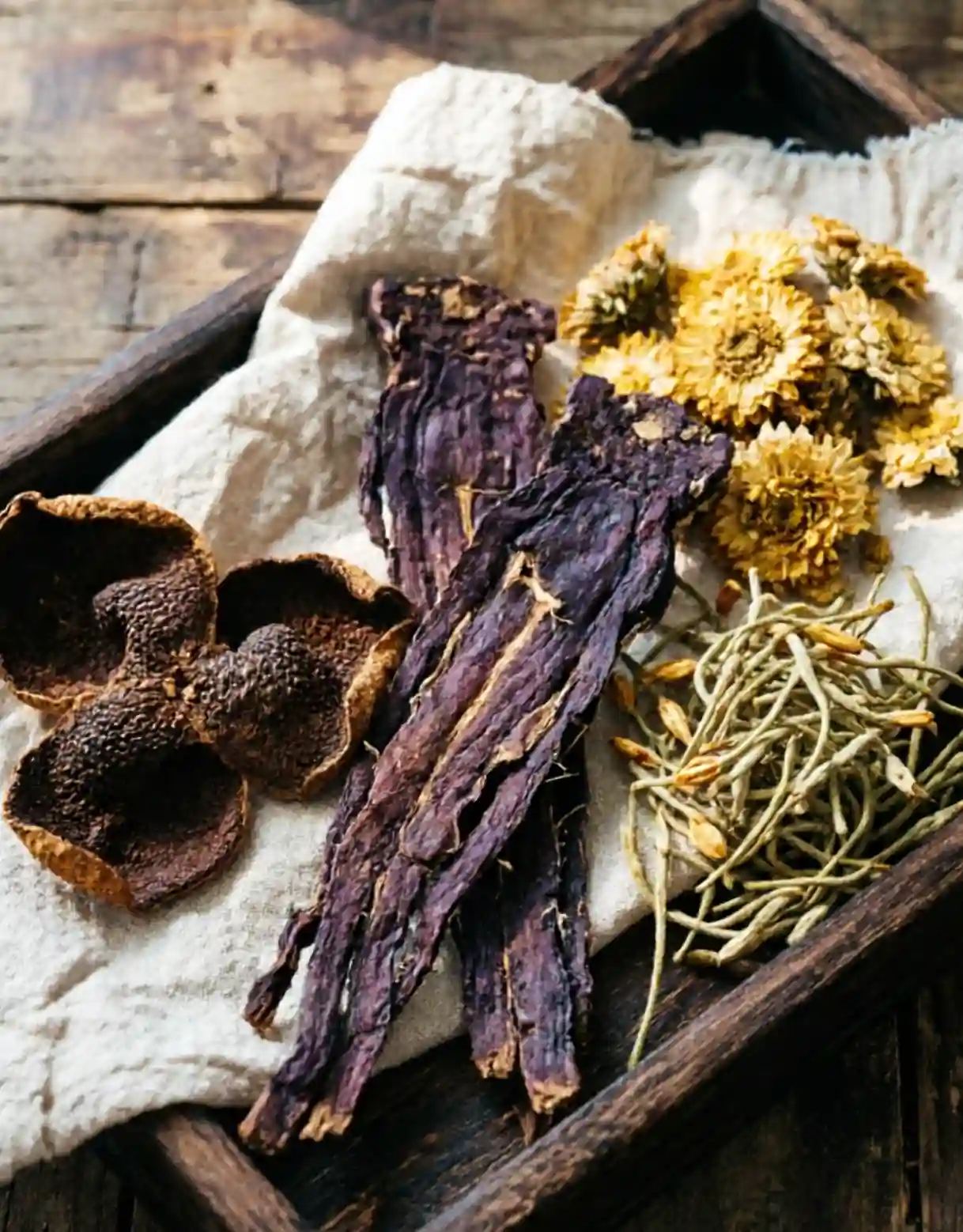
This product is subglobose in shape, 0.3-1 cm in diameter, and brownish-yellow in color. The involucre consists of 4-5 layers of bracts; the outer bracts are ovate or linear, with a grayish-green or light brown outer surface, usually covered with white hairs and a membranous margin; the inner bracts are oblong, membranous, and glabrous on the outer surface. The base of the involucre sometimes bears a remnant peduncle. There is one whorl of ligulate flowers, yellow to brownish-yellow, wrinkled and curled; the tubular flowers are numerous and deep yellow. The texture is light. The odor is aromatic, and the taste is bitter.
Chemical Constituents
This product contains yejuhua lactone, yejuhua alcohol, and yejuhua triol among other constituents.
Pharmacology
Has antihypertensive, hemodynamic regulatory, and anti-myocardial ischemic effects; inhibits phosphodiesterase; inhibits platelet aggregation; anti-pathogenic microbial effects; antipyretic; enhances phagocytic function of phagocytes; inhibits plasma coagulase formation in Staphylococcus aureus.
Properties and Channel Entry
Bitter, acrid, and slightly cold. Enters the Liver and Heart channels.
Functions and Indications
Clears Heat and resolves toxicity, drains Fire and calms the Liver. Used for furuncles, carbuncles, swelling, red and swollen eyes, headache, and dizziness.
Dosage and Administration
Internal use: decoction, 10-15 g, fresh product may be used up to 30-60 g. External use: appropriate amount, mash and apply; decoct for mouth rinse or for washing.
Precautions and Contraindications
Those with Spleen and Stomach deficiency-cold should use with caution.
Prescriptions
1. For boils: Crush *Chrysanthemum indicum* and brown sugar, apply to the affected area. If the boil grows at the hairline, add *Borneolum* and fresh earthworm, apply together. (Lingnan Herbal Records) 2. For all carbuncles, abscesses, and Yang-type swelling in the ear, nose, throat, and oral cavity: *Chrysanthemum indicum* 48 g, *Taraxacum mongolicum* 48 g, *Viola yedoensis* 30 g, *Forsythia suspensa* 30 g, *Dendrobium nobile* 30 g. Decoct in water. Take in 3 divided doses daily. (Materia Medica Tuidang) 3. For acute mastitis: *Chrysanthemum indicum* 15 g, *Taraxacum mongolicum* 30 g. Decoct and take; additionally, crush fresh *Chrysanthemum indicum* leaves and apply to the affected area, replace when dry. (Anhui Chinese Herbal Medicine) 4. For venomous snake bite: *Chrysanthemum indicum* 15-30 g. Decoct in water and drink as tea. (Zhejiang Medicinal Flora) 5. For common cold: *Chrysanthemum indicum*, *Lonicera japonica*, *Viola yedoensis* 9-15 g each. Decoct in water and take. (Zhejiang Medicinal Flora) 6. Prevention of influenza: *Chrysanthemum indicum* 30 g, decoct in water and take; or *Chrysanthemum indicum* 30 g, *Houttuynia cordata* 30 g, *Lonicera japonica* vine 30 g. Decoct in water and take. (Sichuan Chinese Materia Medica, 1982) 7. For wind-heat red, painful, swollen eyes: *Chrysanthemum indicum* 15 g, *Prunella vulgaris* 15 g, *Senecio scandens* 15 g, *Morus alba* leaf 9 g, *Glycyrrhiza uralensis* 3 g. Decoct in water and take. (Sichuan Chinese Materia Medica, 1982) 8. For nephritis: *Chrysanthemum indicum*, *Desmodium styracifolium*, *Plantago asiatica* each 3 g. Decoct in water and take. (Selected Shaan-Gan-Ning-Qing Chinese Herbal Medicine)