Pinyin: Yangjinhua
Aliases
Mandaluohua, Shanqiehua, Fengqiehua
Source
Solanaceae plant Datura metelDatura metelL. is the dried flower.
Botanical Description
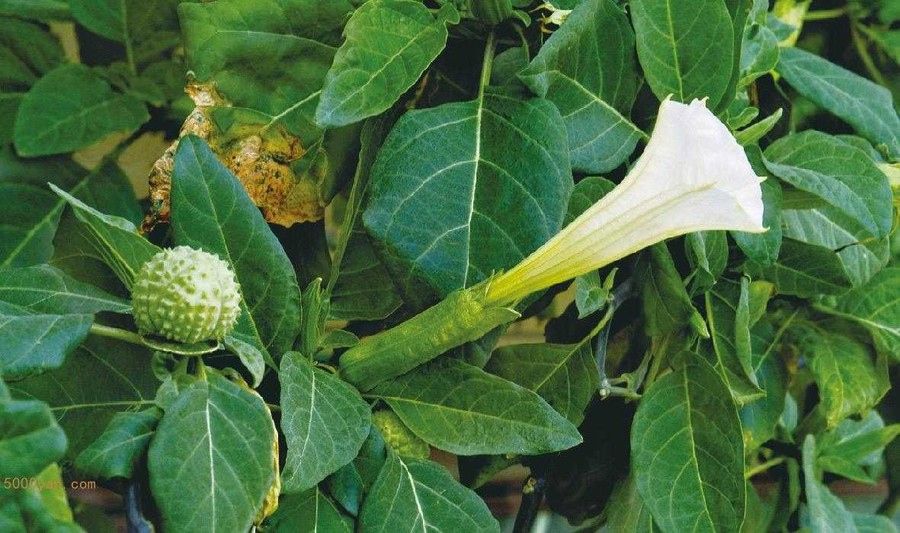
Annual herb, 30-100 cm tall. Nearly glabrous throughout. Stem erect, cylindrical, woody at the base, dichotomously branched above, green, with irregular wrinkles on the surface; young branches quadrangular, slightly purple, covered with short pubescence. Leaves alternate, upper leaves subopposite; petiole 2-5 cm long; leaf blade broadly ovate, base asymmetrical, margin with irregular short teeth or entire and wavy, both surfaces glabrous or sparsely pubescent, veins raised abaxially. Flowers solitary in branch forks or leaf axils; pedicel about 1 mm long, erect or ascending, white pubescent; calyx tubular, 4-6 cm long, 1-1.5 cm in diameter, pale yellow-green, 5-lobed at apex; corolla tube funnelform, 14-20 cm long, limb 5-7 cm in diameter, narrow at base, gradually expanding upward into a trumpet shape, white, 5-ribbed, lobes 5, triangular, apex long-acuminate; stamens 5, inserted in corolla tube, anthers linear, flat, basifixed; pistil 1, ovary globose, 2-locular, sparsely short-spiny, ovules numerous, style filiform, 11-16 cm long, stigma peltate. Capsule globose or oblate, about 3 cm in diameter, sparsely short-spiny, light brown when mature, irregularly 4-valved. Seeds numerous, flat, somewhat triangular. Flowering period March to November, fruiting period April to November.
Habitat and Distribution
It grows on mountain slopes, grasslands, or near residential areas. It is distributed in Jiangsu, Zhejiang, Fujian, Hubei, Guangdong, Guangxi, Sichuan, Guizhou, and Yunnan; it is also cultivated in Shanghai, Nanjing, and other places.
Harvesting and Processing
Harvest from April to November when flowers first open, sun-dry or dry at low temperature.
Medicinal Properties
This product is mostly wrinkled into strips; intact specimens are 9-15 cm long. The calyx is tubular, 2/5 the length of the corolla, gray-green or gray-yellow, with 5 apical lobes, 5 longitudinal veins at the base, and a slightly hairy surface; the corolla is trumpet-shaped, pale yellow or yellow-brown, with 5 shallow apical lobes, each lobe has a short tip with 3 distinct longitudinal veins beneath it, and slight indentations between the lobes; stamens 5, filaments attached to the inside of the corolla tube, 3/4 the length of the corolla; pistil 1, stigma club-shaped. Dried products are pliable and tough with a distinctive odor; sun-dried products are brittle, with a faint odor and slightly bitter taste.
Chemical Constituents
This product contains apoatropine, atropine, scopolamine, anisodamine, and other components.
Pharmacology
Has anesthetic, central nervous system stimulant effects; at small doses it slows heart rate, at large doses it increases heart rate; improves microcirculation; antioxidant; dilates pupils; regulates paralysis; inhibits secretion of various glands; relaxes smooth muscle, among other actions.
Properties and Channel Entry
Acrid, warm; toxic. Enters the Lung and Liver channels.
Functions and Indications
Relieves panting and cough, relieves spasms and pain, and stops convulsions
Dosage and Administration
Internal use: decoct 0.3-0.5 g, suitable for use in pills or powders. If used as a cigarette for divided inhalation, the daily amount should not exceed 1.5 g. External use: appropriate amount, decoct in water for washing; or grind into powder for topical application.
Precautions and Contraindications
Internal use should be used with caution. It is contraindicated in cases of external contraction, phlegm-heat with wheezing and cough, glaucoma, hypertension, heart disease, liver and kidney dysfunction, and during pregnancy. This product is toxic; excessive dosage can easily lead to poisoning, manifesting as dry mouth, flushed skin, dilated pupils, tachycardia, dizziness, headache, restlessness, delirium, hallucinations, and even coma, ultimately leading to death due to respiratory paralysis.
Prescriptions
1. For rheumatic joint pain: a. Flos Daturae (Datura flower) 30 g, Baijiu (white liquor) 50 g. Soak the flowers in the liquor for half a month, take half a small wine cup (approx. 5 ml) each time, twice daily. ("Inner Mongolia Chinese Herbal Medicine") b. Flos Daturae 9 g. Decoct in water, wash the affected area while hot. ("National Compilation of Chinese Herbal Medicine") 2. For muscle pain: Yangjinhua (Datura flower) 60 g, decoct in water for external washing. ("Guangxi Selection of Herbal Medicine") 3. For fracture pain and joint pain: Dried whole plant of Manshuluo (Datura), grind into powder, take 0.3 g per dose. ("National Compilation of Chinese Herbal Medicine") 4. For infantile chronic convulsions: Datura flower seven pieces, Tianma (Rhizoma Gastrodiae) 7.5 g, Quanxie (Scorpion, fried) ten pieces, Tiannanxing (Rhizoma Arisaematis, processed), Dansha (Cinnabar), Ruxiang (Frankincense) each 7.5 g. Grind into powder. Take 1.5 g per dose, mixed with mint decoction. ("Imperial Pharmacy Formulary") 5. For Yang depression with Qi rebellion, excessive anger and mania: Zhusha (Cinnabar, water-ground) 15 g, Datura flower 7.5 g. Grind the above into fine powder. Take 6 g per dose, mixed with warm wine, then lie down as if drunk. Do not startle or awaken the patient. ("Standards for Diagnosis and Treatment - Qufeng Yizui San") 6. For facial sores: Datura flower, sun-dried and ground into powder, apply a small amount topically. ("Simple and Effective Prescriptions for Health")