Pinyin: Xiakucao
Aliases
Tiesecao, Denglongcao, Bangchuicao.
Source
Labiatae plant Prunella vulgarisPrunella vulgarisL. of the dried fruit cluster.
Botanical Description
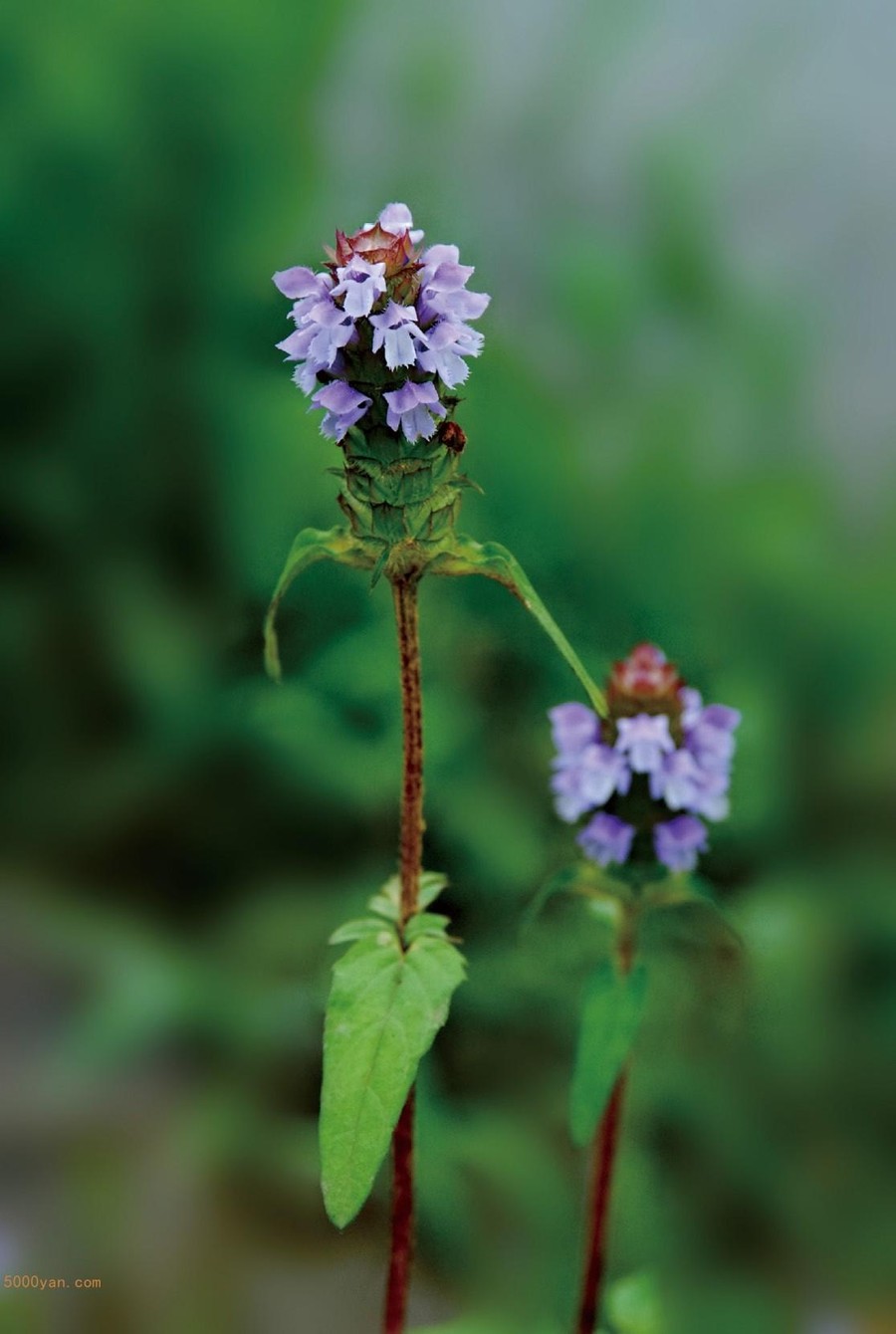
Perennial herb, stem 15-30 cm tall. Rhizome creeping on the ground, producing fibrous roots at nodes. Stem ascending, lower part prostrate, much branched from base, bluntly quadrangular, shallowly grooved, purplish-red, sparsely covered with rough hairs or nearly glabrous. Leaves opposite, petiolate; petiole 0.7-2.5 cm long, gradually shorter from lower to upper; leaf blade ovate-oblong or ovate-orbicular, variable in size, 1.5-6 cm long, 0.7-2.5 cm wide, apex obtuse, base rounded, truncate or broadly cuneate, decurrent into petiole forming narrow wings, margin with inconspicuous undulate teeth or nearly entire. Verticillasters densely arranged into terminal false spikes 2-4 cm long, shorter at anthesis, gradually elongating; bracts reniform or transversely elliptic, abruptly pointed; calyx campanulate, up to 10 mm long, bilabiate, upper lip flat, nearly truncate at apex, with 3 inconspicuous short teeth, middle tooth broad, lower lip 2-lobed, lobes lanceolate, fruit calyx closed due to oblique extension of lower 2 teeth; corolla purple, blue-purple or red-purple; stamens 4, didynamous; ovary glabrous. Nutlets yellowish-brown, oblong-ovoid, 1.8 mm long, slightly grooved. Flowering April to June, fruiting June to August.
Habitat and Distribution
It grows in wastelands, roadsides, and grassy slopes on hillsides. It is distributed in most regions of the country.
Harvesting and Processing
Harvest when the fruit spike turns brownish-red in summer, remove impurities, and sun-dry.
Medicinal Properties
This product is cylindrical in shape, slightly flattened, 1.5-8 cm long, 0.8-1.5 cm in diameter; light brown to brownish-red in color. The entire spike consists of several to over ten whorls of persistent calyces and bracts, each whorl having 2 opposite bracts, fan-shaped, with pointed tail-like tips, prominent veins, and white hairs on the outer surface. Each bract contains 3 flowers; the corolla has mostly fallen off, the persistent calyx is bilabiate, and inside there are 4 small nuts, ovoid, brown, with a white protrusion at the tip. Light in weight. Odor: faint; Taste: bland.
Chemical Constituents
This product contains ursolic acid, oleanolic acid, prunellin A, prunellin B, umbelliferone, oleic acid, and other components.
Pharmacology
Has antihypertensive, antiarrhythmic, anti-inflammatory, immunosuppressive, hypoglycemic, antibacterial, antiviral, and cytotoxic effects.
Properties and Channel Entry
Acrid, bitter, and cold. Enters the Liver and Gallbladder channels.
Functions and Indications
Clears Liver Heat and drains Fire, brightens the eyes, disperses nodules and reduces swelling
Dosage and Administration
Oral: decocted in water, 6-15 g, up to 30 g in large doses; used in decoctions or pills and powders. External use: appropriate amount, decocted for washing or pounded for application.
Precautions and Contraindications
Those with weak Spleen and Stomach should use with caution.
Prescriptions
1. For epilepsy and hypertension: Xiakucao (fresh) 90 g, Dongmi (winter honey) 30 g. Take with boiling water. (From Min Dong Ben Cao) 2. For facial paralysis with mouth and eye deviation: Xiakucao 9 g, Dannanxing 1.5 g, Fangfeng 3 g, Gouteng 3 g. Decoct in water, take with a small amount of water and wine before bed. (From Dian Nan Ben Cao) 3. For distending pain due to Liver Qi stagnation: Xiakucao 30 g. Decoct in water and take orally. (From Ji Ren Ji Yan Fang) 4. For scrofula (cervical lymphadenitis), whether ulcerated or not: Xiakucao 9 g, Dahuang 0.9 g, Gancao 0.6 g. Decoct in water and take in a single dose. (From Fang Jia Fang Xuan, Xiakucao Tang) 5. For reddish and whitish leukorrhea: Collect Xiakucao when in flower, dry in the shade and grind into powder. Take 6 g per dose with rice water before meals. (From Gang Mu, cited from Xu Shi Jia Chuan Fang)