Pinyin: Mujinhua
Aliases
Lizhanghua, Wangaihua, Muhonghua.
Source
Malvaceae family plant *Hibiscus syriacus*Hibiscus syriacusL. is the dried flower.
Botanical Description
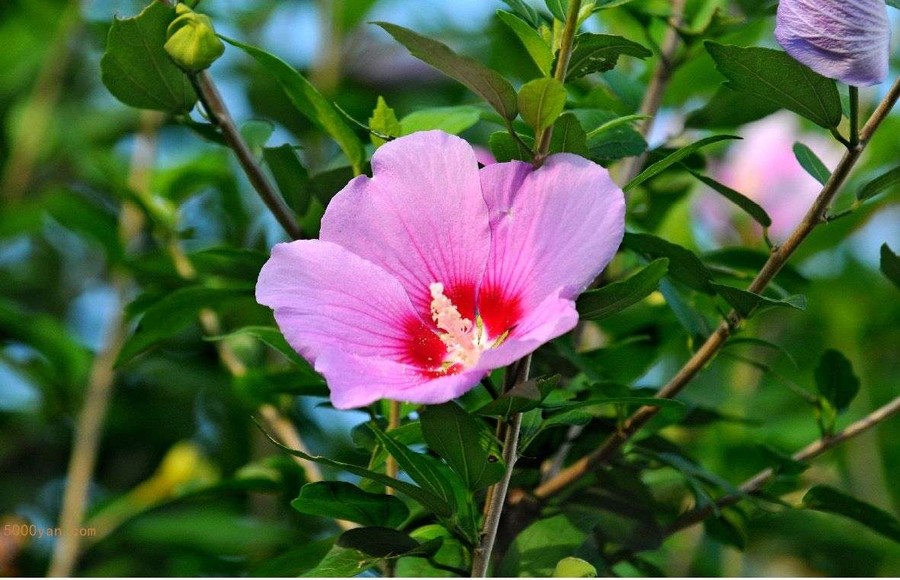
Deciduous shrub, 3-4 m tall. Branchlets densely covered with yellow stellate tomentum. Leaves alternate, petiole 5-25 mm long, covered with stellate pubescence; stipules linear, about 6 mm long, sparsely pubescent; leaf blade rhombic to triangular-ovate, 3-10 cm long, 2-4 cm wide, with varying degrees of 3-lobed or unlobed, apex obtuse, base cuneate, margin irregularly toothed, underside sparsely hairy along veins or nearly glabrous. Flowers solitary in leaf axils at branch tips, pedicel 4-14 mm long, covered with stellate short tomentum; bracteoles 6-8, linear, 6-15 mm long, 1-2 mm wide, densely covered with stellate sparse tomentum; calyx campanulate, 14-20 mm long, densely covered with stellate short tomentum, lobes 5, triangular; corolla campanulate, pale purple, 5-6 cm in diameter, petals obovate, 3.5-4.5 cm long, outside sparsely ciliate and with stellate long hairs; staminal column about 3 cm long; style branches glabrous. Capsule ovoid, about 12 mm in diameter, densely covered with yellow stellate tomentum. Seeds reniform, dorsally covered with yellow long hairs. Flowering period July to October.
Habitat and Distribution
It is cultivated in East China, Central China, South China, Southwest China, and Hebei, Shaanxi, Taiwan, and other regions.
Harvesting and Processing
Harvest on sunny mornings in summer and autumn when the flowers are half-open, then sun-dry.
Medicinal Properties
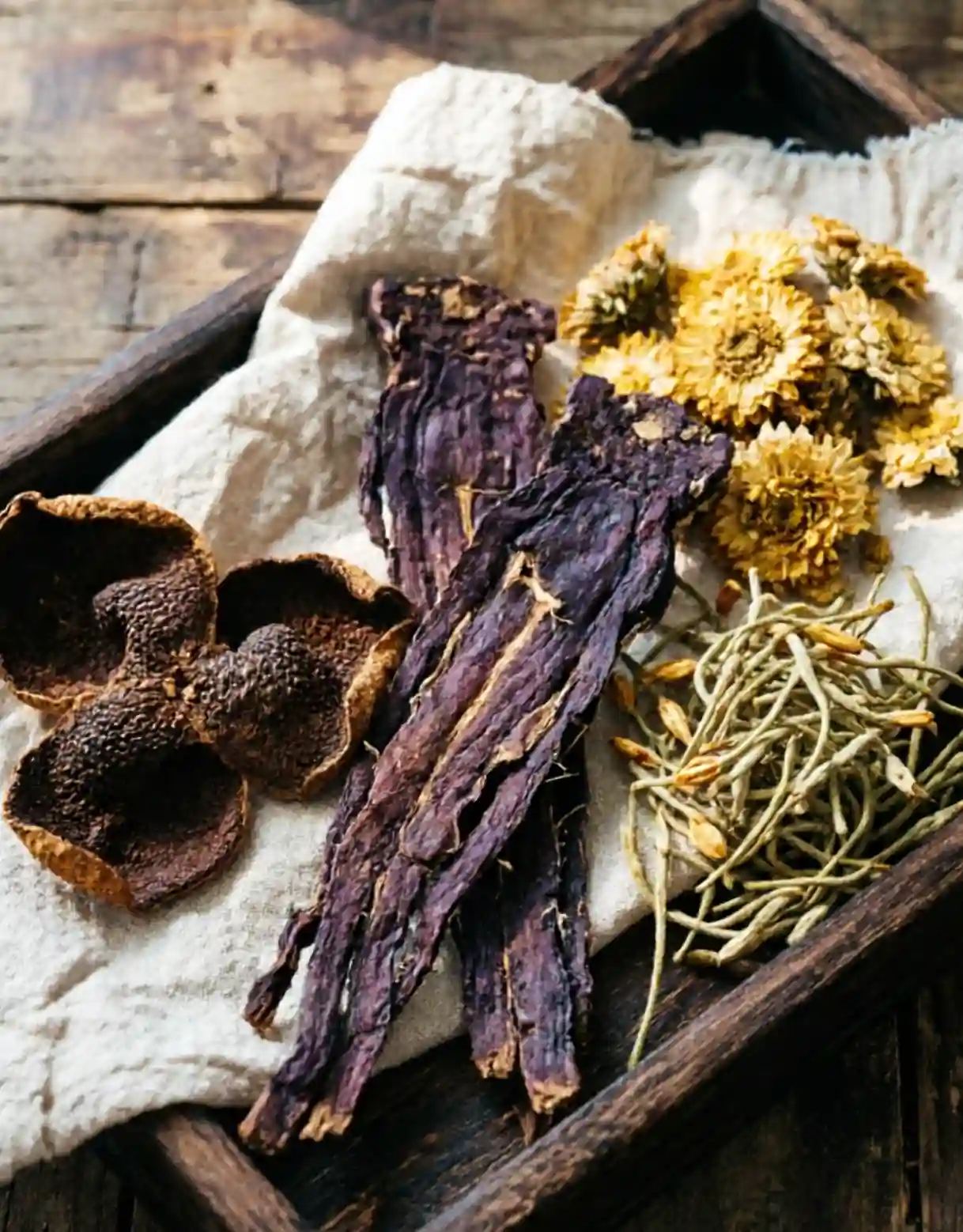
This product is mostly crumpled into clumps or irregularly shaped, 2-4 cm long and 1-2 cm wide, entirely covered with hairs. The calyx is campanulate, yellow-green or yellow, with 5 apical lobes, the lobes are triangular, there are 6-7 linear bracts outside the calyx tube, and a pedicel 3-7 mm long is often attached below the calyx tube; the calyx, bracts, and pedicel surfaces are densely covered with fine hairs and stellate hairs. There are 5 petals or double petals, yellow-white to yellow-brown, basally fused with the stamens and densely covered with white long soft hairs. There are numerous stamens, with the lower part of the filaments fused into a tube surrounding the style, and the stigma is 5-lobed, extending out of the filament tube. The texture is light and fragile, the odor is faintly aromatic, and the taste is bland.
Chemical Constituents
This product contains lutein-5,6-epoxide, cryptoxanthin, chrysanthemaxanthin, and taxifolin-3-O-β-D-pyranoglucoside, delphinidin-3-O- glucose glycosides and other components.
Properties and Channel Entry
Sweet, bitter, cool. Enters the Spleen, Lung, and Liver channels.
Functions and Indications
Clears Heat and eliminates Dampness, cools Blood and resolves toxicity
Dosage and Administration
Oral: decoct in water, 3-9 g (30-60 g fresh). External: apply an appropriate amount of ground powder or mashed fresh herb as a poultice.
Prescriptions
1. For dysentery with inability to eat: Remove the calyx from Hibiscus syriacus flowers, dry in the shade and grind into powder. First, fry two flour cakes, stuff the powder inside and eat. (From *Jiji Xianfang*). 2. For hematemesis, hematochezia, and red-white dysentery: 9-13 flowers of Hibiscus syriacus. Add an appropriate amount of boiled water and rock sugar, stew for half an hour. Take before meals, 2 times daily. (From *Fujian Folk Herbal Medicine*). 3. For hemoptysis: Fresh Hibiscus syriacus flowers 30 g, rock sugar 15 g. Decoct in water and take orally. (From *Fujian Materia Medica*). 4. For hemorrhoidal bleeding: Hibiscus syriacus flowers and charcoal-baked Sophora japonica flowers, 15 g each, plus charcoal-baked Sanguisorba officinalis 9 g. Decoct and take orally. (From *Anhui Chinese Herbal Medicine*). 5. For leukorrhea in women: Hibiscus syriacus flowers 6 g (ground into powder). Mix into half a cup of human milk, steam over rice until cooked, and eat. (From *Diannan Bencao*). 6. For leukorrhea due to Damp-Heat: Hibiscus syriacus flowers 30 g, lean pork 120 g. Stew in water, eat the meat and drink the soup. (From *Anhui Chinese Herbal Medicine*). 7. For leukorrhea: Hibiscus syriacus flowers, Patrinia villosa, and white Celosia cristata flowers, 15 g each. One dose daily, decoct in water and take in 2 divided doses. (From *Fujian Materia Medica*). 8. For boils and sores: Fresh Hibiscus syriacus flowers, mash into a paste for external application, replace when dry. (From *Anhui Chinese Herbal Medicine*).