Pinyin: Kuandonghua
Ali
1
Donghua, Kuanhua, Aidonghua.
Source
Asteraceae family plant Tussilago farfara.TussilagofarfaraDried flower buds of L.
Botanical Description
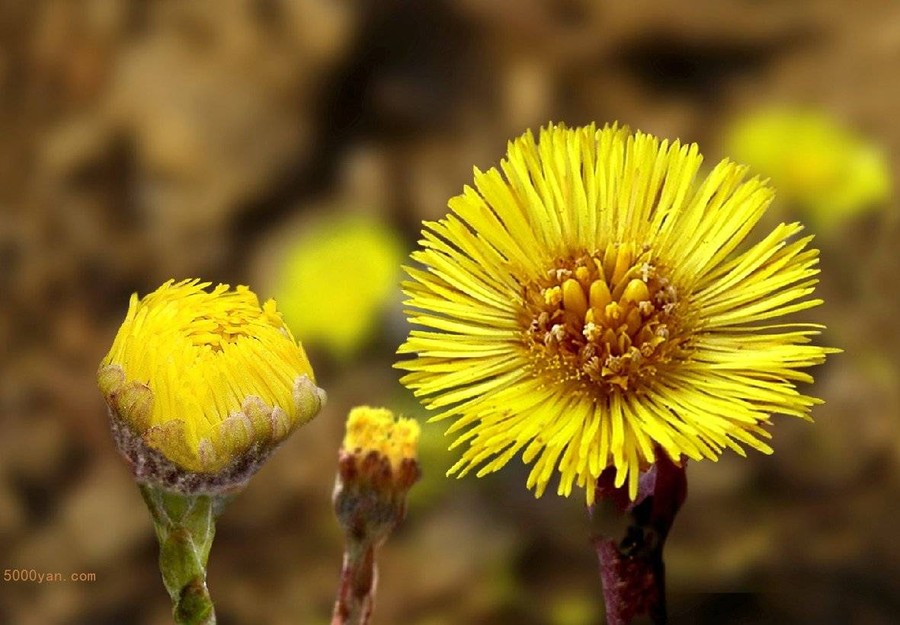
Perennial herb. Rhizome brown, creeping horizontally underground. Leaves emerge from near the root after flowering; leaf blade broadly heart-shaped or kidney-shaped, 3-12 cm long, 4-14 cm wide, apex nearly rounded or bluntly pointed, margin with wavy, blackish-brown sparse teeth thickened at the apex, upper surface with cobweb-like hairs, lower surface with white felt-like hairs; palmate reticulate venation, main veins 5-9 cm, petiole 5-19 cm long, covered with white woolly hairs. In winter and spring, several scapes emerge, covered with white downy hairs; bracts elliptic, pale purplish-brown, more than 10 pieces, densely alternate on the scape; terminal capitulum, bright yellow, drooping when unopened; involucre bell-shaped; involucral bracts 1-2 layers, covered with downy hairs; marginal ray florets, female, multi-layered, ovary inferior, style 2-lobed; central tubular florets, bisexual, apex 5-lobed, stamens 5, anther base tailed, stigma capitate, usually sterile. Achene oblong, with 5-10 ribs, pappus pale yellow. Flowering period January to February, fruiting period April.
Habitat and Distribution
Born in sunny, relatively warm areas on both sides of ditches. Distributed in North China, Northwest China, and Jiangxi, Hubei, Hunan, and other regions.
Harvesting and Processing
Harvest in December or before the ground freezes, when the flowers have not yet emerged from the soil; remove the flower stalks and sediment, and dry in the shade.
Medicinal Properties
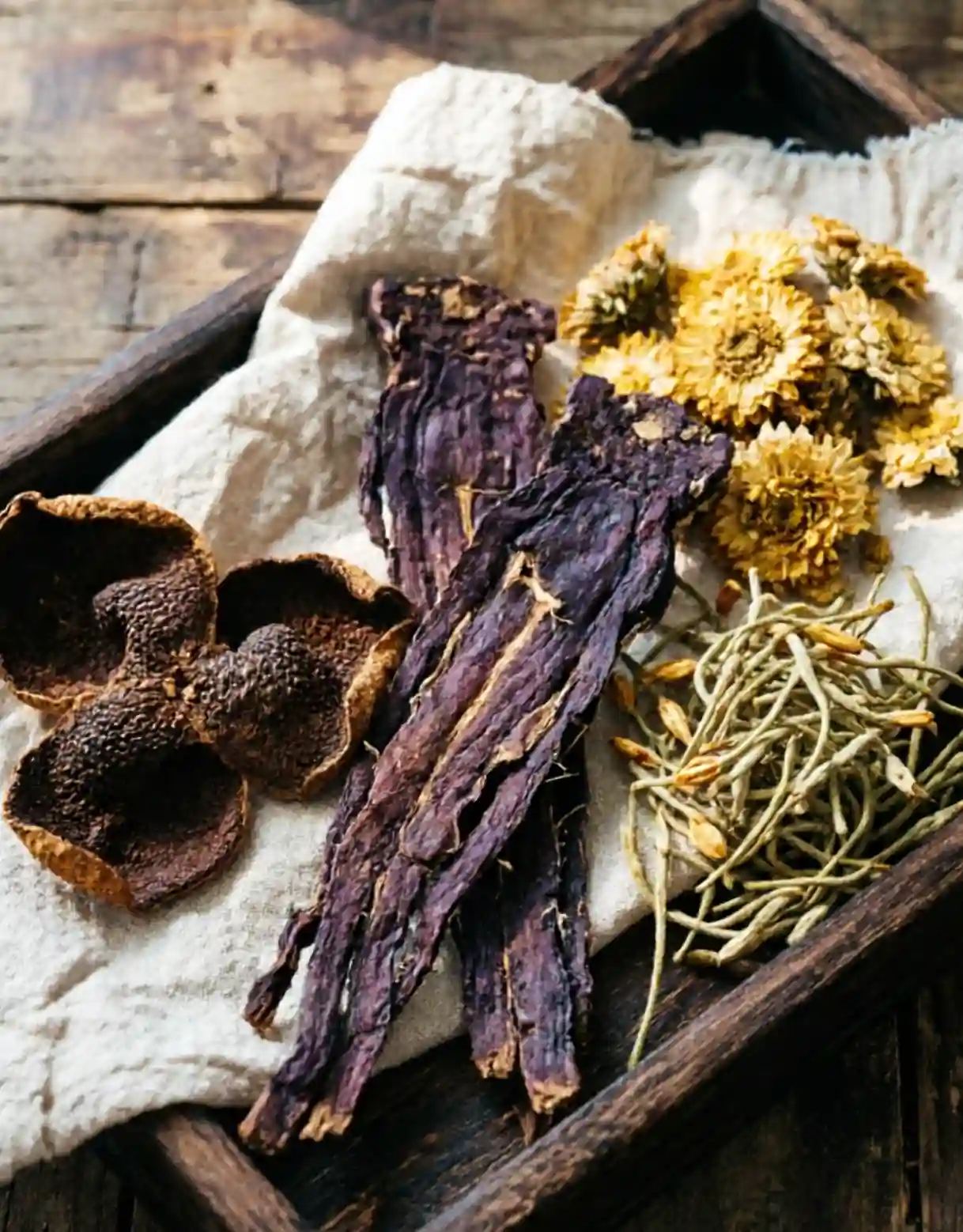
This product is long and rod-shaped. It grows singly or with 2-3 individuals connected at the base, measuring 1-2.5 cm in length and 0.5-1 cm in diameter. The upper end is thicker, while the lower end gradually tapers or has a short stem, and the exterior is covered with numerous scaly bracts. The outer surface of the bracts is purplish-red or pale red, and the inner surface is densely covered with white, cotton-like hairs. The body is light, and when torn open, white hairs can be seen. Odor: aromatic; Taste: slightly bitter and acrid.
Chemical Constituents
This product contains tussilagine, senkirkine, hyperoside,α-11-undecene, 1-undecen-3-ol, tussilagolide, and faradiol and other constituents.
Pharmacology
Has antitussive, expectorant, anti-asthmatic, respiratory stimulant, smooth muscle contractile, vasoconstrictive, heart rate-slowing, and calcium channel-blocking effects, and exhibits carcinogenic activity.
Properties and Channel Entry
Acrid, slightly bitter, and warm. Enters the Lung channel.
Functions and Indications
Moistens the Lungs, descends Qi, stops cough, and transforms Phlegm. Used for acute and chronic cough, wheezing cough with copious phlegm, consumptive cough with hemoptysis.
Dosage and Administration
Internal: decoct in water, 3-10 g; or prepare as concentrated decoction; or make into pills or powder. External: appropriate amount, grind into powder and apply as paste.
Precautions and Contraindications
Patients with Yin deficiency should use with caution.
Prescriptions
1. For Lung deficiency with cough: Renshen, Baizhu, Kuandonghua (stems removed), Gancao (honey-fried), Chuanjiang (processed), Zhongrufen. 15 g each, grind into fine powder, form into pills with honey. Each 30 g makes 10 pills. Take 1 pill with rice beverage before meals. (Chuanxin Shiyong Fang: Kuandonghua Gao) 2. For persistent cough and wheezing, or phlegm with blood: Kuandonghua, Baihe (steamed and baked). Equal parts, grind into fine powder, form into pills with honey, each the size of a Longan. Take 1 pill after meals or before bed, chew finely and swallow with ginger soup; melting in the mouth is even better. (Jisheng Fang: Baihua Gao) 3. For Lung abscess with cough, chest fullness, chills, rapid pulse, dry throat, severe thirst, foul sputum, and eventually purulent sputum like rice water: Kuandonghua (stems removed) 45 g, Gancao (honey-fried) 30 g, Jiegeng 60 g, Yiyiren 30 g. Make into 10 doses, decoct in water and take orally. (Chuangyangke Jingyan Quanshu: Kuanhua Tang) 4. For aphthous ulcers in the mouth: Kuandonghua, Huanglian. Equal parts, grind into fine powder. Mix with saliva to form a paste. First rinse the mouth with a decoction of Shechuangzi, then apply the paste. (Gangmu, quoting Yang Cheng Jingyan Fang) 5. For hemorrhoids and fistulas: Grind Kuandonghua buds into powder, mix with water and apply externally. (Hunan Materia Medica)