Pinyin: Xianhecao
Aliases
Longyacao, Laoguanzui, Qunlanbaiducao
Source
Rosaceae plant *Agrimonia pilosa*.Agrimonia pilosaDried aerial parts of Ledeb.
Botanical Description
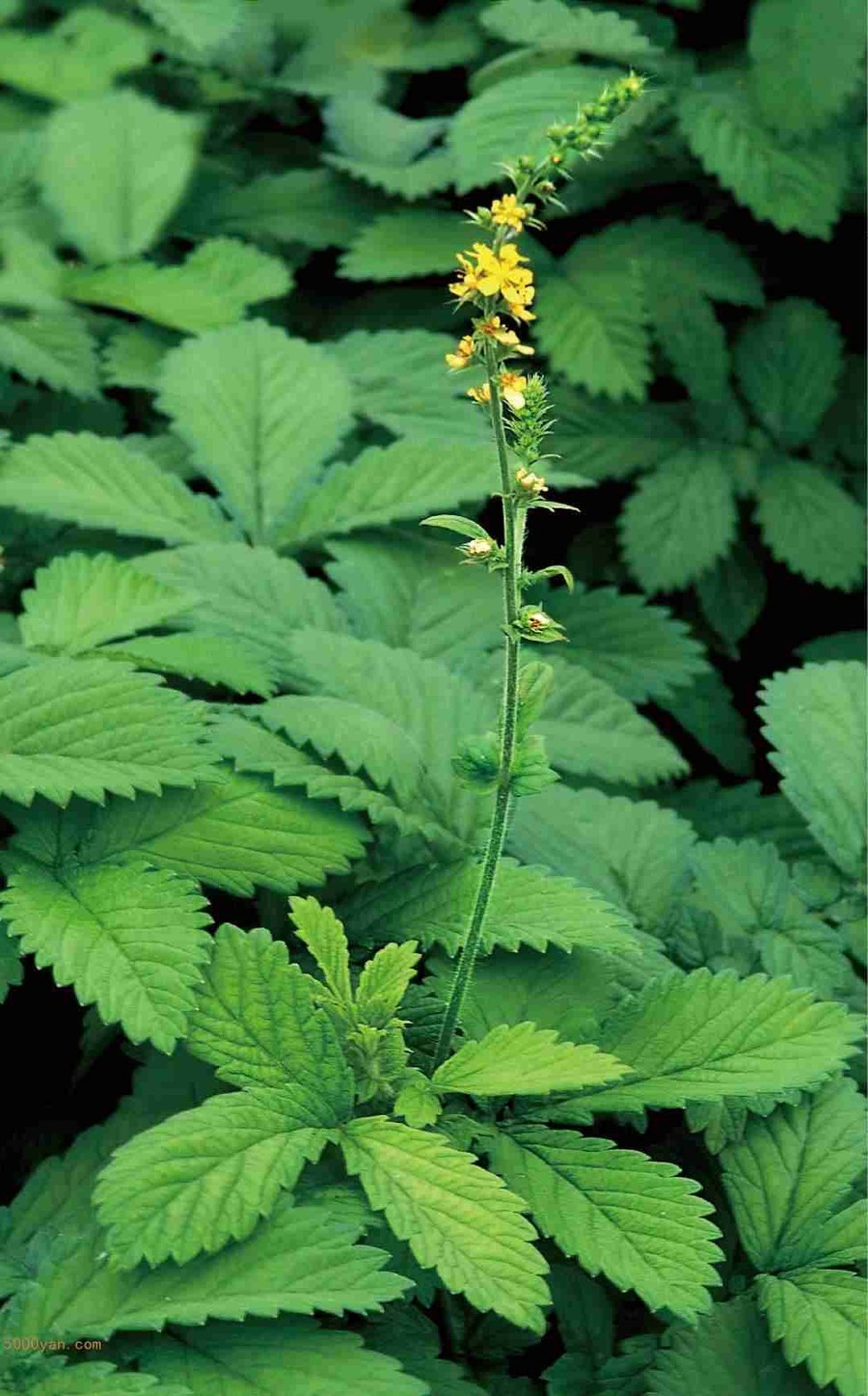
Perennial herb, 30-120 cm tall. Odd-pinnate leaves alternate, stipules falcate, rarely ovate, apex acute to acuminate, margin sharply serrate or lobed, rarely entire; leaflets of two sizes, alternately arranged on the rachis, larger leaflets 3-4 pairs, rarely 2 pairs, reducing upward to 3 leaflets, leaflets nearly sessile, obovate to obovate-lanceolate, 1.5-5 cm long, 1-2.5 cm wide, apex acute to rounded, rarely acuminate, base cuneate, margin sharply to bluntly serrate, upper surface green, sparsely pubescent, lower surface pale green, sparsely pubescent along veins, rarely glabrescent, with conspicuous glandular dots. Racemes solitary or 2-3 at stem apex; bracts usually 3-lobed, lobes linear, bractlets opposite, ovate; sepals 5, triangular-ovate; petals 5, oblong, yellow; stamens 5-15; styles 2, filiform, stigma capitate. Achenes obovoid-conical, with 10 ribs externally, sparsely pubescent, apex with several rows of hooked spines, erect when young, incurved at maturity. Flowering and fruiting period: May to December.
Habitat and Distribution
It grows along streams, roadsides, grasslands, thickets, forest edges, and under sparse forests. It is distributed throughout northern and southern China.
Harvesting and Processing
Harvested in summer and autumn when the stems and leaves are lush, remove impurities, and dry.
Chemical Constituents
This product contains constituents such as kaempferol-7-rhamnoside, rutin, luteolin-7-glucoside, and gallic acid.
Pharmacology
Has anticoagulant and antithrombotic effects; has anti-tumor effects and has a good killing effect on Trichomonas vaginalis.
Properties and Channel Entry
Bitter, astringent, and neutral. Enters the Heart and Liver channels.
Functions and Indications
Converges to stop bleeding, interrupts malaria, stops dysentery, resolves toxicity, and tonifies deficiency. Used for hemoptysis, hematemesis, metrorrhagia and metrostaxis with vaginal bleeding, malaria, bloody dysentery, carbuncles, swellings, sores, and toxins, vaginal itching with leukorrhea, and fatigue from overexertion.
Dosage and Administration
Oral administration: decoct in water, 10-15 g, for large doses 30-60 g; or prepared as powder. External use: appropriate amount, crushed for application; or made into paste for application.
Prescriptions
1. For hematuria: Xianhecao (Herba Agrimoniae), Daji (Radix Cirsii Japonici), and Mutong (Caulis Akebiae) 9 g each, Maogen (Rhizoma Imperatae) 30 g. Decoct in water for oral administration. (Ningxia Zhongcaoyao) 2. For hematochezia: Xianhecao (dried, fried with mussel powder), Huaihua (Flos Sophorae Immaturus), and Baiyaojian, grind into powder. Take 9 g each time, mix with rice-washed water, take on an empty stomach. (Weisheng Yijian Fang) 3. For red and white dysentery, hemoptysis, and hematemesis: Xianhecao 9-18 g. Decoct in water for oral administration. (Lingnan Caiyao Lu) 4. For heatstroke: Xianhecao whole herb 30 g. Decoct in water for oral administration. (Hunan Yaowu Zhi) 5. For acute mastitis (resolves early cases, causes suppuration in pus-formed cases, and minimizes pus discharge): Xianhecao 30 g, half a pot of white wine, decoct to half a bowl, take after a full meal. (Baicao Jing)