Pinyin: Jinqiancao
Aliases
Da jinqian cao, dui zuo cao, wu gong cao, huang dan cao.
Source
Plant belonging to the Primulaceae family, Lysimachia christinae Hance.Lysimachia christinaeHance.
Botanical Description
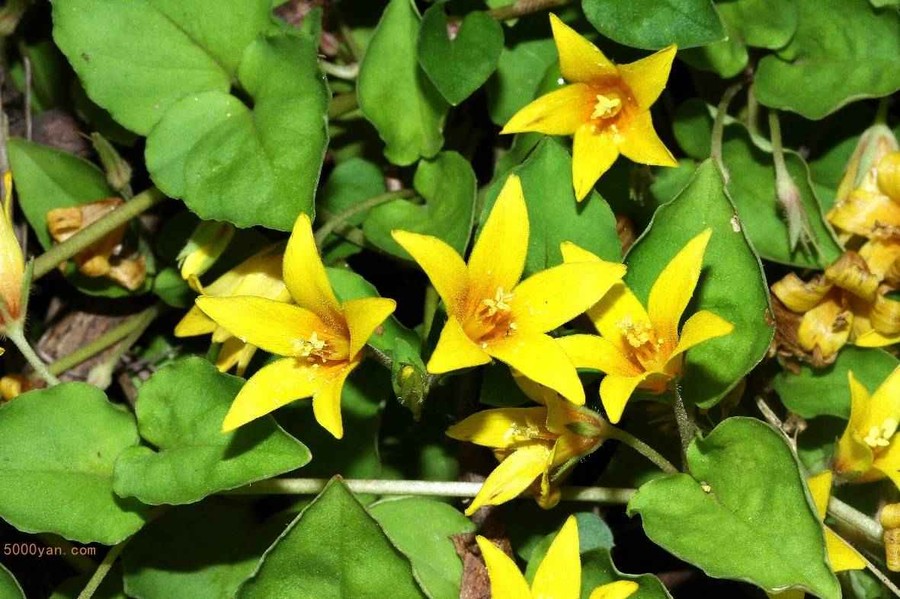
Perennial vine herb. Stems slender, prostrate and spreading, 20-60 cm long, surface gray-green or with reddish purple, glabrous or sparsely hairy throughout, densely covered with brown sessile glands on young parts, lower internodes shorter, often producing adventitious roots, middle internodes 1.5-5 (-10) cm long. Leaves opposite; petiole 1-3 cm long, glabrous; leaf blade ovate, suborbicular to reniform, (1.5-) 2-6 (-8) cm long, 1-4 (-6) cm wide, apex acute or rounded to obtuse, base truncate to shallowly cordate, slightly fleshy, translucent with dense transparent glandular spots, turning black when dry, both surfaces glabrous, with glandular hairs. Flowers solitary in leaf axils; pedicel 1-5 cm long, usually not exceeding leaf length; calyx 5-lobed to near base, lobes lanceolate, elliptic-lanceolate to linear or slightly expanded above and nearly spatulate, apex acute or slightly obtuse. Corolla yellow, rotate-campanulate, 7-15 mm long, 5-lobed, lobes narrowly ovate to nearly lanceolate, apex acute or obtuse, with black elongate glandular stripes; stamens 5, filaments 6-8 mm long, lower half fused into a tube, anthers ovoid, 1-1.5 mm long; ovary ovoid, style 6-8 mm long. Capsule globose, 3-5 mm in diameter, glabrous, with sparse black glandular stripes, valvularly dehiscent. Flowering May-July, fruiting July-October.
Habitat and Distribution
Grows on slopes, roadsides, ditches, and at the edges of forests in relatively shaded and damp areas, with vertical distribution up to an altitude of 2300 m. Distributed in Central and South China, Southwest China, as well as Shanxi, Shaanxi, Gansu, Jiangsu, Anhui, Zhejiang, Jiangxi, and Fujian.
Harvesting and Processing
Harvested in summer and autumn, remove impurities, and dry in the sun.
Chemical Constituents
This product contains quercetin, isoquercitrin, kaempferide, kaempferol, and kaempferol-3-Ogalactoside, kaempferol-3-O- pearl vegetable trisaccharide glycoside, kaempferol-3-O- Glucoside.
Pharmacology
It has lithotriptic (stone-expelling) and anti-inflammatory effects; inhibits cellular immunity and humoral immunity; enhances the phagocytic function of macrophages in mice; relaxes vascular smooth muscle; and also has a certain inhibitory effect on human platelet aggregation induced by ADP and arachidonic acid in vitro.
Properties and Channel Entry
Sweet, salty, and slightly cold. Enters the Liver, Gallbladder, Kidney, and Urinary Bladder channels.
Functions and Indications
Drains Dampness and alleviates jaundice, promotes urination and relieves painful urinary dribbling, resolves toxicity and reduces swelling. Used for Damp-Heat jaundice, gallbladder distension with rib-side pain, stone stranguria, heat stranguria, painful and difficult urination, abscesses, furuncles, and snake or insect bites.
Dosage and Administration
Oral: decoct 15-60 g (double if fresh); or crush for juice. External: apply appropriate amount of fresh crushed herb topically.
Precautions and Contraindications
For patients with rheumatic arthritis and frozen shoulder, using the fresh product decocted in water for fumigation and washing may cause contact dermatitis.
Prescriptions
1. For cholelithiasis: Lysimachia 60 g, chicken gizzard membrane 18 g. Grind into fine powder, take in 3 divided doses with boiling water. (Fujian Materia Medica) 2. For cholecystitis: Lysimachia 45 g, Polygonum cuspidatum root 15 g. Decoct in water for oral administration. If pain is present, add Curcuma aromatica 15 g. (National Chinese Herbal Medicine Compilation) 3. For acute icteric hepatitis: Lysimachia 90 g, Artemisia capillaris 45 g, Isatis indigotica root 15 g. Decoct in water, add appropriate amount of sugar, take in 3 divided doses daily for 10-15 doses. (New Edition of Southern Zhejiang Herbal Medicine) 4. For urinary stone: Lysimachia and Plantago asiatica 9-15 g each, decoct in water for oral administration. (Guizhou Herbal Medicine) 5. For toxic swelling: Lysimachia and Sophora flavescens. Pound into paste and apply topically. (Hunan Materia Medica) 6. For furuncle: Squeeze juice from fresh Lysimachia, mix with rice-washing water or strong liquor and take orally. (Hunan Materia Medica) 7. For abdominal edema: Appropriate amount of fresh Lysimachia, pound into paste and apply to the navel area. (Shanghai Commonly Used Chinese Herbal Medicine)