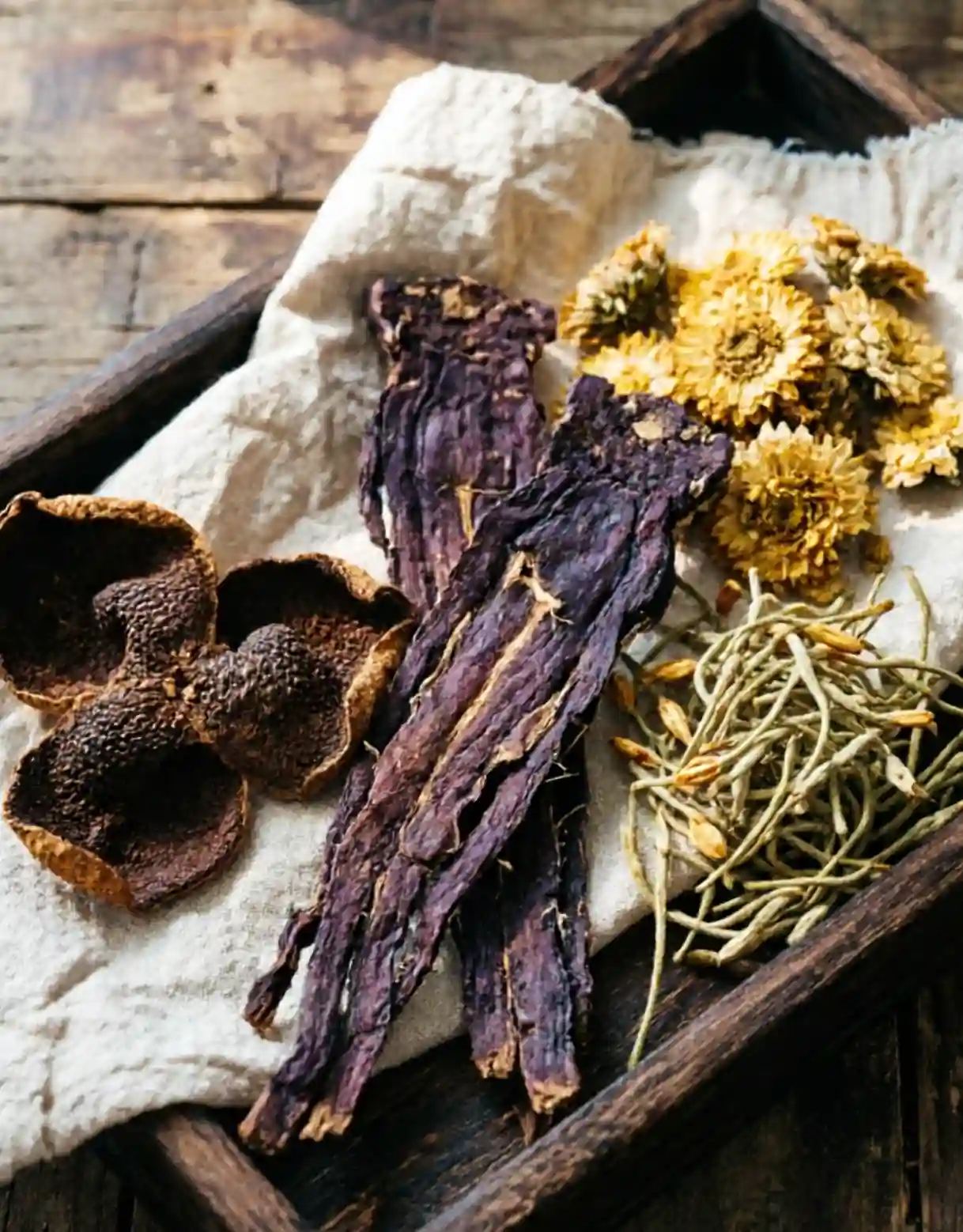
Pinyin: Zuiyucao
Aliases
Yuweicao, Huaimu, Naoyuhua, Sifangma.
Source
Plant of the Buddlejaceae family, Buddleja lindleyana.Buddleja lindleyanaDried stem and leaves of Fort.
Botanical Description
Deciduous shrub, 1-2.5 m tall. Bark tea-brown, multi-branched, branchlets quadrangular with narrow wings. Both sides of the ridges covered with short white pubescence, becoming glabrous with age. Leaves opposite, simple; petiolate, petiole densely pubescent; leaf blade papery, ovate to oblong-lanceolate, 3-8 cm long, 1.5-3 cm wide, apex acute, base cuneate, margin entire or sparsely serrate; young leaves densely yellow-tomentose on both surfaces, becoming glabrous with age. Spike terminal, 18-40 cm long, flowers inclined to one side; calyx tubular, 4- or 5-lobed, densely scaly; corolla slender tubular, slightly curved, purple, about 15 mm long, outer surface with white shiny fine scales, inner surface with white fine pubescence, apex 4-lobed, lobes ovate; stamens 4, filaments short, adnate; pistil 1, style linear, stigma 2-lobed, ovary superior. Capsule oblong, about 5 mm long, scaly, splitting into 2 valves at maturity, base with persistent calyx. Seeds minute, brown. Flowering April to July, fruiting October to November.
Habitat and Distribution
Growing at altitudes of 200-2700 m on slopes, forest edges, or riverbanks and soil ridges. Distributed in Southwest China and Jiangsu, Anhui, Zhejiang, Jiangxi, Fujian, Hubei, Hunan, Guangdong, Guangxi, and other regions.
Harvesting and Processing
Harvested in summer and autumn, cut into pieces, and dried in the sun or used fresh.
Chemical Constituents
The whole plant contains buddleoside and other constituents.
Pharmacology
Has insecticidal effects and has inhibitory effects on Staphylococcus aureus.
Properties and Channel Entry
Acrid, bitter, warm in nature, and toxic.
Functions and Indications
Expels Wind, resolves toxicity, expels parasites, and transforms lodged fish bones. Indications: mumps, abscesses, scrofula, ascariasis, hookworm disease, and various fish bones stuck in the throat.
Dosage and Administration
Internal: decoct in water, 10-15 g, fresh product 15-30 g; or crush for juice. External: appropriate amount, crush for topical application.
Precautions and Contraindications
Oral use should not be excessive, otherwise it may cause toxic reactions such as dizziness, vomiting, dyspnea, numbness of the limbs, and tremors.
Prescriptions
1. For mumps: Zuicao 15 g, Fengqiu 7 pieces, Qicai 9 g. Boil with eggs and eat. (From "Hunan Materia Medica") 2. For scrofula: Zuicao whole herb 30 g. Decoct in water and take orally. (From "Hunan Materia Medica") 3. For yin-type abscess: fresh Zuicao leaves. Mash with wine or vinegar and apply to the affected area. (From "Fujian Chinese Herbal Medicine") 4. For wind-cold toothache: fresh Zuicao leaves with a little salt, mash to extract juice and use as a mouth rinse. (From "Fujian Chinese Herbal Medicine")

