Pinyin: Shenjincao
Aliases
Kuanjinteng, Choujincao, Shizicao.
Source
Plant from the Lycopodiaceae family: Lycopodium clavatum.Lycopodium japonicumThunb. dry whole plant.
Botanical Description
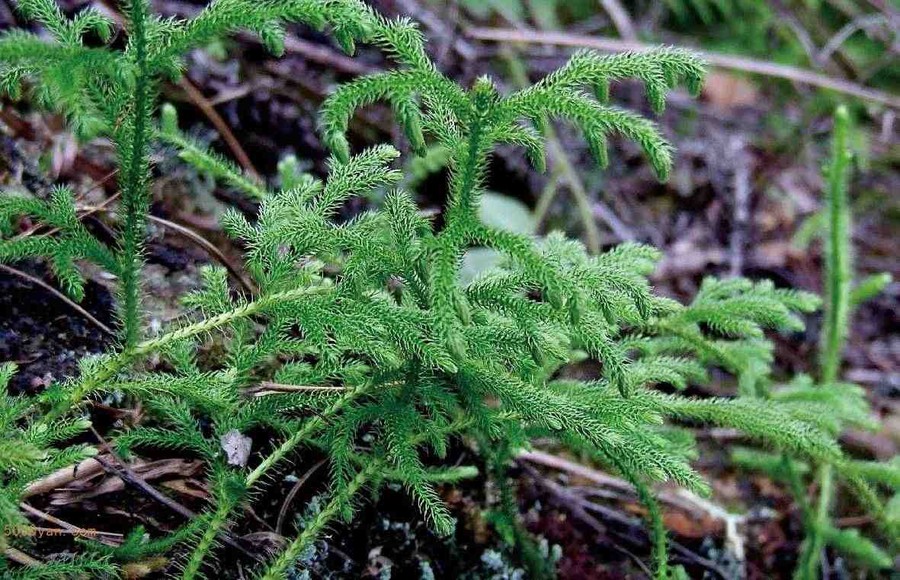
The main stem is prostrate, 2-3 m long, with erect lateral branches up to 15 cm high, approximately 6 mm in diameter, and dichotomously branched multiple times. The branches of the main stem diverge at obtuse angles, forming a broad fork, with the ultimate branchlets spreading widely in a "Y" shape pointing to both sides; branchlets are 3-5 mm in diameter. Leaves are spirally arranged, linear-lanceolate, 3-5 mm long, 0.3-0.8 mm wide, with a broad base, acuminate apex bearing a broken membranous long awn, entire margin, and papery texture. Strobili are cylindrical, 3-6 borne at the tips of fertile branches, 3-5 cm long, approximately 0.5 cm wide; sporophylls are rhomboid-ovate, about 2 mm long, about 1.5 mm wide, with an awned apex and erose margins, membranous. Sporangia are borne in the axils of sporophylls, reniform, yellow, about 0.8 mm long, about 1.5 mm wide, and 0.5 mm thick.
Habitat and Distribution
It grows on slopes, grasslands, in thickets, or under pine forests on acidic soil
Harvesting and Processing
Harvested in summer and autumn when the stems and leaves are lush, remove impurities and dry in the sun.
Chemical Constituents
This product contains lycopodine, nicotine,α- Contains components such as ononitol and 16-oxo-lycopodatrienol.
Properties and Channel Entry
Slightly bitter and pungent, warm. Enters the Liver, Spleen, and Kidney channels.
Functions and Indications
Expels Wind and eliminates Dampness, relaxes tendons and activates collaterals. Used for joint soreness and pain, and difficulty in flexion and extension.
Dosage and Administration
Oral: decoct in water, 9-15 g; or steep in wine. External use: appropriate amount, mash for topical application.
Precautions and Contraindications
Pregnant women and those with excessive bleeding should use with caution.
Prescriptions
1. For joint pain: Lycopodium japonicum 9 g, Polygonum cuspidatum rhizome 15 g, Sargentodoxa cuneata 9 g. Decoct in water for oral administration. (Zhejiang Folk Commonly Used Herbal Medicine) 2. For joint pain and numbness of hands and feet: Lycopodium japonicum 30 g, Luffa vegetable sponge 15 g, Parthenocissus tricuspidata 15 g, Sargentodoxa cuneata 9 g. Decoct half in water and half in wine for oral administration. (Jiangxi Chinese Materia Medica) 3. For hepatitis, jaundice, and dysentery: Lycopodium japonicum 50 g, decoct in water. Take in 2 divided doses per day. (Changbai Mountain Plant Medicine Journal) 4. For pulmonary tuberculosis cough: Lycopodium japonicum, Ardisia japonica, and Eriobotrya japonica leaf 9 g each. Decoct in water for oral administration. (Hunan Materia Medica) 5. For traumatic injury: Lycopodium japonicum 15 g, Caesalpinia sappan, Eupolyphaga sinensis 9 g each, Carthamus tinctorius 6 g. Decoct in water for oral administration. (Shaanxi-Gansu-Ningxia-Qinghai Selection of Chinese Herbal Medicines) 6. For pain from sprains and contusions: Lycopodium japonicum, Sargentodoxa cuneata, and Achillea alpina 60 g each, Carthamus tinctorius 18 g. Soak in white liquor and take orally. Each dose 9-15 g, 2 times daily. (Sichuan Journal of Chinese Materia Medica, 1982) 7. For herpes zoster: Lycopodium japonicum (roasted) ground into powder, mix with vegetable oil or sesame oil to form a paste, apply to the affected area, several times daily. (Zhejiang Folk Commonly Used Herbal Medicine)