Pinyin: Machixian
Aliases
Machicao, Changmingxian, Changshoucai.
Source
Portulacaceae plant *Portulaca oleracea*Portulaca oleraceaL. of the dried aerial parts.
Botanical Description
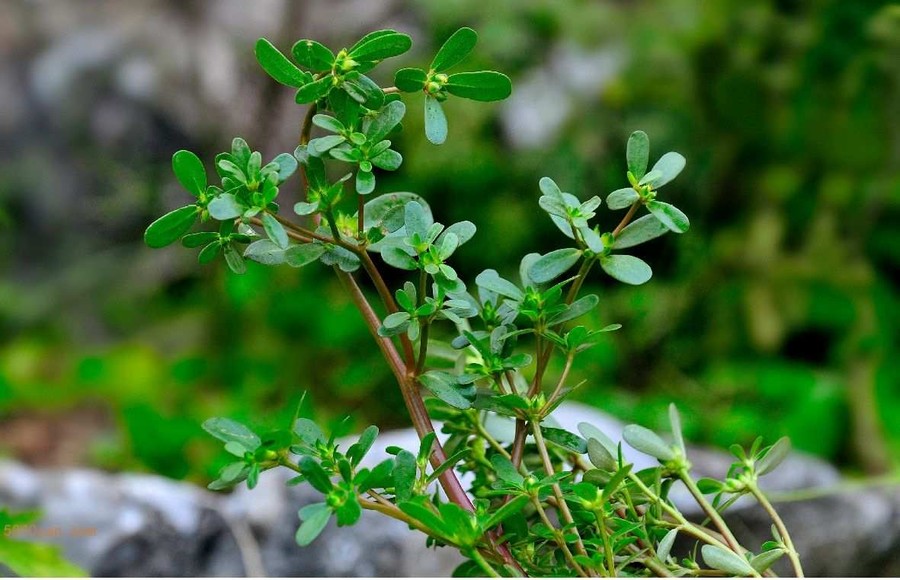
Annual herb, fleshy and succulent, glabrous (hairless), 10-30 cm tall. Stem cylindrical, lower portion prostrate, upper portion ascending or erect, much branched, often with pale brownish-red color on sunny side. Leaves alternate or subopposite; obovate, oblong, or spatulate, 1-3 cm long, 5-15 mm wide, apex rounded and obtuse, sometimes slightly emarginate, base narrowed into a short petiole, green above, dark red beneath. Flowers usually 3-5 clustered at branch tips; involucral bracts 4-5, triangular-ovate; sepals 2, opposite, ovate; petals 5, pale yellow, obovate, base adnate to the ovary with sepals; stamens 8-12, anthers yellow; pistil 1, ovary semi-inferior, style 4-5 cleft, linear, exserted beyond stamens. Capsule short-conical, about 5 mm long, brown, circumscissile. Seeds black, about 1 mm in diameter, surface minutely dotted. Flowering period May to August, fruiting period July to October.
Habitat and Distribution
It grows in sunny areas such as fields, roadsides, and garden ruins. Distributed throughout China.
Harvesting and Processing
Harvested in summer and autumn, remove residual roots and impurities, wash clean, steam or blanch briefly, then dry in the sun.
Chemical Constituents
This product contains alanine, betaxanthin, betanin, isobetaxanthin, isobetanin, norepinephrine, and other components.
Pharmacology
It has the effect of contracting the uterus; affects the cardiovascular and respiratory systems; exhibits a biphasic effect on skeletal muscle, increasing the tension, amplitude, and frequency of small intestinal contractions, although there are also reports that the decoction of this product has an inhibitory effect on the isolated small intestine of guinea pigs; antibacterial action; cholesterol-lowering effect. It can promote the normalization of epithelial cell function and the healing of ulcers. It has a diuretic effect.
Properties and Channel Entry
Sour, cold. Enters the Liver and Large Intestine channels.
Functions and Indications
Clears Heat and resolves toxicity, cools Blood and stops bleeding, and stops dysentery
Dosage and Administration
Internal use: decoction, 10-15 g, fresh product 30-60 g; or extract juice
Precautions and Contraindications
Those with Spleen deficiency and loose stools, as well as pregnant women, should use with caution.
Prescriptions
1. For whooping cough: Machixian 30 g, Baibu 10 g. Decoct in water, add white sugar and take. (Sichuan Chinese Materia Medica, 1979) 2. For pulmonary tuberculosis: fresh Machixian 45 g, Guizhencao and Hulucha 15 g each. Decoct in water and take orally. (Fujian Materia Medica) 3. For anal swelling and pain: Machixian leaves and Sanzisuancao in equal parts. Decoct in water for fumigation and washing, twice daily, effective. (Binhu Ji Jian Fang) 4. For hematuria and bloody stools: fresh Machixian juice and lotus root juice in equal amounts. Take half a cup (about 60 g) each time, mixed with rice water. (Food Chinese Medicine and Prescriptions) 5. For hemorrhoids and fistulae: decoct Machixian with Huajiao. Wash 3-5 times for effect. (Zhong Xing Xian Fang) 6. For cold-damp painful impediment: mash fresh Machixian into a paste, apply hot to the affected area; also pound to extract juice, cook with wine, and take immediately for immediate effect. (He Shi Ji Sheng Lun) 7. For jaundice: fresh Machixian juice. Take about 30 g each time, mixed with boiling water, twice daily. (Food Chinese Medicine and Prescriptions)