Pinyin: Sanbaicao
Aliases
Shuǐ mù tōng, Bái huā zhào shuǐ lián, Bái yè lián.
Source
Saururaceae plant *Saururus chinensis* (Lour.) Baill.Saururus chinensisThe dried aerial part of (Lour.) Baill.
Botanical Description
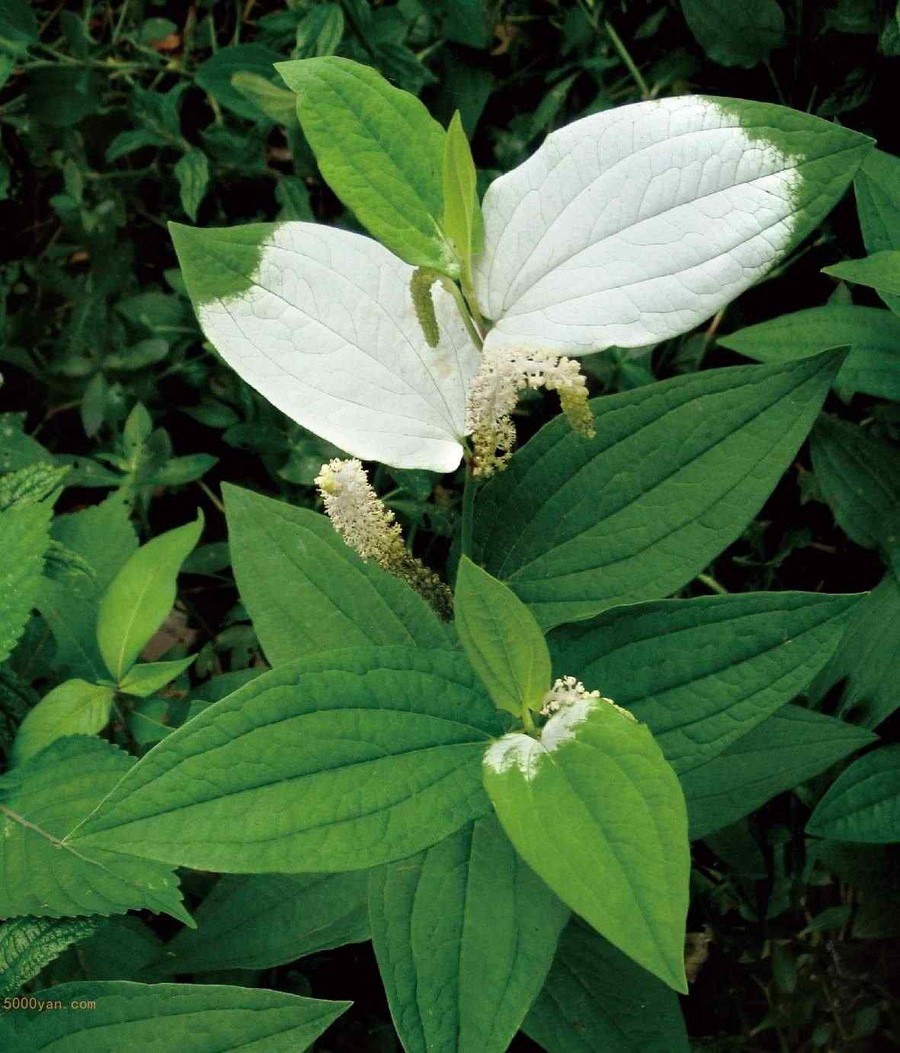
A perennial wetland herb, up to 1 m tall. The underground stem bears fibrous small roots; the stem is erect, stout, and glabrous (hairless). Leaves are simple, alternate, papery, and densely glandular-punctate; petioles 1-3 cm long, the base united with stipules into a sheath, slightly clasping the stem; leaf blades broadly ovate to ovate-lanceolate, 5-14 cm long, 3-7 cm wide, apex shortly acute to acuminate, base cordate, slightly auriculate or oblique, margin entire, both surfaces glabrous; 2-3 leaves below the inflorescence often turn white in early summer, becoming petaloid. Racemes terminal, opposite the leaves, 10-20 cm long, white; rachis and pedicels pubescent; bracts nearly spatulate to oblanceolate, about 2 mm long; flowers bisexual, without a perianth; stamens 6, anthers oblong, slightly shorter than the filaments; pistil 1, composed of 4 carpels, ovary globose, stigmas 4, recurved outward. Capsule subglobose, about 3 mm in diameter, surface with many verrucose protuberances, dehiscent at the apex when mature. Seeds numerous, rounded. Flowering May to August, fruiting June to September.
Habitat and Distribution
Grows near ditches, ponds, and other aquatic environments. Distributed in Hebei, Henan, Shandong, the Yangtze River basin, and areas south of it.
Harvesting and Processing
It can be harvested throughout the year, washed clean, and dried in the sun.
Chemical Constituents
This product primarily contains quercetin, quercitrin, isoquercitrin, hyperoside, and sauchinone.
Pharmacology
Has central inhibitory and antipsychotic effects.
Properties and Channel Entry
Sweet, pungent, cold. Enters the Lung and Urinary Bladder channels.
Functions and Indications
Diuresis to reduce edema, clears Heat and resolves toxicity
Dosage and Administration
Oral: decocted in water, 10-30 g; fresh product double the amount
Precautions and Contraindications
Those with Spleen and Stomach deficiency-cold should use with caution.
Prescriptions
1. For urinary tract infection with heat stranguria and blood stranguria: 15 g of Saururus chinensis, 30 g each of Plantago asiatica, Commelina communis, and Imperata cylindrica. Decoction for oral administration. ("Anhui Chinese Herbal Medicine") 2. For bacterial dysentery: 30 g each of Saururus chinensis and Portulaca oleracea. Decoction for oral administration. ("Anhui Chinese Herbal Medicine") 3. For snake bite: Mash the stems and leaves of Saururus chinensis and apply externally to the affected area. ("Hunan Materia Medica") 4. For reddish and whitish leukorrhea: 15 g each of Saururus chinensis, Oenanthe javanica, and Celosia cristata. Decoction for oral administration. ("Anhui Chinese Herbal Medicine") 5. For early-stage boils and furuncles: 15 g of Saururus chinensis and 30 g of Houttuynia cordata. Decoction for oral administration. Also, take Saururus chinensis leaves, add an appropriate amount of tung oil, mash, and apply externally. ("Anhui Chinese Herbal Medicine") 6. For insufficient lactation: 30 g of Saururus chinensis and 2 pig trotters. Boil in water until the meat is tender. Drink the soup and eat the meat. ("Anhui Chinese Herbal Medicine") 7. For hypertension: 15-30 g of Saururus chinensis, decoction for oral administration. ("Anhui Chinese Herbal Medicine")