Pinyin: Cujiangcao
Aliases
San Ye Suan, Suan Mi Mi Cao, Pu Di Lian.
Source
The plant is from the Oxalidaceae family, specifically the species *Oxalis corniculata* L.Oxalis corniculataL. of the dried whole plant.
Botanical Description
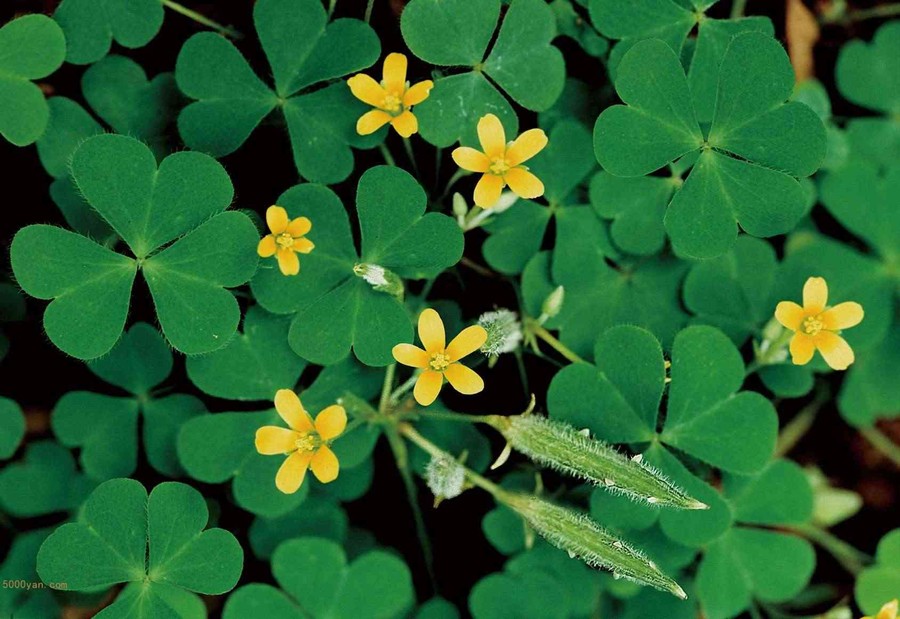
Perennial herb. Rhizome slender, stem thin and weak, often brown, creeping or oblique, much branched, covered with soft hairs. Petiole 2-6.5 cm long; stipules distinct; leaflets 3, obcordate, 4-10 mm long, apex emarginate, base broadly cuneate, glabrous above, sparsely appressed hairy beneath, with denser hairs on veins, margin with appressed ciliate hairs; sessile. Flowers solitary or several in axillary umbels; pedicels as long as petioles; flowers yellow, sepals long-ovate-lanceolate, about 4 mm long, apex obtuse; petals obovate, about 9 mm long, apex rounded, base slightly connate; stamens with filaments connate at base into a tube; styles 5. Capsule nearly cylindrical, 1-1.5 cm long, slightly 5-angled, beaked, dehiscing elastically when ripe; seeds dark brown, nearly ovate and compressed, with longitudinal grooves. Flowering period May to August, fruiting period June to September.
Habitat and Distribution
Grows in wastelands, fields, and roadsides. Distributed throughout most regions of the country.
Harvesting and Processing
Can be harvested year-round, preferably in summer and autumn, wash clean and use fresh or sun-dry.
Chemical Constituents
This product mainly contains ascorbic acid, dehydroascorbic acid, vitexin, isovitexin, 2-heptenal and other components.
Properties and Channel Entry
Sour, cold. Enters the Liver, Lung, and Bladder channels.
Functions and Indications
Clears Heat and eliminates Dampness, cools Blood and disperses stasis, resolves toxicity and reduces swelling. Indicated for Damp-Heat diarrhea, dysentery, jaundice, stranguria, leukorrhea, hematemesis, epistaxis, hematuria, irregular menstruation, traumatic injury, sore throat, carbuncles, furuncles, erysipelas, eczema, scabies, hemorrhoids, measles, scalds and burns, and snake or insect bites.
Dosage and Administration
Internal: decoct in water, 9-15 g, fresh product 30-60 g; or grind into powder; or extract fresh juice for drinking. External: appropriate amount, wash with decoction, apply mashed, apply extracted juice, or rinse the mouth with decoction.
Precautions and Contraindications
Pregnant women and those with weak constitution should use with caution.
Prescriptions
1. For cough: *Oxalis corniculata* (honey-fried) 9 g, *Morus alba* bark (honey-fried) 3 g. Decoction in water for oral administration. (*Shaanxi Chinese Herbal Medicine*) 2. For cough and dyspnea: Fresh *Oxalis corniculata* 30 g, *Aster tataricus* 9 g. Decoction for oral administration. (*Anhui Chinese Herbal Medicine*) 3. For postpartum abdominal pain: Fresh whole plant of *Oxalis corniculata* 30 g, egg 3 pieces, wine appropriate amount. Decoction in water, take in 3 divided doses. (*Zhuang Folk Medicine Selected*) 4. For icteric hepatitis: *Oxalis corniculata* 15-30 g. Decoction in water for oral administration; or use fresh herb pounded with rice-washed water to extract juice, take 1 dose daily. (*New Compilation of Southern Zhejiang Herbal Medicine*) 5. For uterine bleeding with dribbling discharge: Fresh *Oxalis corniculata* 60 g. Pound to extract juice, add appropriate brown sugar and stew for oral administration. (*Henan Chinese Herbal Medicine Manual*) 6. For acute mastitis: *Oxalis corniculata* and *Kalimeris indica* 30 g each. Decoction in water for oral administration. Mash the dregs and apply to the affected area. (*Henan Chinese Herbal Medicine Manual*) 7. For rectal prolapse: Appropriate amount of fresh *Oxalis corniculata*, decoct in water for fumigation and washing of the affected area. (*Qingdao Chinese Herbal Medicine Manual*)