Pinyin: Laoguancao
Aliases
Wǔyè Cǎo, Wǔbàn Huā, Pò Tóngqián
Source
Herb from the Geraniaceae family: *Erodium stephanianum* Willd.Erodium stephanianumWilld. dried aerial parts.
Botanical Description
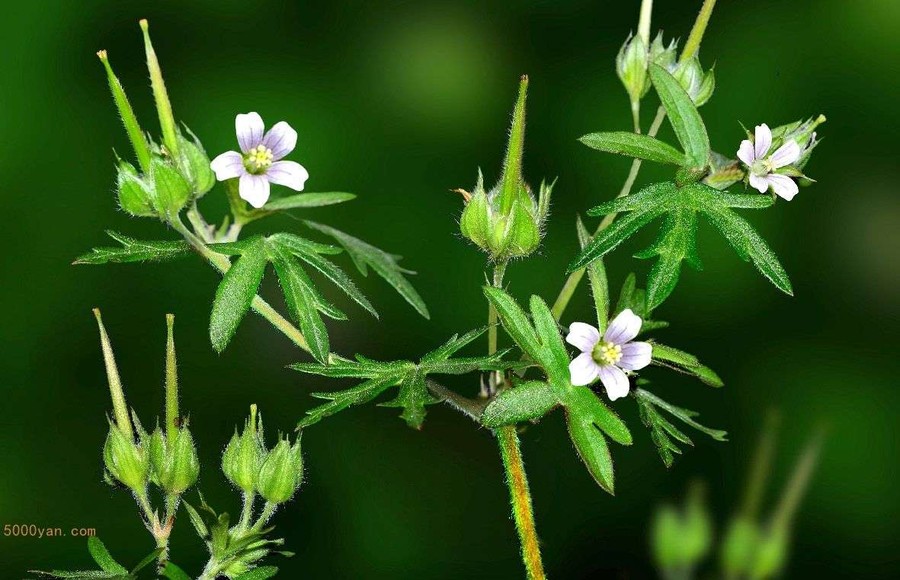
Annual or biennial herb, 10-50 cm tall. Stems prostrate or ascending, much branched, pubescent. Leaves opposite; petiole 4-6 cm long; stipules lanceolate, 5-10 mm long, margin membranous; leaf blades ovate-oblong or oblong-triangular, 4-6 cm long, 3-4 cm wide, bipinnately deeply divided, with 5-9 pairs of pinnae, decurrent at base. Umbels axillary; sepals oblong, apex mucronate, pedicel 2-3 cm long; petals 5, obovate, pale purple or blue-purple; stamens 10, in 2 whorls, outer 5 without anthers, inner 5 with anthers; nectaries 5; ovary densely white villous. Capsule 3-4 cm long, apex with long beak, at maturity 5 carpels separate from central axis, beak spirally twisted, inner side with brown hairs. Flowering April to August, fruiting June to September.
Habitat and Distribution
Born on hillsides, grasslands, field ridges, roadsides, and near village dwellings. Distributed in Northeast, North, Northwest, Central China, as well as western Yunnan and Tibet.
Harvesting and Processing
Harvested by cutting in summer and autumn when the fruit is nearly ripe, bundled into sheaves, and dried in the sun.
Chemical Constituents
This product contains geraniol, scyllitol, kaempferol, gallic acid, quercetin, brevifolin, corilagin, geraniin, and kaempferitrin, among other constituents.
Pharmacology
Has antiviral and antibacterial effects; has anti-inflammatory effects; can reduce serum and hepatic lipid peroxide concentrations, lowering elevated aspartate aminotransferase and alanine aminotransferase levels; has antitussive and antimutagenic effects, exhibits inhibitory effects on carcinogens and antioxidant activity.
Properties and Channel Entry
Acrid, bitter, neutral. Enters the Liver, Kidney, and Spleen channels.
Functions and Indications
Expels Wind-Dampness, unblocks the channels and collaterals, and stops diarrhea and dysentery
Dosage and Administration
Oral: decocted in water, 9-15 g; or steeped in wine; or made into a paste
Prescriptions
1. For rheumatic pain: 250 g of *Geranium wilfordii*, 18 g each of *Ramulus Cinnamomi*, *Radix Angelicae Sinensis*, *Radix Paeoniae Rubra*, and *Flos Carthami*, 1000 ml of wine, macerate for 1 week, filter. Take 1 small cup each time, 2 times daily. (Zhejiang Flora of Medicinal Plants) 2. For numbness of skin and sciatica: Appropriate amount of fresh *Geranium wilfordii*, decoct in water to a thick decoction, remove dregs, filter, add sugar to form an extract. Take 9-15 g each time, 2 times daily, taken with warm water. (Sichuan Chinese Materia Medica, 1982, *Geranium wilfordii* Extract) 3. For lumbar sprain: 30 g of *Geranium wilfordii* root, 15 g of *Lignum Sappan*, decoct in water, add 9 g of *Crinis Carbonisatus*. Take as a draft, 1 dose daily, 2 times daily. (National Compilation of New Chinese Medicine Therapies Exhibition Materials) 4. For acute and chronic enteritis and dysentery: 18 g of *Geranium wilfordii*, 9 red dates. Decoct to a concentrated decoction, divide into 3 portions and take throughout the day. (Modern Practical Chinese Medicine) 5. For sore throat: 15-30 g of *Geranium wilfordii*, decoct in water and use as a gargle. (Zhejiang Flora of Medicinal Plants) 6. For early-stage sores and toxins: Appropriate amount of fresh *Geranium wilfordii*. Pound to extract juice or decoct to a concentrated juice, apply to the affected area. (Zhejiang Flora of Medicinal Plants) 7. For snake and insect bites: Fresh *Geranium wilfordii*, a small amount of *Realgar* powder, pound, and apply externally around the wound. (Sichuan Chinese Materia Medica, 1982)