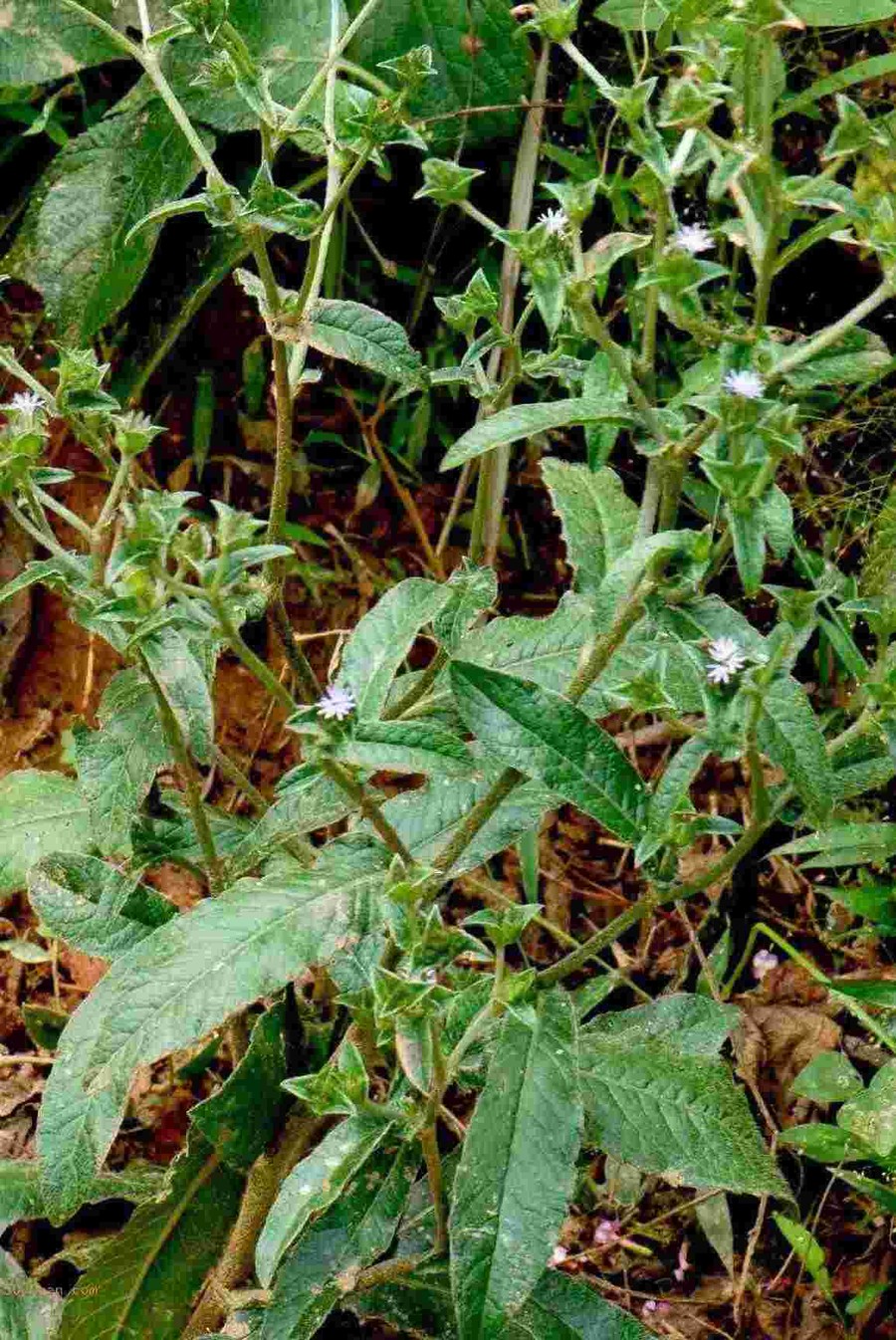
Pinyin: Kudidan
Aliases
Ku Long Dan Cao, Cao Xie Di, Tie Deng Tai.
Source
1. For pneumonia: Renshen 6 g, decoct in water and take orally.Eleph-antopus scaberDried whole herb of L.
Botanical Description
Perennial herb, 30-60 cm tall. Rhizome prostrate or ascending; stem erect, dichotomously branched, stems and branches covered with white coarse hairs. Leaves simple, mostly basal; leaf blade spoon-shaped, oblong-spoon-shaped or oblong-lanceolate, 5-18 cm long, 2-4 cm wide, apex obtuse-rounded, base gradually narrowed, margin with rounded serrations, both surfaces with white long coarse hairs, more densely hairy along veins and leaf margins below. Capitulum with about 4 florets; numerous capitula densely aggregated into a compound capitulum; corolla tubular, pale purple; all florets bisexual, apex 4-lobed, split on one side. Achenes ribbed, covered with white soft hairs, apex with long stiff bristles. Flowering from July to November, fruiting from November to February of the following year.
Habitat and Distribution
Grows on mountain slopes, roadsides, and in sparse forests of valleys. Distributed in Jiangxi, Fujian, Taiwan, Guangdong, Guangxi, Guizhou, and Yunnan, among other regions.
Harvesting and Processing
Harvested in late summer, washed clean, used fresh or dried in the sun.
Chemical Constituents
This product mainly contains epifriedelinol, lupeol, stigmasterol, lupeol acetate, deoxyelephantopin, isodeoxyelephantopin, elephantopin, and deoxyelephantopin lactone, among other components.
Pharmacology
Has antibacterial, anti-inflammatory, and anti-tumor effects.
Properties and Channel Entry
Bitter, acrid, and cold. Enters the Lung, Liver, and Kidney channels.
Functions and Indications
Clears Heat, cools Blood, resolves toxicity, and promotes diuresis. Indications: common cold, pertussis, tonsillitis, pharyngitis, conjunctivitis, jaundice, nephritis with edema, irregular menstruation, leukorrhea, furuncles, eczema, and insect or snake bites.
Dosage and Administration
Internal: decoct in water, 6-15 g, fresh product 30-50 g; or crush to extract juice. External: appropriate amount, crush for topical application; or decoct in water for fumigation and washing.
Prescriptions
1. For jaundice: Fresh whole plant of *Elephantopus scaber* with roots and leaves, 120-180 g, washed and boiled with pork, take consecutively for 4-5 days. 2. For diabetes: 10 whole plants of *Elephantopus scaber* (with roots and leaves), 15 g fresh ginger, decoct in water and drink as tea. 3. For dysentery: 60 g of *Elephantopus scaber*, take with water. 4. For whooping cough: 9 g each of *Elephantopus scaber*, *Hydrocotyle sibthorpioides*, and *Dichondra repens*, 3 g of *Tetrastigma hemsleyanum*, decoct in water and take. 5. For malaria: 15 g of *Elephantopus scaber* whole plant, 30 g of *Mayodendron igneum* bark, decoct in water and take. 6. For irregular menstruation and amenorrhea: 50 g of *Elephantopus scaber* whole plant, 50 g brown sugar, decoct in water and take. 7. For furuncles and mastitis: Appropriate amount of *Elephantopus scaber* whole plant, mash, mix with rice vinegar, and apply to the affected area. 8. For conjunctivitis: 30 g each of *Elephantopus scaber* and *Ficus microcarpa* leaves, decoct in water and take, 1 dose daily.