Pinyin: Beiliujinu
Aliases
Jinzhongyinchen, Chuifengcao, Guimayou, Tuyinchen.
Source
1. For pneumonia: Renshen 6 g, decoct in water and take orally.Siphonostegia chinensisDried whole plant of Benth.
Botanical Description
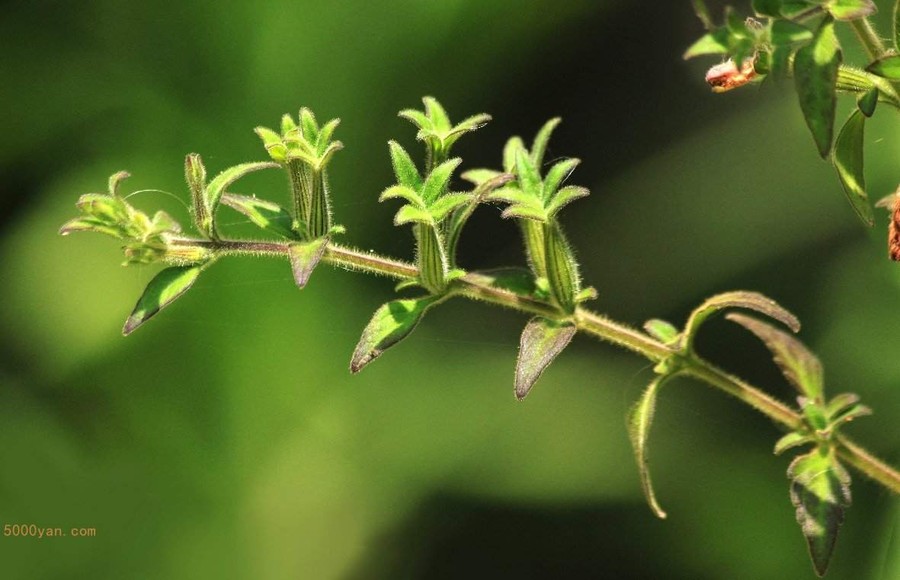
Annual herb, 30-70 cm tall. Entire plant densely covered with rust-colored short hairs. Roots branched. Stem solitary, erect, upper part much branched, slightly angular, upper part of stem with light red color. Leaves opposite; sessile or with short petiole; leaf blades bipinnately dissected, linear or linear-lanceolate, about 8 mm long, 1-2 mm wide. Flowers opposite on upper part of stems and branches, forming sparse racemes; pedicels very short, with 1 pair of linear bracteoles; calyx tube 1-1.5 cm long, with 10 distinct main veins, calyx teeth 5, 1/4 to 1/3 the length of the tube; corolla upper lip red-purple, lower lip yellow, 2-2.5 cm long, tube straight, upper lip falcate-curved, apex slightly rounded, back densely covered with long cilia, lower lip 3-lobed at apex, plicae highly raised into petal-like structures, outer surface with short pubescence; stamens 4, didynamous, filament bases hairy, lower part fused with corolla tube; style long, apex slightly thickened and curved. Capsule broadly ovoid, apex slightly oblique and flattened, enclosed by persistent calyx. Seeds black. Flowering July-August, fruiting August-October.
Habitat and Distribution
It grows on hillsides and grasslands. Distributed throughout China.
Harvesting and Processing
Harvested in autumn, remove impurities and dry in the sun.
Chemical Constituents
This product contains 10-p-coumaroyl aucubin, 8-epilogic acid, and acteoside. The whole herb also contains volatile oil.
Pharmacology
It has hepatoprotective and cholagogic effects, lowers serum cholesterol, and has antibacterial activity.
Properties and Channel Entry
Bitter, cold. Enters the Spleen, Stomach, Liver, and Gallbladder channels.
Functions and Indications
Activates Blood, dispels stasis, unblocks the menses, alleviates pain, cools Blood, stops bleeding, clears Heat and promotes diuresis. Used for traumatic injuries, external bleeding, amenorrhea due to Blood stasis, irregular menstruation, postpartum stasis pain, abdominal masses, bloody dysentery, painful urinary bleeding (hematuria), Damp-Heat jaundice, edema with abdominal distension, and excessive leukorrhea.
Dosage and Administration
Oral: Decoct 9-15 g (fresh product 30-60 g) or grind into powder. External use: Appropriate amount, grind into powder and apply with a suitable vehicle.
Prescriptions
1. For acute jaundice hepatitis: 30 g of Northern Artemisia. Decoct and take orally. (Anhui Chinese Herbal Medicine) 2. For enteritis and dysentery: 30 g of Northern Artemisia and 15 g of Potentilla chinensis. Decoct and take orally. (Anhui Chinese Herbal Medicine) 3. For turbid stranguria: 15 g of Northern Artemisia and 12 g of White Poria. Decoct in water. (Jilin Chinese Herbal Medicine) 4. For heat-induced coma with difficult urination: 30-45 g of Northern Artemisia. Decoct in water, mix with winter honey, and take. Take 1-2 times daily. (Fujian Folk Herbal Medicine) 5. For leukorrhea: 30 g of Northern Artemisia. Decoct in water, mix with yellow wine and brown sugar, and take. (Zhejiang Folk Commonly Used Herbal Medicine) 6. For cold and cough: 9-15 g of Northern Artemisia. Decoct in water and take orally. (Zhejiang Folk Commonly Used Herbal Medicine) 7. For tinea pedis (athlete's foot): Appropriate amount of fresh Northern Artemisia. Decoct in water and wash the affected area. (Fujian Materia Medica)