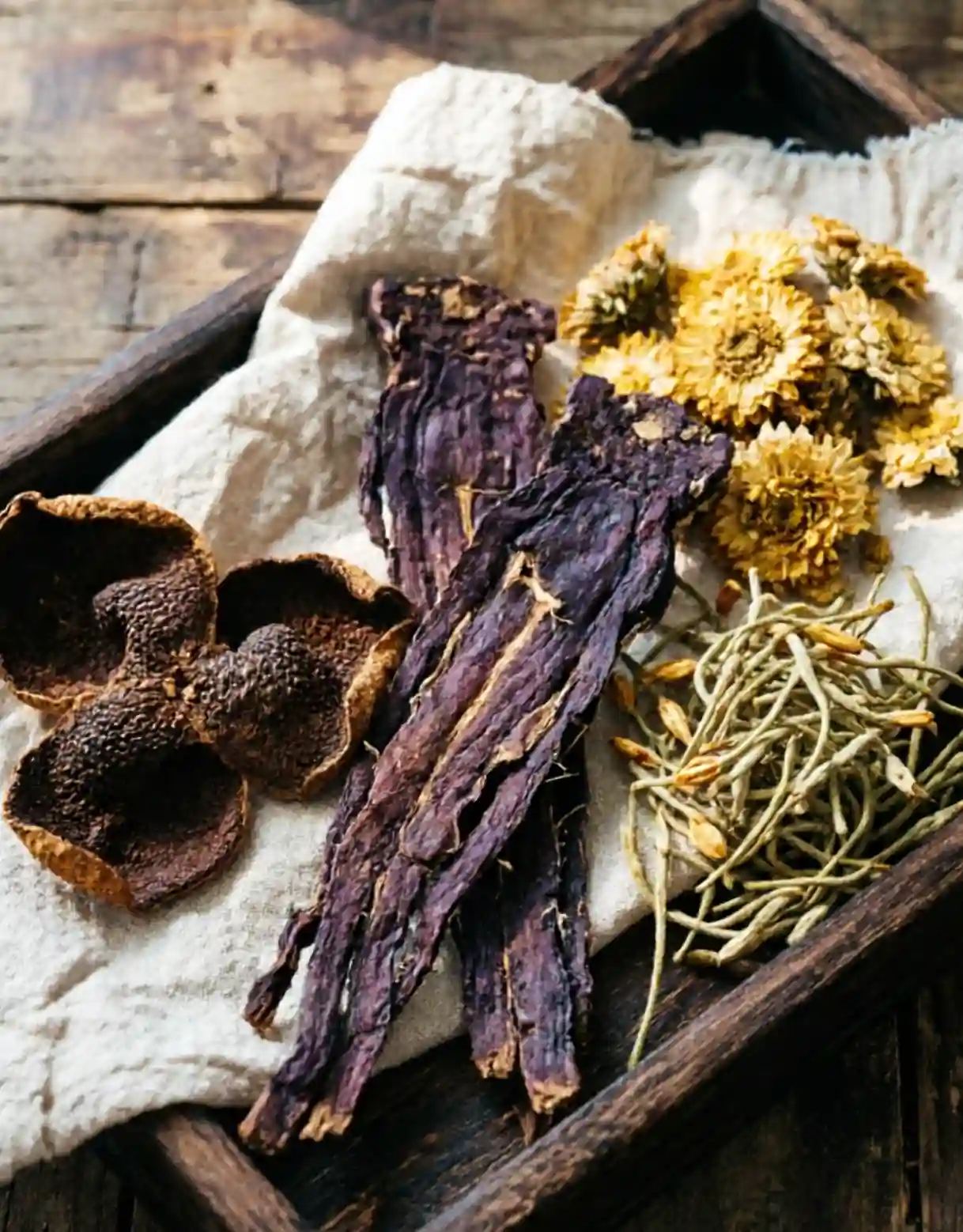
Pinyin: Daokoucao
Aliases
1. Jituncao (Chicken Grass), Hubiancao (Tiger Whip Grass), Niushetou (Ox Tongue), Daocicao (Reverse Thorn Grass), Niuqifeng (Ox Seven Wind).
Source
Amaranthaceae plant Achyranthes asperaAchyranthes asperaL. in the dried whole herb.
Botanical Description
Perennial herb, 20-120 cm tall. Root slender, 3-5 mm in diameter, yellowish-brown. Stem quadrangular, pubescent, nodes slightly swollen, branches opposite. Leaves opposite; petiole 5-15 mm long; leaf blade papery, broadly ovate-obovate or elliptic-oblong, apex rounded-obtuse with a mucronate tip, base cuneate or rounded, margin entire or undulate, both surfaces densely covered with coarse hairs. Spike terminal, erect, 10-30 cm long, reflexed after flowering; peduncle angled, robust, hard, densely covered with white appressed or spreading hairs; flowers 3-4 mm long, sparse; bracts lanceolate, 3-4 mm long, apex long-acuminate; bracteoles spinous, 2.5-4.5 mm long, hard, shiny, often purple, with a membranous wing on each side at base, 1.5-2 mm long, entire, entirely adnate to the spine but easily separable; perianth segments lanceolate, 3.5-5 mm long, long-acuminate, becoming hard and sharp after flowering, with 1 vein. Utricle ovoid, 2.5-3 mm long. Seed ovoid, not compressed, about 2 mm long, brown. Flowering period June to August, fruiting period October.
Habitat and Distribution
It grows on mountain slopes in sparse forests or in open areas near villages. It is distributed in South China, Southwest China, and in Jiangxi, Fujian, Taiwan, Hubei, Hunan, and other regions.
Harvesting and Processing
Harvest the whole plant in summer and autumn, wash clean, and use fresh or sun-dry.
Properties
Root cylindrical, slightly curved, surface grayish-yellow, with fine longitudinal striations and lateral root scars; texture pliable, not easily broken, fracture fibrous, dotted vascular bundles arranged in several rings. Stem subcylindrical, young branches slightly quadrangular, branched, surface brownish-green, young branches pubescent, nodes swollen and geniculate; texture brittle, easily broken, fracture yellowish-green. Leaves opposite, petiolate; leaf blades mostly crumpled, intact ones oblong-obovate, obovate, or elliptic, both surfaces coarsely hairy. Spike elongated, flowers reflexed like hooks. Utricle ovoid, black. Odor faint, taste sweet.
Chemical Constituents
Mainly contains ecdysterone, achyranthes saponin A, achyranthes saponin B, achyranthes saponin C, achyranthes saponin D, achyranthes alkaloid, tritriacontanol, 36,47-dihydroxyhenpentacontan-4-one, and various amino acids.
Pharmacology
It has bidirectional effects of strengthening the heart and lowering blood pressure while slowing heart rate, as well as anti-fertility, antibacterial, and antagonistic effects on intestinal and uterine smooth muscle spasm. It also exhibits mild antidiuretic and slight antipyretic effects in rats.
Properties and Channel Entry
Bitter and sour, slightly cold. Enters the Liver, Lung, and Urinary Bladder channels.
Functions and Indications
Activates Blood and resolves stasis, promotes urination and relieves strangury, clears Heat and releases the Exterior. Main indications: amenorrhea, dysmenorrhea, irregular menstruation, traumatic injury, rheumatic joint pain, strangury, edema, Damp-Heat leukorrhea, externally contracted fever, malaria, dysentery, sore throat, furuncle and abscess.
Usage
Internal: decoct in water, 10-15 g. External: apply an appropriate amount, mashed for topical application; or grind into powder for insufflation into the throat.
Precautions and Contraindications
Contraindicated during pregnancy.
Prescriptions
1. For blood stasis amenorrhea: 30-60 g of Achyranthes aspera, 30 g of fresh Verbena officinalis whole herb. Decoction in water, mixed with wine for oral administration. (Fujian Chinese Herbal Medicine) 2. For traumatic tendon contracture pain: A handful of fresh Achyranthes aspera whole herb, a tuft of human hair. Decoct for fumigation and washing, once daily, can be used regularly. (Fujian Folk Herbal Medicine) 3. For various types of stranguria in men and women, difficult urination: Use Achyranthes aspera with leaves, decoct in wine and take several times; particularly effective for hematuria. (Lingnan Herbal Records) 4. For popliteal abscess: 60 g of Achyranthes aspera whole herb. Stew in wine and water for oral administration; mash the residue and apply to the affected area. (Fujian Chinese Herbal Medicine) 5. For frostbite: 60 g of fresh Achyranthes aspera, 30 g of fresh ginger. Decoct in water for external washing, suitable for both unruptured and ruptured lesions. (Fujian Common Chinese Herbal Medicine Selections)

