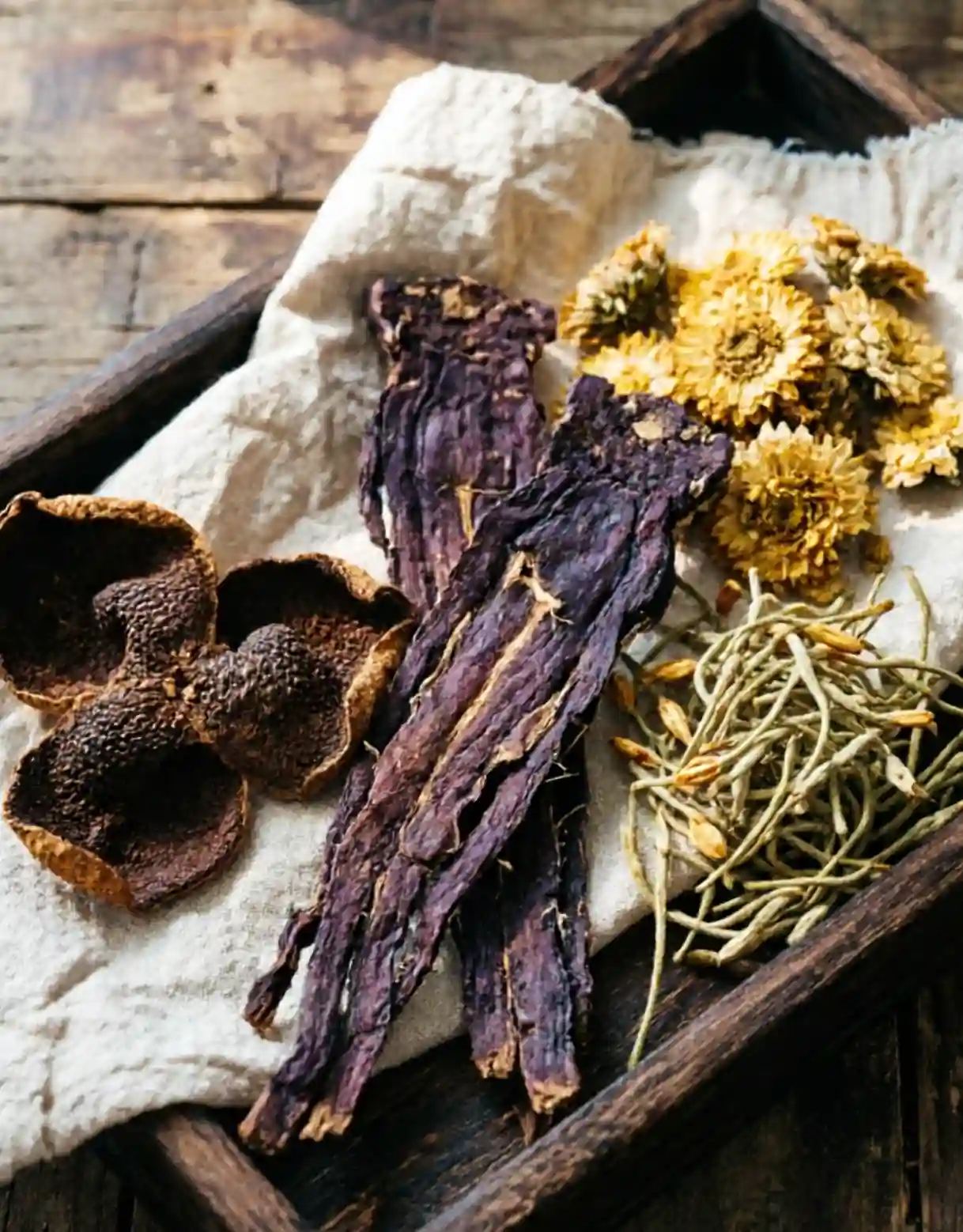
Pinyin: Lücao
Aliases
Ge Lū Màn, Ku Guā Téng, Dà Yè Wǔ Zhǎo Lóng.
Source
Moraceae plant Humulus scandensHumulus scandensDried whole plant of (Lour.) Merr.
Botanical Description
An annual or perennial climbing herb. Stems up to several meters long, light green with longitudinal ridges, densely covered with short recurved hooked prickles on stems, branches, and petioles. Leaves simple, opposite; petioles 5-20 cm long, slightly 6-angled, with recurved short hooked prickles; palmately divided leaves with 5-7 deep lobes, 5-15 cm in diameter, lobes ovate or ovate-lanceolate, apex acute to acuminate, margins serrate, upper surface with coarse stiff hairs, lower surface with fine oil dots, veins with stiff hairs. Flowers unisexual, dioecious; male inflorescence paniculate, female inflorescence a short spike; male flowers small, with 5 tepals, yellow-green, 5 stamens, filaments filiform and short; female flowers with 2 flowers per bract, bracts ovate-lanceolate, covered with white bristles and yellow small glands, tepal 1, gray-white, tightly encasing the pistil, ovary single, upper part protruding, sparsely covered with fine hairs. Infructescence green, nearly spherical; achenes pale yellow, oblate-spherical. Flowering period June to October, fruiting period August to November.
Habitat and Distribution
Grows along roadsides, ditches, wet areas, village fences, or forest-edge thickets. Distributed in most regions of China.
Harvesting and Processing
Harvest from September to October, choose a sunny day, cut the above-ground parts, remove impurities, and dry in the sun.
Chemical Constituents
This product mainly contains luteolin, choline, caryophyllene,β- Humulene, cosmosiin, luteolin-7-glucoside, and vitexin and other constituents.
Pharmacology
Has antibacterial effects and exhibits dinitrophenol-like effects in cats. Large doses administered via injection may also produce glycosuria and hematuria.
Properties and Channel Entry
Sweet, bitter, cold. Enters the Lung and Kidney channels.
Functions and Indications
Clears Heat and resolves toxicity, promotes urination and treats stranguria. Mainly indicated for lung heat cough, lung abscess, deficiency-heat with vexation and thirst, heat stranguria, edema, difficult urination, damp-heat diarrhea and dysentery, heat-toxin sores, and skin pruritus.
Dosage and Administration
Oral: decoction, 10-15 g (fresh product 30-60 g); or mashed for juice. External: appropriate amount, mashed for application; or decocted for fumigation and washing.
Prescriptions
1. For sweating and deficiency-heat after febrile disease caused by Cold Damage: Humulus scandens (cut into pieces), grind and extract fresh juice. Drink one ge (approx. 100 mL) to recover. (From *Ben Cao Yan Yi*) 2. For pulmonary tuberculosis: Humulus scandens, Prunella vulgaris, and Stemona sessilifolia, 12 g each. Decoct in water and take orally. (From *Anhui Zhong Cao Yao*) 3. For stone stranguria (urinary stones): Fresh Humulus scandens leaves, pound and squeeze to obtain three sheng of juice. Take in three doses; the toxic stone will pass on its own. (From *Pu Ji Fang*) 4. For red, swollen, hot, and painful joints: Fresh Humulus scandens (mashed into paste), white sugar (or honey). Apply to the affected area, replace when dry. (From *Anhui Zhong Cao Yao*) 5. For hemorrhoids with rectal prolapse: Fresh Humulus scandens 9 g. Decoct in water and use the steam/wash for fumigation and bathing. (From *Min Dong Ben Cao*) 6. For scrofula (tuberculous lymphadenitis): Fresh Humulus scandens leaves 30 g, yellow rice wine 60 g, brown sugar 120 g. Decoct in water and take in three divided doses after meals. (From *Fu Jian Min Jian Cao Yao*) 7. For skin itching: Humulus scandens, Xanthium sibiricum, and Phellodendron chinense, appropriate amounts each. Decoct in water and wash the affected area. (From *Anhui Cao Yao*) 8. For infantile pemphigus: Decoct Humulus scandens in water and wash the affected area, 1-2 times daily. Avoid fish, shellfish, and other allergenic foods. (From *Jiangsu Yao Cai Zhi*)

