Pinyin: Wulianmei
Aliases
Wuyeteng, Wuzhaolongteng, Zhixueteng.
Source
The plant is *Cayratia japonica* (Thunb.) Gagnep. of the Vitaceae family.Cayratia japonicaDried whole herb or root of (Thunb.) Gagnep.
Botanical Description
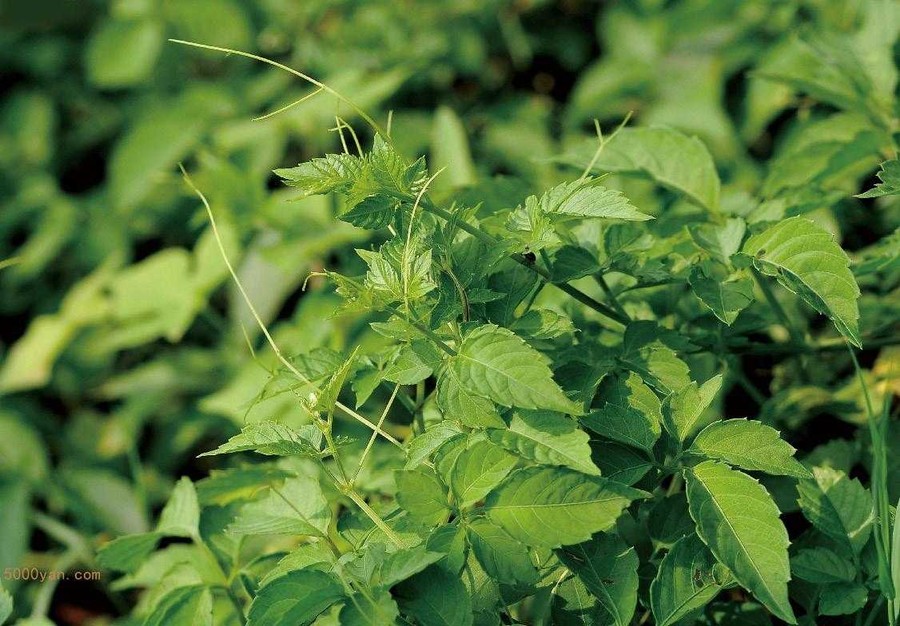
A perennial herbaceous vine. The stem is purplish-red with longitudinal ridges; tendrils are bifurcated, opposite to the leaves. The leaves are bird-foot-shaped, compound, and alternate; there are 5 leaflets, membranous, elliptical, elliptical-ovate to narrow-ovate, 2.5-8 cm long, 2-3.5 cm wide, with an acute to short acuminate apex, a small tip, a cuneate to broadly cuneate base, sparsely serrated margins, and short hairs or nearly hairless on both sides along the veins; the central leaflet is larger with a longer petiole, while the lateral leaflets are smaller; the petiole can be up to 4 cm or more; stipules are triangular and deciduous early. The inflorescence is a corymbose cyme, usually axillary or pseudo-axillary, with a long peduncle, hairy or hairless; flowers are small, yellow-green; the calyx is indistinct; petals 4, without or with very slight small horns at the apex; stamens 4, opposite the petals; the disc is fleshy, shallowly cup-shaped; the ovary is sunken within the 4-lobed disc. The berry is ovoid, 6-8 mm in diameter, turning black when ripe. Flowering period is May to June; fruiting period is August to October.
Habitat and Distribution
Grows on hillsides, roadsides, and shrub forests, often climbing on other objects. Distributed in Shaanxi, Gansu, Shandong, Jiangsu, Anhui, Zhejiang, Jiangxi, Fujian, Taiwan, Henan, Hubei, Guangdong, Guangxi, Sichuan and other areas.
Harvesting and Processing
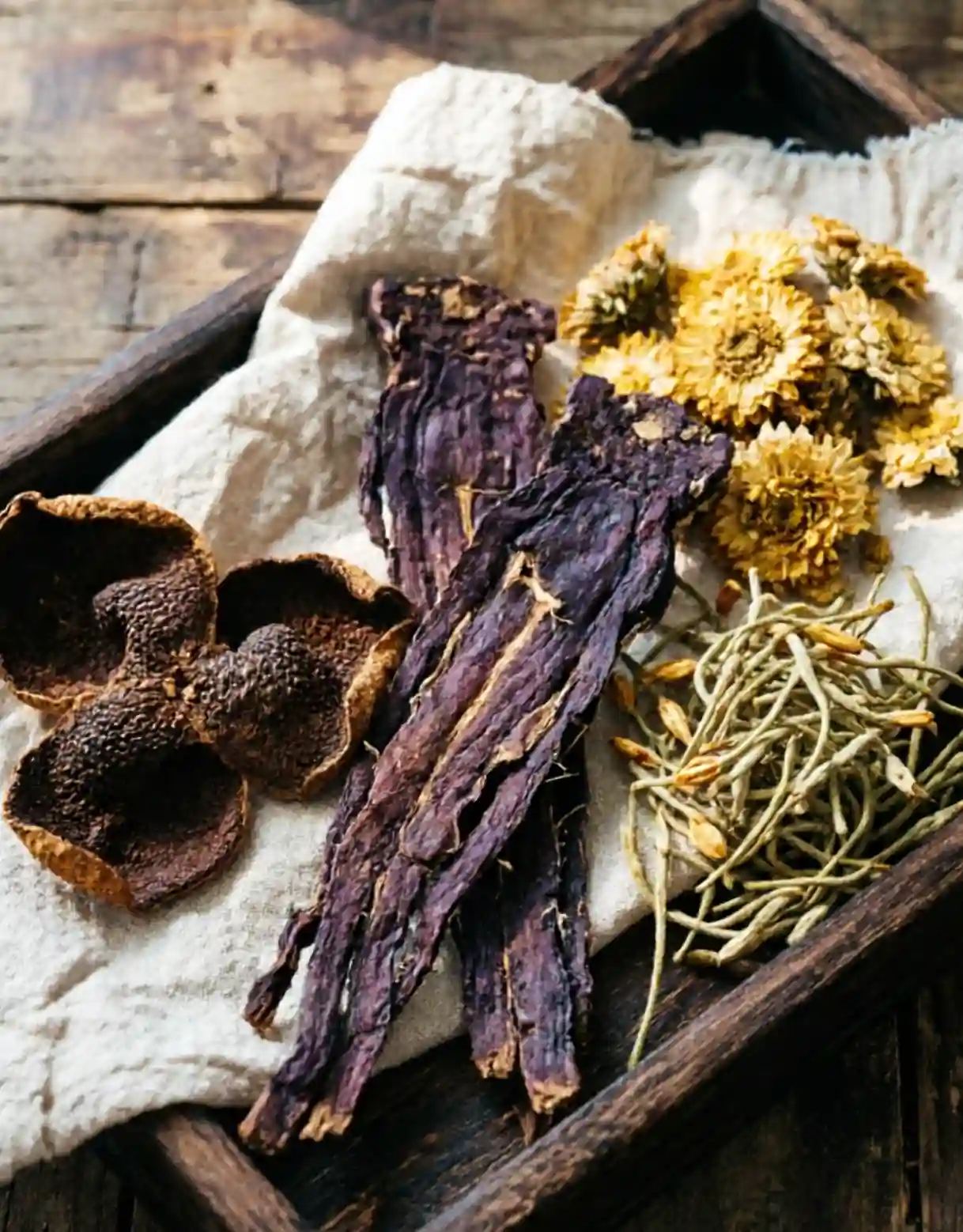
Harvest the vine stems or dig out the roots in summer and autumn, remove impurities, wash, cut into segments, and dry in the sun or use fresh.
Chemical Constituents
This product contains camphor, sabinene,δ- Bichenggie alcohol.α- Terpineol, Cayratia anthocyanin and other constituents.
Pharmacology
Antiviral, anti-inflammatory, antipyretic; antibacterial; possesses anticoagulant and immune-regulating functions.
Properties and Channel Entry
Bitter, sour, and cold. Enters the Heart, Liver, and Stomach channels.
Functions and Indications
Clears Heat and drains Dampness, resolves toxicity and reduces swelling. Indicated for: heat-toxin abscesses and furuncles, erysipelas, sore throat, snake and insect bites, scalds and burns, wind-damp painful obstruction (bi syndrome), jaundice, diarrhea and dysentery, turbid urine, and hematuria.
Dosage and Administration
Internal: decoct 15-30 g in water, steep in wine, or pound to extract juice for drinking. External: apply an appropriate amount of the pounded herb topically.
Prescriptions
1. For swelling with heat below the neck, commonly known as toad plague (mumps): apply pounded *Cayratia japonica* (Wulianmei) topically. (From *Danxi's Collected Essentials*) 2. For back abscess, buttock abscess, and bubo (inguinal lymphadenitis): decoct the whole plant of *Cayratia japonica* (Wulianmei) in water twice, collect both decoctions, combine them, and further concentrate over a water bath into a paste. Apply the paste on gauze and affix to the affected area, changing once daily. (From *Jiangxi Folk Herbal Medicine*) 3. For mastitis: mash fresh *Cayratia japonica* (Wulianmei) and apply to the affected area. (From *Qingdao Chinese Herbal Medicine Manual*) 4. For lymphadenitis: take an appropriate amount of *Cayratia japonica* (Wulianmei) leaves, mix with an equal amount of narcissus bulbs and a small amount of brown sugar, pound together, warm, and apply to the affected area. (From *Fujian Materia Medica*) 5. For herpes zoster (shingles): grind *Cayratia japonica* (Wulianmei) root with strong liquor and realgar, and apply to the affected area. (From *Fujian Materia Medica*) 6. For rheumatic joint pain: soak 30 g of *Cayratia japonica* (Wulianmei) root in wine and take it orally. (From *Guizhou Herbal Medicine*)