Pinyin: Dijincao
Aliases
Cao Xue Jie, Xue Jian Chou, Tie Xian Cao
Source
Euphorbiaceae plant Euphorbia humifusaEuphorbia humifusaWilld. or *Euphorbia maculata* L.Euphorbia maculataL. in the dried whole herb.
Botanical Description
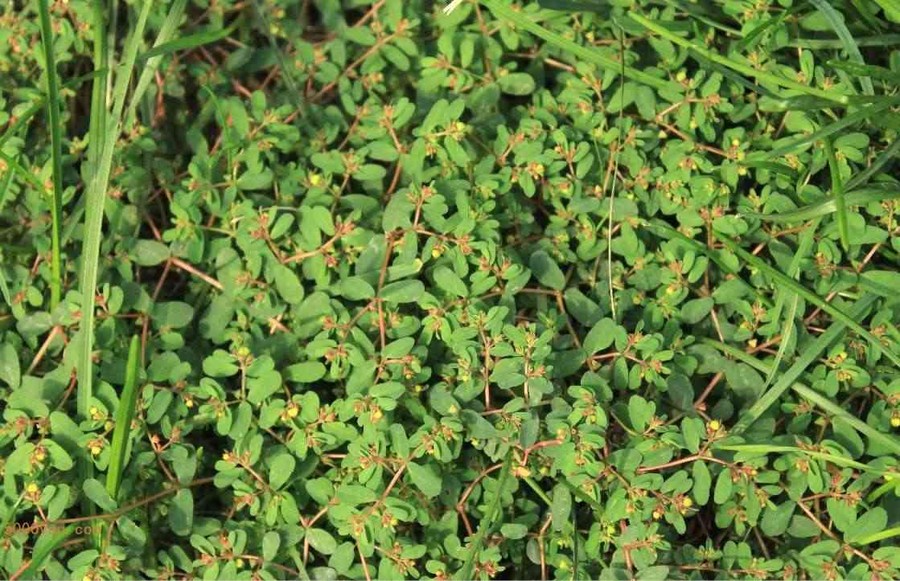
1. Dijin (Euphorbia humifusa): Annual prostrate herb. Stems slender, branched near the base, purplish-red, glabrous. Leaves opposite; petioles very short; stipules linear, usually 3-lobed; leaf blades oblong, 4-10 mm long, 4-6 mm wide, apex obtuse-rounded, base slightly narrowed, margin finely serrate, both surfaces glabrous or sparsely pubescent, green or pale red. Cyathia solitary in leaf axils; involucre obconical, light red, apex 4-lobed, lobes long-triangular; glands 4, oblong, with white petal-like appendages; ovary 3-locular; styles 3, 2-lobed. Capsule trigonous-globose, smooth and glabrous; seeds ovoid, dark brown, coated with white waxy powder, about 1.2 mm long, about 0.7 mm wide. Flowering period June to October, fruits maturing gradually from July.
2. Spotted Euphorbia: This species is very similar to Euphorbia humifusa, with the main differences being: a purple spot in the center of the leaf blade, soft hairs on the back; the capsule surface is densely covered with fine white soft hairs; seeds are ovoid with angular ridges. The flowering and fruiting period is the same as Euphorbia humifusa.
Habitat and Distribution
Euphorbia humifusa grows on plains, wastelands, roadsides, and fields, and is a common weed
Harvesting and Processing
Harvested in summer and autumn, remove impurities, and dry in the sun.
Chemical Constituents
This product contains quercetin, scopoletin, umbelliferone, gallic acid,β- Contains components such as sitosterol.
Pharmacology
Has antibacterial, antiparasitic, and detoxifying effects; hemostatic effect is significant.
Properties and Channel Entry
Acrid, neutral. Enters the Liver and Large Intestine channels.
Functions and Indications
Clears Heat, resolves toxicity, cools Blood, stops bleeding, promotes diuresis, and reduces jaundice. Used for dysentery, diarrhea, hemoptysis, hematuria, hematochezia, metrorrhagia and metrostaxis, furuncles, carbuncles, and Damp-Heat jaundice.
Dosage and Administration
Oral: decoct in water, 10-15 g, fresh product can be used 15-30 g; or taken as powder
Precautions and Contraindications
Use with caution in patients with Blood deficiency without stasis and those with Spleen and Stomach weakness.
Prescriptions
1. For tooth bleeding: wash fresh Dijincao (Herba Euphorbiae Humifusae), decoct in water and use as a mouth rinse. (Quanzhou Bencao) 2. For sore throat and swelling pain: fresh Dijincao 15 g, fresh Xiansuan Tiencao (Oxalis corniculata) 15 g. Pound to extract juice, mix with honey and take orally, three times daily. (Quanzhou Bencao) 3. For boils, sores, and painful swelling: fresh Dijincao, wash and mix with sour rice grains and a little salt, apply to the affected area. (Quanzhou Bencao) 4. For wind sores and scabies: pound Dijincao together with Manjianghong (Azolla imbricata) into a powder and apply externally. (Gangmu, citing Qiankun Miyun) 5. For herpes zoster (shingles): pound fresh Dijincao, mix with vinegar, stir well, and apply the juice to the affected area. (Fujian Zhongcaoyao) 6. For red, swollen eyes (fire eye): decoct Dijincao in water and wash the eyes, or steam with pork liver and eat. (Guiyang Minjian Caoyao) 7. For traumatic swelling and pain: an appropriate amount of fresh Dijincao, pound evenly with distiller's grains, add a little flour, and apply externally. (Hunan Yaowu Zhi)