Pinyin: Diercao
Aliases
Tianjihuang, Hezhangcao, Xiaowangbuliuxing
Source
Clusiaceae plant Hypericum japonicumHypericum japonicumDried whole plant of Thunb. ex Murray.
Botanical Description
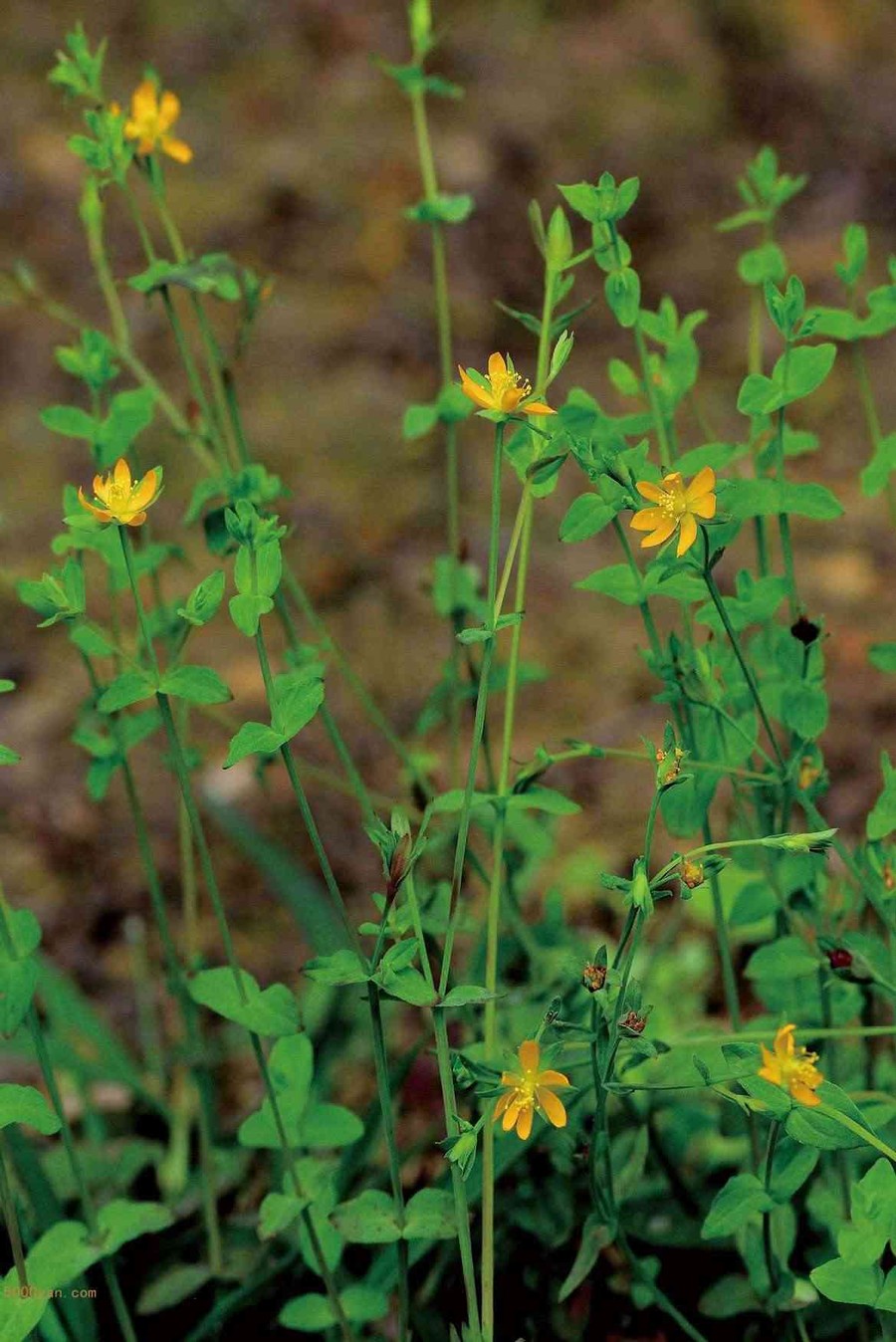
Annual small herb, 10-40 cm tall. Entire plant glabrous (hairless). Roots numerous and fibrous. Stems fascicled, erect or ascending, quadrangular, with fine roots emerging near nodes at base. Leaves opposite, sessile; leaf blade ovate to broadly ovate, 3-15 mm long, 1.5-8 mm wide, apex obtuse, base clasping the stem, oblique, margin entire, upper surface with minute translucent oil dots. Cymes terminal, dichotomously branched; flowers small, about 6 mm in diameter; pedicels linear, 5-10 mm long; sepals 5, lanceolate to elliptic, 3-5 mm long, apex acute, upper portion with glandular dots; petals 5, yellow, ovate-oblong, approximately as long as sepals; stamens 5-30, filaments filiform, united at base into 3 bundles; ovary superior, 1-locular, ovoid to elliptic, styles 3, filiform. Capsule elliptic, about 4 mm long, splitting into 3 valves at maturity, surrounded by persistent sepals of nearly equal length. Seeds numerous. Flowering May-June, fruiting September-October.
Habitat and Distribution
1. For pneumonia: Renshen 6 g, decoct in water and take orally. Internal use: decoct 3-10 g.
Harvesting and Processing
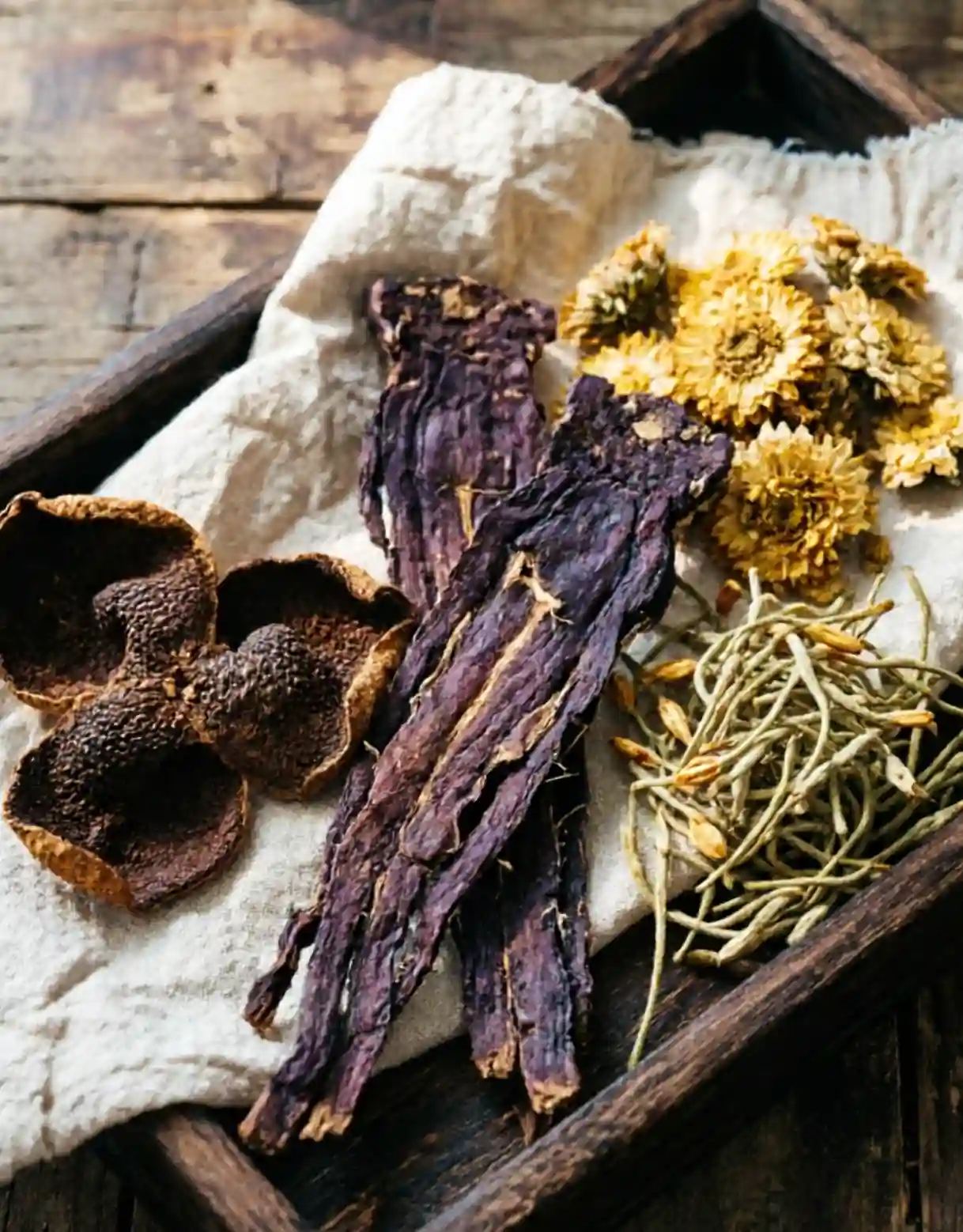
Harvest the whole plant during flowering in spring and summer, dry in the sun or use fresh.
Chemical Constituents
This product contains quercitrin, isoquercitrin, quercetin-7-rhamnoside, sarothranol, sarothranol A, sarothranol B, sarothranin, and sarospermin.
Pharmacology
Has antibacterial effects; on in vivo and in vitro toad hearts, it exhibits initial excitation followed by inhibition, with excessive doses potentially causing cardiac fibrillation and cardiac arrest; it has a certain hypotensive effect on anesthetized dogs; it can enhance the contraction of isolated rabbit intestines, with high concentrations possibly causing spasms, and it has a synergistic effect with acetylcholine.
Properties and Channel Entry
Sweet, slightly bitter, cool. Enters the Liver, Gallbladder, and Large Intestine channels.
Functions and Indications
Clears Heat and drains Dampness, resolves toxicity, disperses stasis and reduces swelling, alleviates pain. Mainly indicated for Damp-Heat jaundice, diarrhea, dysentery, intestinal abscess, lung abscess, furuncles and carbuncles with swelling and toxicity, tonsillitis, mouth sores, red and swollen eyes, venomous snake bite, and traumatic injury.
Dosage and Administration
Oral: Decoct 15-30 g, fresh product 30-60 g, large dose up to 90-120 g; or crush to extract juice. External use: appropriate amount, crush for external application, or decoct for washing.
Prescriptions
1. For hepatitis: Fresh Hypericum japonicum and fresh Pteris multifida 30 g each, red dates 6 pieces. Decoct in water for oral administration, 2 times daily. (Fujian Materia Medica) 2. For acute icteric hepatitis: Hypericum japonicum 30 g, Lysimachia christinae 30 g, Taraxacum mongolicum 30 g, Isatis indigotica 30 g. Decoct in water for oral administration. (Sichuan Chinese Materia Medica, 1979) 3. For enteritis: Fresh Hypericum japonicum 45 g, fresh Pteris multifida 30 g. Decoct in equal parts of water and wine for oral administration. (Zhejiang Medicinal Flora) 4. For acute nephritis: Fresh Hypericum japonicum 60 g, red dates 10 pieces, decoct in water for oral administration; or Hypericum japonicum 3-9 g, grind into powder, stir-fry with eggs for oral administration. (Fujian Materia Medica) 5. For eczema and ulcers: Hypericum japonicum appropriate amount, decoct in water for external washing. (Anhui Chinese Herbal Medicine) 6. For stomatitis: Fresh Hypericum japonicum 30 g, mash to extract juice, soak gauze in the juice and wash the oral cavity, 1-2 times daily. Adults may also gargle. (Southern Medicine Chinese Materia Medica) 7. For acute conjunctivitis: Hypericum japonicum 30-60 g. Decoct in water and fumigate and wash the affected eye, 3 times daily. (National Compilation of Chinese Herbal Medicine)