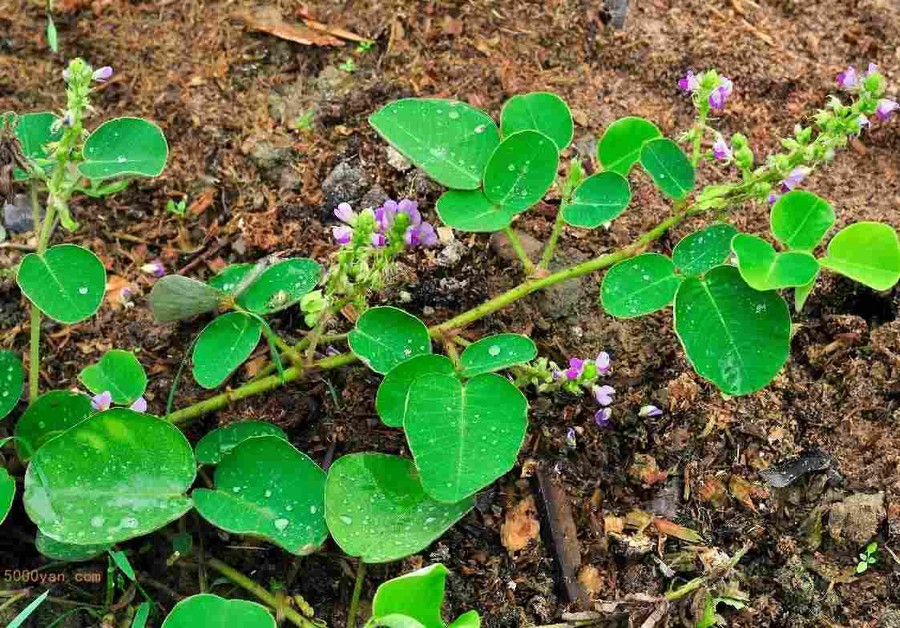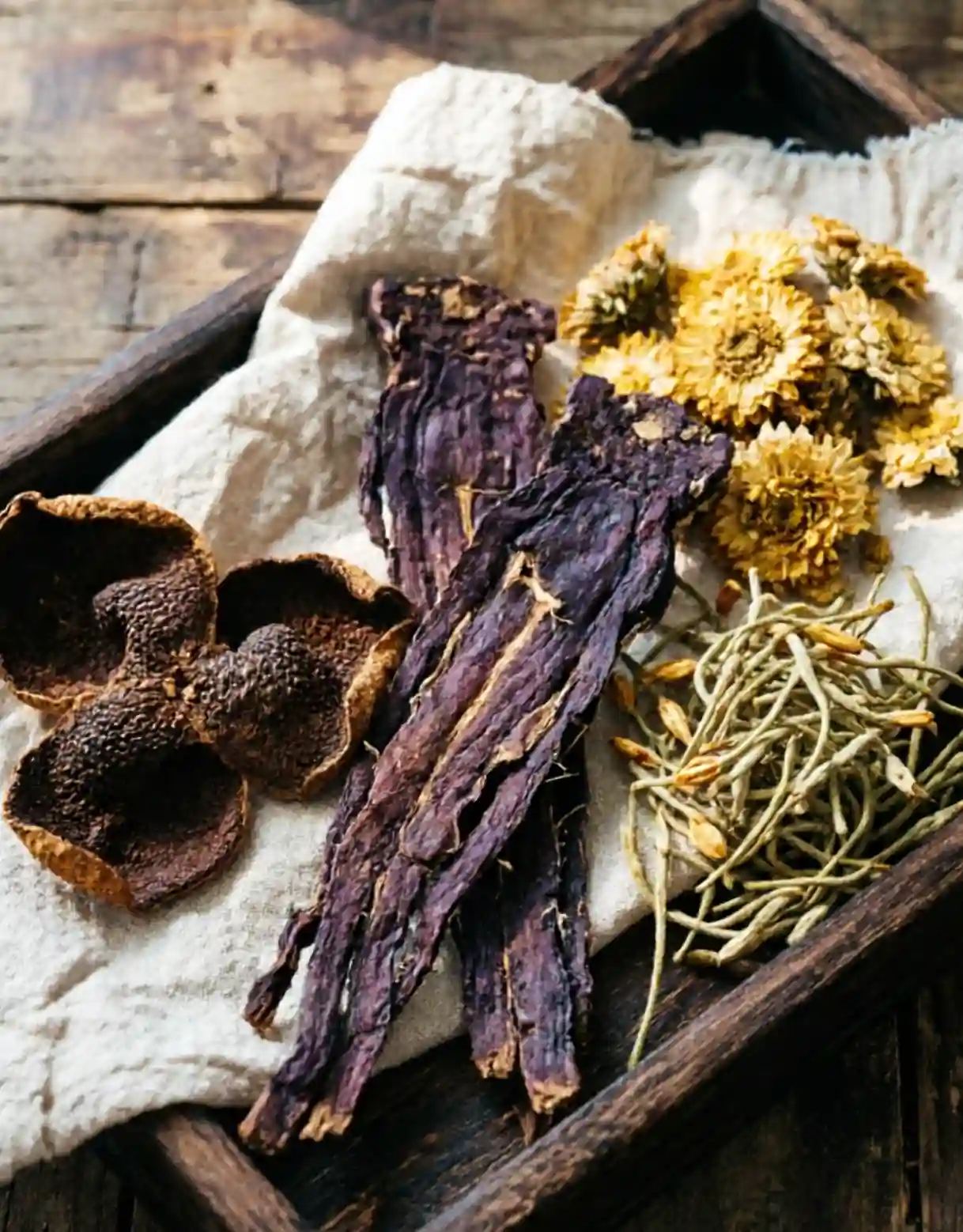
Pinyin: Guangjinqiancao
Aliases
Guangdong Jinqiancao, Luodi Jinqian, Jia Huasheng.
Source
Fabaceae plant *Desmodium styracifolium*Desmodium styracifoliumDried aerial parts of (Osb.) Merr.
Botanical Description
Subshrubby herb, 30-100 cm tall, branches densely covered with yellow villous hairs, leaflets 1 or 3, petiole 1-1.8 cm long. Leaves nearly orbicular, 2.5-4.5 cm long, 2-4 cm wide, apex slightly emarginate, base cordate, glabrous above, densely appressed golden yellow sericeous beneath; racemes axillary or terminal; bracts ovate-triangular, each bract with two flowers, pedicel filiform, 3-4 mm long; flowers small, about 5 mm long; calyx campanulate, calyx teeth lanceolate, twice as long as calyx tube; corolla purple, fragrant. Legume, 1-1.5 cm long, about 3 mm wide, ventral suture straight, dorsal suture wavy, with 3-6 articles, pubescent and with hooked hairs. Flowering period June to September.
Habitat and Distribution
It grows on hillsides, grasslands, terraces, or in shrub thickets. It is distributed in Fujian, Hunan, Guangdong, Guangxi, Sichuan, Yunnan and other regions.
Harvesting and Processing
Harvested in summer and autumn, remove impurities, and sun-dry.
Chemical Constituents
This product contains components such as quercetin, isoquercitrin, and kaempferol.
Pharmacology
It has significant effects in preventing and treating urinary tract stones and promoting diuresis. It influences cardiovascular and cerebrovascular functions, increases coronary and cerebral arterial blood flow, reduces cerebrovascular resistance, lowers common carotid artery blood pressure, enhances tolerance to normobaric hypoxia, counteracts aortic spasm, and protects against acute myocardial ischemia. It can significantly inhibit platelet aggregation and markedly antagonize in vitro thrombus formation. It has anti-inflammatory and analgesic effects. It can effectively improve learning and memory abilities. It has a significant choleretic effect and can inhibit the growth of Candida albicans.
Properties and Channel Entry
Sweet and bland, cool. Enters the Liver, Kidney, and Urinary Bladder channels.
Functions and Indications
Promotes diuresis to reduce jaundice, and induces diuresis to treat stranguria. Used for jaundice with dark urine, heat stranguria, stone stranguria, painful urination, edema with scanty urine.
Dosage and Administration
Oral: decoct in water, 15-30 g, fresh product 30-60 g. Topical: appropriate amount, crush for application.
Prescriptions
1. For urinary tract infection: 24 g of *Desmodium styracifolium*, 15 g each of *Plantago asiatica*, *Lygodium japonicum*, and *Lonicera japonica*. Decoct in water and take one dose daily. ("National Chinese Herbal Medicine Compilation") 2. For bladder stones: 60 g of *Desmodium styracifolium* and 15 g of *Lygodium japonicum*. Decoct in water. ("Lingnan Herbal Records") 3. For kidney stones: 24 g of *Desmodium styracifolium*, 4.5 g of *Foeniculum vulgare*, 45 g of *Illicium verum*, 15 g of *Rheum palmatum* (added later), and 30 g of *Polygonum aviculare*. Use 3 bowls of clean water, decoct to 1 bowl. Drink plenty of soybean sprout soup to help accelerate kidney stone expulsion. ("Lingnan Herbal Records") 4. For cholecystitis: 30 g of *Desmodium styracifolium* and 9 g of *Gallus gallus domesticus* (inner membrane). Decoct in water. ("Fujian Materia Medica") 5. For stomatitis and laryngitis: 15-30 g of *Desmodium styracifolium*, decoct in water and mix with honey to take. ("Lingnan Herbal Records") 6. For urticaria: 750 g of fresh whole *Desmodium styracifolium* and 30 g of crude salt, mash together for external application. Also take 60 g of the whole herb, decoct in water. ("Guangxi Herbal Compilation")