Pinyin: Weilingcai
Aliases
Fanbaicai, Baitouweng, Tianqingdibai.
Source
Rosaceae plant Potentilla chinensisPotentilla chinensisSer. dried whole plant.
Botanical Description
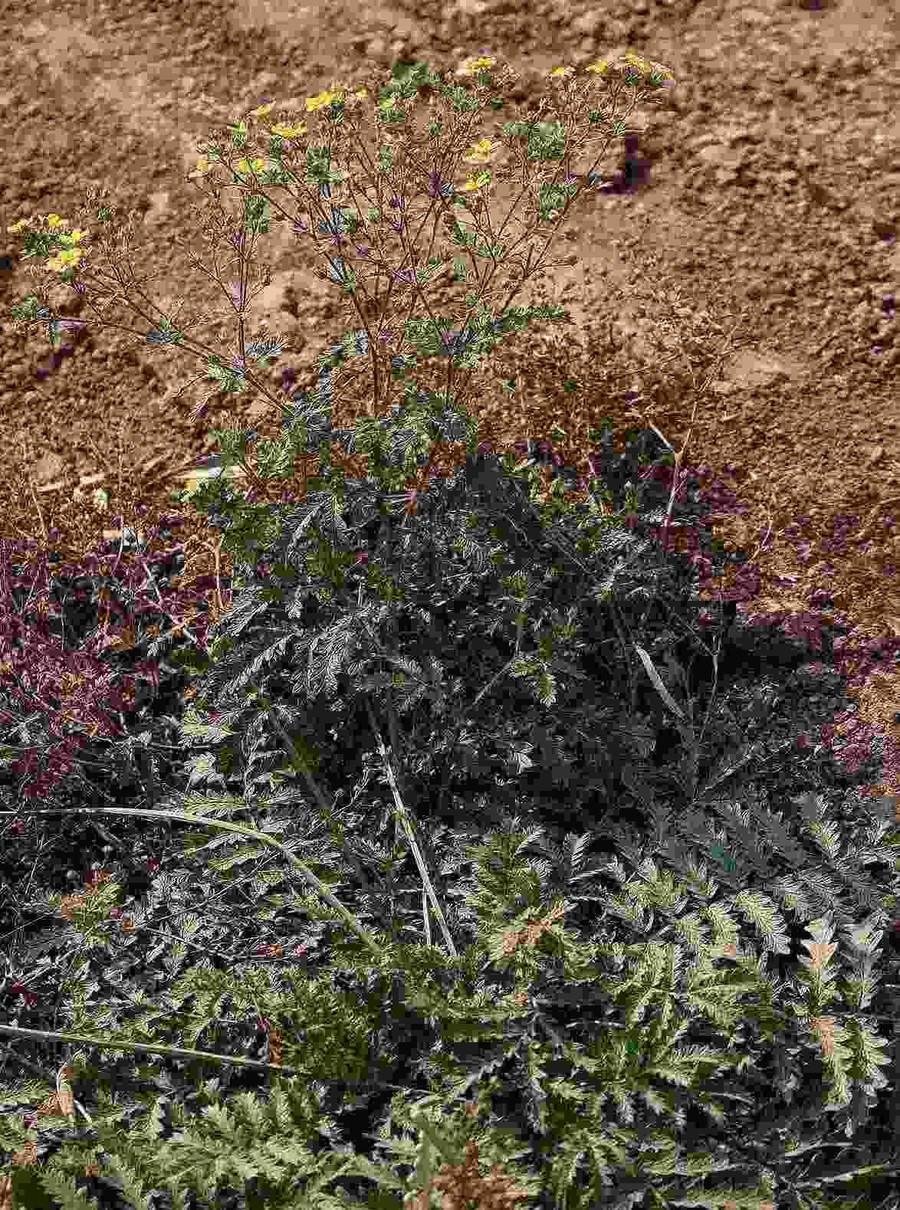
Perennial herb, 20-70 cm tall. Roots stout, cylindrical, slightly woody. Flower stems erect or ascending, sparsely covered with short hairs and white silky long hairs. Basal leaves are pinnately compound; petioles with short hairs and silky long hairs; stipules nearly membranous, brown, outer surface with white silky long hairs; leaflets in 5-15 pairs, opposite or alternate, upper leaflets longer, gradually shorter downward, sessile; leaflet blades oblong, obovate, or oblong-lanceolate, 1-5 cm long, 0.5-1.5 cm wide, apex acute or obtuse, margin pinnately parted, lobes triangular-ovate, triangular-lanceolate, or oblong-lanceolate, margin reflexed downward, upper surface with short hairs or nearly glabrous, midrib sunken, lower surface with white tomentum, along veins with white silky long hairs; stem leaves similar to basal leaves, with fewer leaflet pairs, stipules herbaceous, margin usually dentate-lobed. Flowers bisexual; corymbose cyme, flower stems with white silky long hairs, base of inflorescence with lanceolate bracts, densely covered with short hairs externally; flower diameter 0.8-1 cm, rarely up to 1.3 cm; sepals 5, triangular-ovate, apex acute, not enlarged after flowering, appressed to fruit; epicalyx segments 5, about half as long as sepals and narrower, externally with short hairs and a few silky hairs; petals 5, broadly obovate, apex slightly emarginate, slightly longer than sepals, yellow; style nearly terminal, stigma enlarged. Achenes ovoid-globose, dark brown, with distinct wrinkles. Flowering and fruiting period: April to October.
Habitat and Distribution
It grows on mountain slopes, grasslands, valleys, forest edges, thickets, and under sparse forests at an altitude of 400-3200 m. It is distributed in Northeast, North, Central South, and Southwest China, as well as Shaanxi, Gansu, Shandong, Jiangsu, Anhui, Zhejiang, Jiangxi, Taiwan, Tibet, and other regions.
Harvesting and Processing
Harvest the entire plant with roots from April to October, remove the flowering and fruiting branches, wash clean, and sun-dry.
Chemical Constituents
This product contains quercetin, kaempferol, gallic acid, azelaic acid, and other components.
Pharmacology
Resists pathogens, exhibits inhibitory effects on isolated frog and rabbit hearts, and also inhibits isolated and in situ rabbit intestinal tracts; additionally, it dilates isolated guinea pig bronchi and stimulates isolated guinea pig uterus.
Properties and Channel Entry
Bitter and cold. Enters the Large Intestine, Lung, and Liver channels.
Functions and Indications
Cools Blood to stop dysentery, clears Heat and resolves toxicity
Dosage and Administration
Oral: decoct in water, 15-30 g; grind into powder or steep in wine. External use: appropriate amount, decoct in water for washing, mash for application, or grind into powder for application.
Prescriptions
1. For dysentery with red and white stools: Weilingcai (Potentilla chinensis) 15 g, Machixian (Portulaca oleracea) 15 g, tea leaves 6 g. Decoct in water and take orally, twice daily. (Gansu Chinese Herbal Medicine Manual) 2. For amebic dysentery: Weilingcai 30 g, stir-fried Huaihua (Sophora japonica flower) 12 g. Decoct and take orally. (Anhui Chinese Herbal Medicine) 3. For recurrent dysentery: Weilingcai root 15 g, Shidagonglao (Mahonia fortunei) 15 g, Cheqiancao (Plantago asiatica) 9 g. Decoct in water and take orally. (Hunan Materia Medica) 4. For chronic dysentery: Weilingcai and white Mujinhua (Hibiscus syriacus flower) 15 g each. Decoct in water and take orally. (Guiyang Folk Herbal Medicine) 5. For furuncles, carbuncles, and abscesses: Weilingcai 15 g, Pugongying (Taraxacum mongolicum) 15 g. Decoct in water and take orally. (Shanxi Chinese Herbal Medicine) 6. For bloody stools: Weilingcai root 15 g, Xiaoji charcoal (Cirsium setosum) 12 g, Ceba charcoal (Platycladus orientalis) 9 g. Decoct and take orally. (Anhui Chinese Herbal Medicine) 7. For peptic ulcers: Dried Weilingcai root 60 g, 1 chicken (approximately 500 g). Stew in water and take orally. (Fujian Jinjiang Chinese Herbal Medicine Manual) 8. For whooping cough: Weilingcai whole plant 15 g, Haijinsha (Lygodium japonicum) 9 g. Decoct in water and take orally. (Hunan Materia Medica)