Pinyin: Shiwei
Aliases
Shiwei, Shilan, Sheshefeng.
Source
Polypodiaceae plant *Pyrrosia*Pyrrosia linguaDried leaves of (Thunb.) Farwell.
Botanical Description
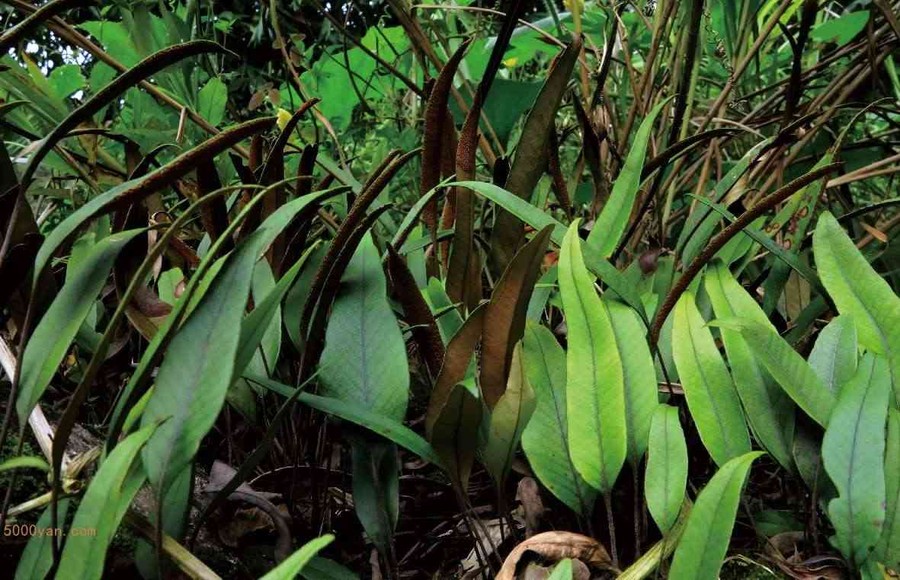
The plant is 10-30 cm tall. The rhizome is slender, elongated, and creeping, densely covered with brown lanceolate scales along with the petiole. Leaves are distant, nearly dimorphic; petioles are 3-10 cm long, dark brown, with shallow grooves, bearing stellate hairs when young, attached to the rhizome at a joint; leaf blades are leathery, lanceolate to oblong-lanceolate, 6-20 cm long, 2-5 cm wide, apex acuminate, base gradually narrowed and decurrent onto the petiole, margin entire; upper surface green, occasionally with stellate hairs and pits, lower surface densely covered with gray-brown stellate hairs; sterile and fertile leaves are similar in shape or slightly shorter and broader; midrib slightly sunken above, raised below, lateral veins somewhat visible, veinlets reticulate. Sporangia are scattered over the entire abaxial surface or upper portion, densely covered with stellate hairs when young, becoming exposed at maturity; indusium absent.
Habitat and Distribution
Attached to tree trunks or rocks by streams in forests at elevations of 100-1800 m. Distributed in East, Central-South, and Southwest China.
Harvesting and Processing
It can be harvested year-round, remove the rhizomes and roots, and dry in the sun or in the shade.
Chemical Constituents
This product contains kaempferol, isoquercitrin, quercetin, and diploptene.β- β-sitosterol, mangiferin, isomangiferin, trifolioside, protocatechuic acid, and other constituents.
Pharmacology
It has antitussive and expectorant effects; antibacterial and antiviral effects; can increase leukocyte counts reduced by chemotherapy and radiotherapy, enhance the phagocytic capacity of the body, and inhibit prostaglandin synthesis.
Properties and Channel Entry
Sweet and bitter, slightly cold. Enters the Lung and Urinary Bladder channels.
Functions and Indications
Diuresis to unblock painful urinary dribbling, clears Lung Heat to stop cough, cools Blood to arrest bleeding. Used for Heat stranguria, Blood stranguria, Stone stranguria, difficult urination, dribbling pain with urinary hesitation, Lung Heat wheezing and cough, hemoptysis, epistaxis, hematuria, and uterine bleeding.
Dosage and Administration
Oral: decoct in water, 9-15 g; or grind into powder. External use: appropriate amount, grind into powder for topical application.
Precautions and Contraindications
Contraindicated in patients with Yin deficiency or those without Damp-Heat.
Prescriptions
1. For heat-induced stranguria with difficult urination: a. Pyrrosia leaf (Shiwei) and Plantago seed (Cheqianzi), equal parts. Grind coarsely, take 15 g per dose, decoct and remove residue, take warm. (Shiwei Decoction from *Quansheng Zhimi Fang*) b. Pyrrosia leaf (Shiwei, hair removed), Dianthus herb (Qumai), and Mallow seed (Dongkuizi) 60 g each, Talc (Huashi, crushed) 150 g. Grind the four ingredients into a powder. Take 9 g per dose, mix with warm water and take before meals. (*Shengji Zonglu*) 2. For stone stranguria: Pyrrosia leaf (Shiwei, hair removed) and Talc (Huashi), equal parts. Grind and sieve into a powder. Take one daogui dose mixed with rice porridge or honey, twice daily. (Shiwei Powder from *Waitai* quoting *Gu Jin Lu Yan Fang*) 3. For blood stranguria: Pyrrosia leaf (Shiwei), Chinese Angelica (Danggui), Cattail pollen (Puhuang), and White Peony (Shaoyao), ground into powder, taken with wine. (Shiwei Powder from *Qianjin Yaofang*) 4. For cough: Pyrrosia leaf (Shiwei, hair removed) and Areca seed (Binglang, chopped), equal parts. Grind the two ingredients into a fine powder. Take 6 g with ginger decoction. (Shiwei Powder from *Shengji Zonglu*) 5. For scalds and burns: Scrape off the spore sacs of Pyrrosia leaf (Shiwei), mix with green oil or candle wax oil, and apply to the affected area. (*Tianmushan Yaoyong Zhiwu Zhi*) 6. For leukopenia caused by radiotherapy and chemotherapy: Pyrrosia leaf (Shiwei) 30 g, Red date (Hongzao) 15 g, Licorice (Gancao) 3 g. Decoct in water and take orally. (*Quanguo Zhongcaoyao Huibian*)