Pinyin: Diren
Aliases
Di Nian, Di Pu Tao, Pu Di Zhan.
Source
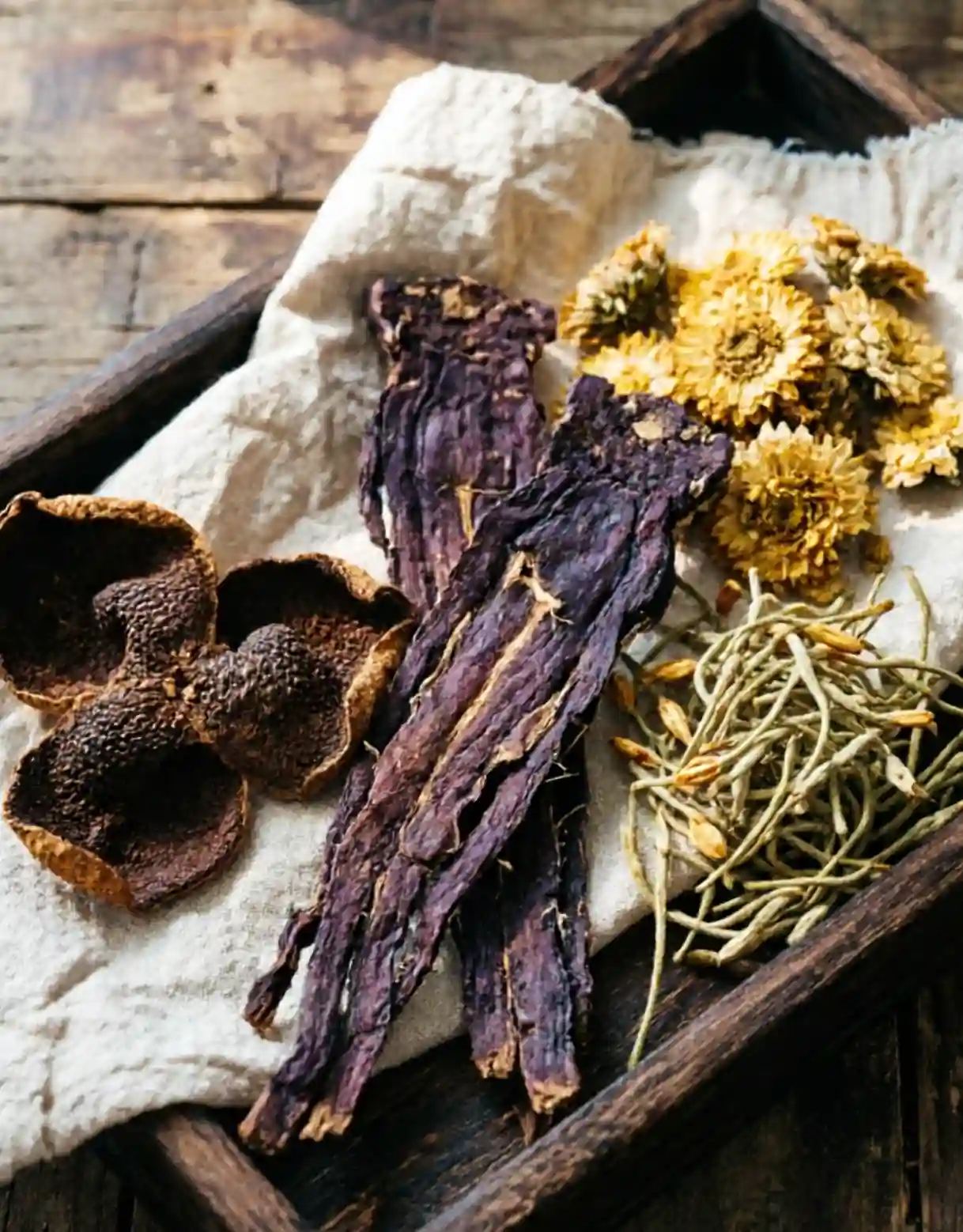
Plants of the family Melastomataceae: Melastoma dodecandrum.Melastoma dodecandrumDried aerial part of *Wikstroemia indica* (Lour.) C.A. Mey.
Botanical Description
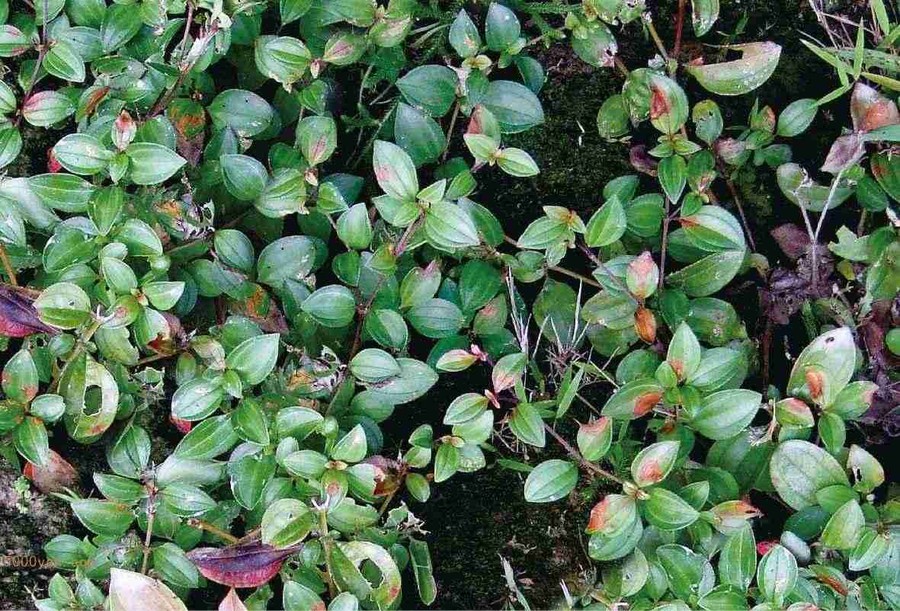
A dwarf shrub, 10-30 cm tall. Stems prostrate and ascending, rooting at nodes, much branched, spreading, all aerial parts covered with rough hairs. Leaves opposite; petiole 2-6 mm; leaf blade firm-papery, ovate or elliptic, 1-4 cm long, 0.8-3 cm wide, apex acute, base broadly cuneate, margin entire or with dense fine serrations; basal veins 3-5. Cymes terminal, with 1-3 flowers, base with 2 leaf-like bracts; pedicel 2-10 mm; flowers pentamerous, hypanthium about 5 mm, covered with rough hairs, hair bases enlarged and conical, sometimes 2-3 clustered; petals pale purple to purplish red, rhombic-obovate, upper part slightly oblique, apex with a tuft of bristles, sparsely ciliate; stamens 5 long and 5 short, the longer ones with an extended, curved connective base bearing 2 small knobs at the tip; the shorter ones with an unextended connective base bearing 2 small knobs at the base; ovary inferior, apex with bristles. Capsule urn-shaped-globose, truncate, slightly constricted near the apex, fleshy, indehiscent, persistent calyx covered with rough hairs. Flowering May to July, fruiting July to September.
Habitat and Distribution
It grows in low grassy slopes at altitudes below 1250 m, commonly found in acidic soil. Distributed in Zhejiang, Jiangxi, Fujian, Hunan, Guangdong, Guangxi, Guizhou, and other regions.
Harvesting and Processing
Harvested from May to June, washed clean, impurities removed, and dried in the sun or by baking.
Chemical Constituents
The main constituents are daucosterol, oleanolic acid, avicularin, 3,7,4'-trimethoxyquercetin, and atractylenolide ketone.
Properties and Channel Entry
Sweet, astringent, cool. Enters the Heart, Liver, Spleen, and Lung channels.
Functions and Indications
Clears Heat, resolves toxicity, activates Blood circulation, and stops bleeding. Indications: high fever, pulmonary abscess, swollen throat, toothache, red and white dysentery, jaundice, edema, dysmenorrhea, metrorrhagia and metrostaxis, leukorrhea, postpartum abdominal pain, scrofula, abscesses, furuncles, hemorrhoids, and venomous snake bites.
Dosage and Administration
Internal: decoct 15-30 g, double the dosage for fresh herbs; or crush fresh herbs to extract juice. External: apply an appropriate amount as a crushed poultice or wash with a decoction.
Precautions and Contraindications
Caution should be exercised in pregnant women.
Prescriptions
1. For hematemesis and epistaxis: 30 g of Melastoma dodecandrum leaves. Decoct in water for oral administration. (Jiangxi Herbal Medicine Manual) 2. For hernia: 60 g of dried Melastoma dodecandrum whole plant, 15 g each of longan aril and tangerine seed. Decoct in water for oral administration. (Fujian Chinese Herbal Medicine) 3. For diphtheria: A handful of fresh Melastoma dodecandrum herb, pound to extract juice, warm and administer orally. (Fujian Folk Herbal Medicine) 4. For all types of sore throat: 18-30 g of Melastoma dodecandrum whole plant, wash, add 1.5 bowls of water, decoct to 60% strength for oral administration. (Minnan Folk Herbal Medicine) 5. For oral ulceration: 30-60 g of Melastoma dodecandrum. Decoct in water for oral administration. (Beihai Commonly Used Folk Chinese Herbal Medicine) 6. For stomach pain: 30-75 g of dried Melastoma dodecandrum, 30 g of camphor tree bark. Decoct in water for oral administration. (Xinhui Herbal Medicine) 7. For dysentery: 60-90 g of fresh Melastoma dodecandrum whole plant. Decoct in water for oral administration. (Hunan Materia Medica)