Pinyin: Malan
Aliases
Ziju, Malanju, Lubianju.
Source
Internal use: decoct 3-10 g.Kalimeris indica(L.) Sch. -Bip.AsterindicusL. of dried whole plant or root.
Botanical Description
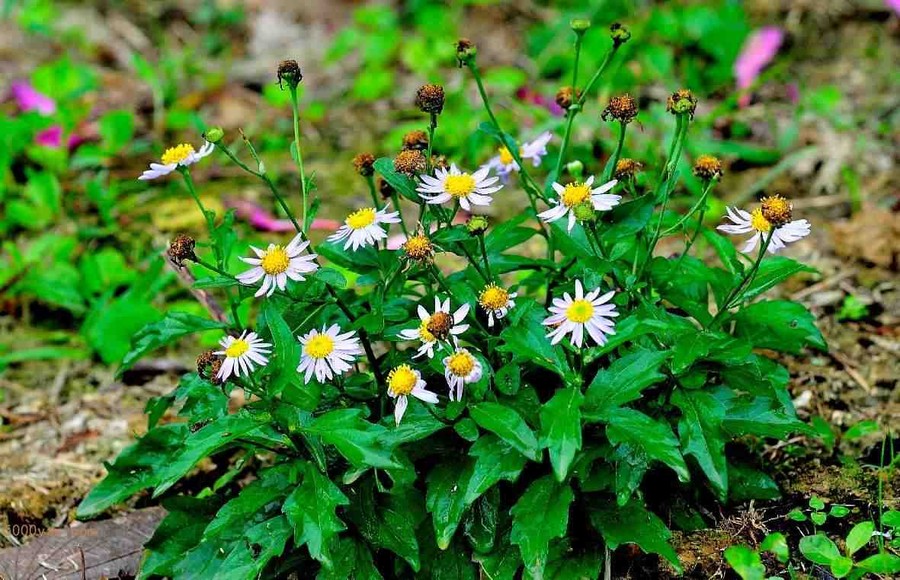
A perennial herb, 30-70 cm tall. Rhizomes have stolons. Stem erect, upper part with short hairs, branched from the upper or lower part. Leaves alternate; base gradually narrowed into a winged long petiole; leaf blade oblanceolate or obovate-oblong, 3-6 cm long, 0.8-2 cm wide, apex obtuse or acute, margin with small-pointed obtuse or sharp teeth from above the middle, or with pinnatifid lobes, both surfaces or upper surface sparsely hairy or nearly glabrous, thin-textured; upper stem leaves small, sessile, entire. Capitula solitary at branch ends and arranged in lax corymbs; involucre hemispherical; phyllaries 2-3 series, imbricate, outer ones oblanceolate, inner ones oblanceolate-oblong, apex obtuse or slightly acute, upper part leathery, sparsely short-haired, margin membranous, ciliate; ray florets 1 series, 15-20, tube 1.5-1.7 mm long; ligules pale purple; tubular florets with tube shortly hairy. Achenes obovate-oblong, very compressed, brown, margin pale with thick ribs, upper part with glandular hairs and short pubescence, easily falling off, unequal in length. Flowering period May-September, fruiting period August-October.
Habitat and Distribution
Grows along roadsides, fields, and hillsides. Distributed throughout the country.
Harvesting and Processing
Harvested in summer and autumn, used fresh or dried in the sun.
Chemical Constituents
This product mainly contains emodin, chrysophanol, and vanillin.β- sitosterol, stigmasterol, linoleic acid, friedelin, friedelinol, lauric acid, and various volatile components such as caryophyllene.γ- Curcumene, pentadecane, etc.
Pharmacology
It has antitussive effects, anticonvulsant effects, and potentiates the hypnotic effect of sodium pentobarbital. It also exhibits weak analgesic effects in mice.
Properties and Channel Entry
Acrid, cool. Enters the Lung, Liver, Stomach, and Large Intestine channels.
Functions and Indications
Cools Blood to stop bleeding, clears Heat and promotes diuresis, resolves toxicity and reduces swelling. Indications: hematemesis, epistaxis, bloody dysentery, metrorrhagia, traumatic bleeding, jaundice, edema, stranguria with turbid discharge, common cold, cough, sore throat and throat obstruction, hemorrhoids, carbuncles and swellings, erysipelas, and infantile malnutrition.
Dosage and Administration
Oral: decoct in water, 10-30 g, fresh product 30-60 g; or crush to extract juice. External use: apply appropriate amount, crushed as a poultice; or decoct in water for fumigation and washing.
Precautions and Contraindications
Caution should be exercised in pregnant women.
Prescriptions
1. For hematochezia (bloody stool): Malan (Kalimeris indica) and Lizhicao (Salvia plebeia) 30 g each. Decoct in water and take orally. (Anhui Zhongcaoyao) 2. For purpura: Malan (Kalimeris indica) and Dijincao (Euphorbia humifusa) 15 g each. Decoct in water and take orally. (Anhui Zhongcaoyao) 3. For sore throat: Malan root (Kalimeris indica) and Shuicaiqin root (Oenanthe javanica) 30 g each, add a small amount of white sugar, mash to extract juice, and take orally. Take consecutively 3-4 times. (Zhejiang Yaoyong Zhiwu Zhi) 4. For stomatitis: Hai Jinsha whole herb (Lygodium japonicum) and Malan (Kalimeris indica) 30 g each. Decoct in water and take orally. (Fujian Zhongcaoyao Chufang) 5. For acute conjunctivitis: Fresh tender leaves of Malan (Kalimeris indica) 60 g. Mash, mix with a small amount of tea oil, and take orally. (Changyong Qingcaoyao Xuanbian)