Pinyin: Wasong
Aliases
Wahua, Shipenghua, Gouzhijia.
Source
1. For pneumonia: Renshen 6 g, decoct in water and take orally.Oros-tachys fimbriataDried aerial parts of (Turcz.) Berg.
Botanical Description
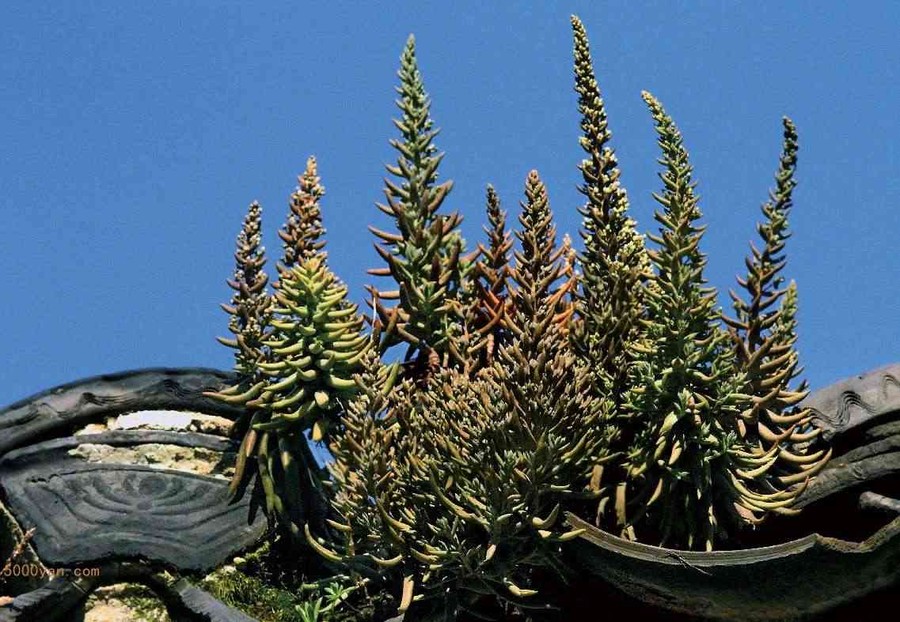
Biennial or perennial herb, 10-40 cm tall. The entire plant is pinkish-green, glabrous (hairless), densely covered with purplish-red spots. Roots are multi-branched, fibrous. Stem erect, unbranched. Basal leaves rosette-like, fleshy, spoon-shaped-linear to oblanceolate, 2-4 cm long, 4-5 mm wide, green with purple or with white powder, margin fringed, apex with a semicircular cartilaginous appendage with a needle-like spine in the center; cauline leaves alternate, sessile, linear to lanceolate, 2-3 cm long, 2-5 mm wide, apex long acuminate, entire margin. Racemes dense, with lower branches forming a pyramidal shape; flowers small, bisexual; bracts linear-acuminate, leaf-like; sepals 5, oblong, 1-3 mm long; petals 5, pale red, lanceolate-elliptic, 5-6 mm long, slightly connate at base; stamens 10, in 2 whorls, as long as or slightly shorter than petals, anthers purple; carpels 5, separate, each carpel base with a nearly quadrangular scale. Follicles, oblong, about 5 mm long, beak slender. Seeds numerous, small, ovoid. Flowering August to September, fruiting September to November.
Habitat and Distribution
It grows on rocky slopes or rooftops. Distributed in Northeast, North China, Northwest, East China, and Hubei.
Harvesting and Processing
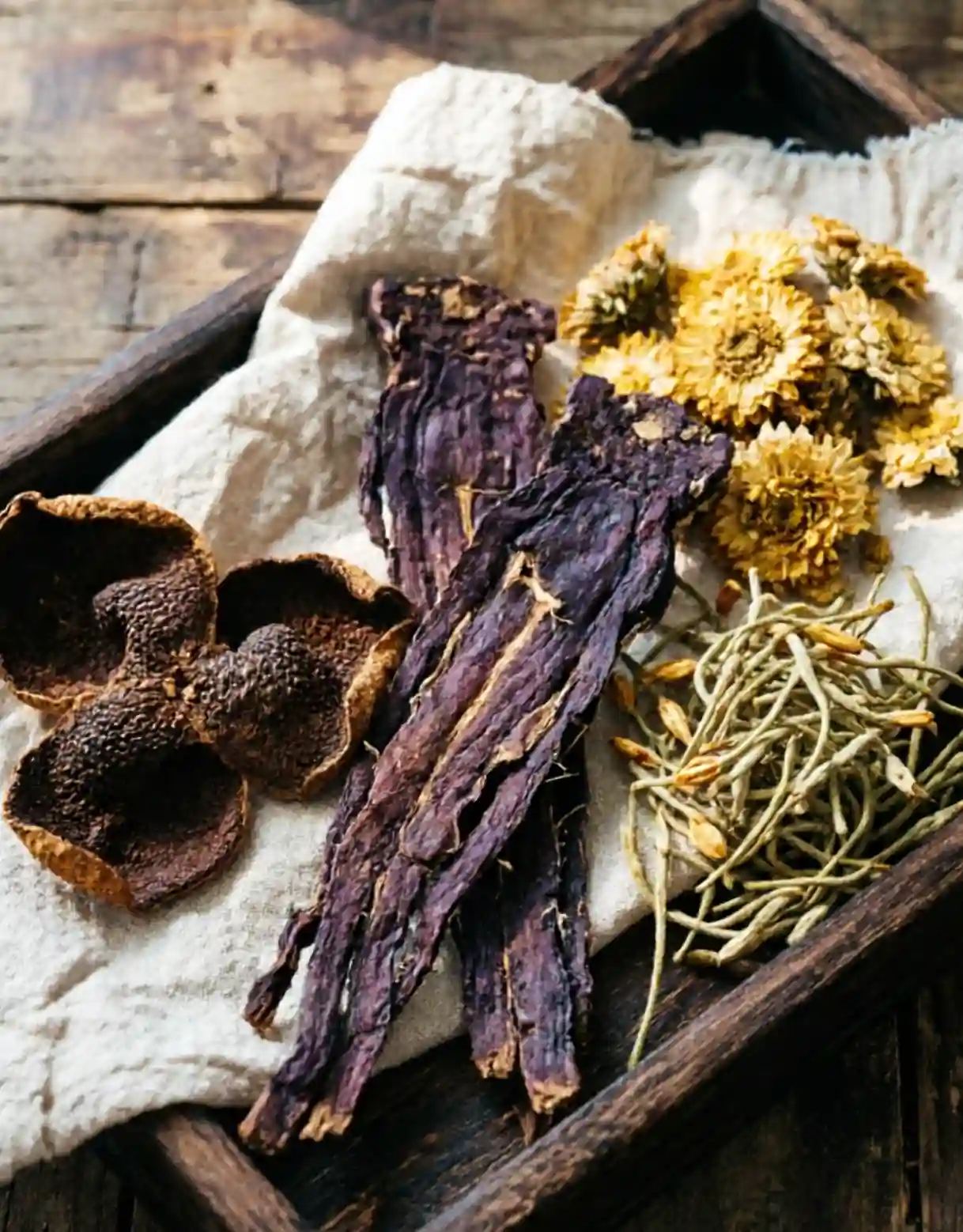
Harvested during summer and autumn when in bloom, remove roots and impurities, and dry in the sun.
Chemical Constituents
This product contains quercetin, quercetin-3-glucoside, kaempferol-7-rhamnoside, kaempferol, oxalic acid, and other components.
Pharmacology
Has cardiotonic effects.
Properties and Channel Entry
Sour, bitter, cool. Enters the Liver, Lung, and Spleen channels.
Functions and Indications
Cools Blood, stops bleeding, resolves toxicity, and closes sores. Used for bloody dysentery, bloody stools, hemorrhoidal bleeding, and wounds that fail to heal for a prolonged period.
Dosage and Administration
Internal use: decoction, 5-15 g; pound for juice; or made into pills. External use: appropriate amount, pound and apply; or decoct for steam and wash; or grind into powder and apply.
Precautions and Contraindications
Caution should be exercised in patients with Spleen and Stomach deficiency-cold. This product is toxic and should not be used in excessive doses for internal use.
Prescriptions
1. For lung heat with wheezing and cough: fresh *Orostachys fimbriata* 60-90 g. Decoct in water with a little white sugar, take together with the dregs. (Sichuan Chinese Materia Medica, 1982) 2. For chyluria: *Orostachys fimbriata* 6 g. Decoct in an appropriate amount of water, take with white sugar. [Shandong Journal of Traditional Chinese Medicine, 1988, 7(4):51] 3. For acute anicteric infectious hepatitis: *Orostachys fimbriata* 60 g, malt 30 g, tender weeping willow branches 9 g. Decoct in water for oral administration. (Zhejiang Folk Commonly Used Chinese Herbs) 4. For hemorrhoids: a. Fresh *Orostachys fimbriata*, decoct in water and fumigate-wash the affected area. (Zhejiang Folk Commonly Used Chinese Herbs) b. For hemorrhoid swelling, pain, and bleeding: *Orostachys fimbriata* 18 g, honeysuckle flower 6 g, forsythia 6 g, coix seed 24 g. Decoct in water for oral administration. (Clinical Manual of Chinese Materia Medica) 5. For scalds and burns with blisters: *Orostachys fimbriata* and fresh *Platycladus orientalis* leaves. Pound together and apply externally; if dry, grind into powder. (Yifang Zhaiyao) 6. For swollen and painful gums: *Orostachys fimbriata* and alum in equal parts. Decoct in water for rinsing the mouth. (Zhaixuan Fang) 7. For eczema: *Orostachys fimbriata* (sun-dried), burn to ash and grind into powder, mix with tea oil and apply externally, to stop pain and relieve itching. (Quanzhou Bencao)