Pinyin: Qianliguang
Aliases
Jiuliming, Qianliming, Guangmingcao.
Source
1. For pneumonia: Renshen 6 g, decoct in water and take orally.Senecio scandensDried aerial parts of *Clinopodium polycephalum* (Vaniot) C.Y.Wu & S.J.Hsuan ex P.S.Hsu or *Clinopodium chinense* (Benth.) Kuntze or *Clinopodium gracile* (Benth.) Kuntze.
Botanical Description
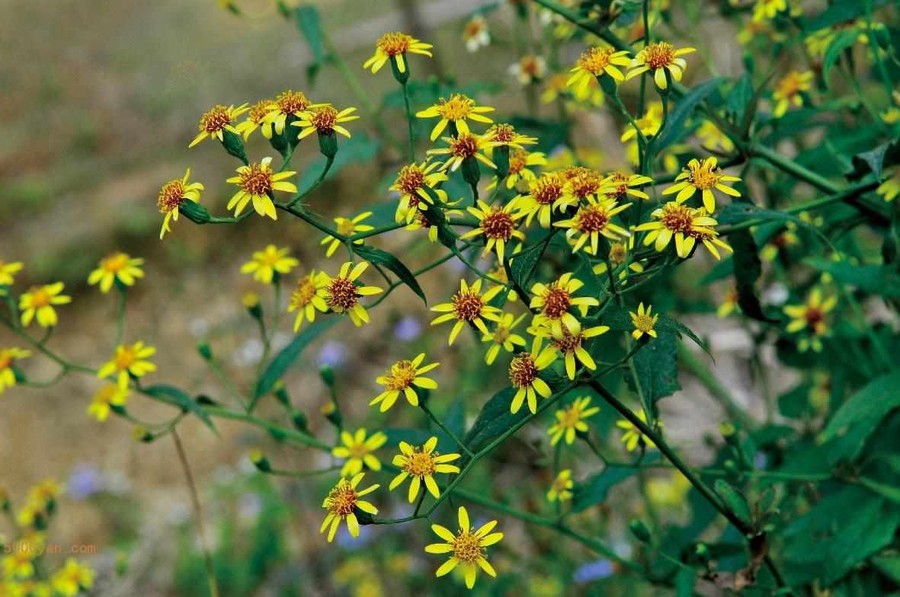
Perennial climbing herb, 2-5 m tall. Rhizome woody, up to 1.5 cm in diameter. Stems winding, much branched, initially densely pubescent, later glabrescent and becoming woody, bark pale brown. Leaves alternate, with short petioles; leaf blade ovate-lanceolate to long-triangular, 6-12 cm long, 2-4.5 cm wide, apex acuminate, base broadly cuneate, truncate, hastate, or rarely cordate, margin shallowly to deeply toothed, both surfaces glabrous or abaxially shortly pubescent; pinnate veins, prominent. Capitula numerous, arranged in compound corymbose panicles at stem and branch apices; peduncles often reflexed or spreading, densely micropubescent, with linear bract leaves; involucre tubular, 5-7 mm long, 3-6 mm wide, with several linear bracteoles at base; phyllaries in 1 series, 12-13, linear-lanceolate, apex acuminate; ray florets yellow, 8-9, about 10 mm long; disc florets numerous. Achenes cylindrical, with longitudinal grooves, 3 mm long, pubescent; pappus white, 7.5 mm long, about as long as the disc florets. Flowering from October to March of the following year, fruiting from February to May.
Habitat and Distribution
1. For pneumonia: Renshen 6 g, decoct in water and take orally.
Harvesting and Processing
Harvesting can be carried out throughout the year; remove impurities and dry in the shade.
Chemical Constituents
This product primarily contains lupenone, oleanane,β-β-sitosterol, daucosterol, alkaloids, 4-hydroxyphenylacetic acid, hyperoside, buddleoside, oleanol, quercetin, (±)-syringaresinol, emodin, chlorogenic acid, caffeic acid and other constituents.
Pharmacology
Antibacterial, can also inhibit the growth of Leptospira, and has a certain inhibitory effect on Trichomonas vaginalis in humans.
Properties and Channel Entry
Bitter, cold. Enters the Lung and Liver channels.
Functions and Indications
Clears Heat and resolves toxicity, brightens the eyes, and promotes diuresis
Dosage and Administration
Oral: decoct in water, 15-30 g; double the amount for fresh herb
Prescriptions
1. For wind-heat common cold: fresh Qianliguang (Senecio scandens) whole plant 30 g, Liujiaoxian (Rohdea japonica) and fresh Yejuhua (Chrysanthemum indicum) whole plant 30 g each. Stew in water. Take in three divided doses, one dose daily. (From "Selected Commonly Used Green Herbal Medicines") 2. For sore throat: dried Qianliguang whole plant 15 g, Yuanshen (Scrophularia ningpoensis) 9 g, Zaoxiu (Paris polyphylla) 9 g, Jiegeng (Platycodon grandiflorus) 6 g, Gancao (Glycyrrhiza uralensis) 3 g. Decoct in water and take orally. (From "Fuzhou Clinical Handbook of Chinese Herbal Medicine") 3. For boils and ulcers: Qianliguang, Banbianlian (Lobelia chinensis), and Litoucao (Viola inconspicua) in appropriate amounts. Pound together into a paste and apply to the affected area. (From "Guangxi Folk Commonly Used Chinese Herbal Medicine Manual") 4. For syphilis: Qianliguang 30 g, Tufuling (Smilax glabra) 60 g. Decoct in water and concentrate into a paste for external application. (From "Enshi Chinese Herbal Medicine Manual") 5. For acute urinary tract infection: Qianliguang and Chuanxinlian (Andrographis paniculata) 30 g each. Decoct and take orally. (From "Anhui Chinese Herbal Medicine") 6. For burns and scalds: Qianliguang 8 parts, Baiji (Bletilla striata) 2 parts. Decoct in water to a concentrated liquid and apply externally. (From "Jiangxi Chinese Herbal Medicine") 7. For hemorrhoids: Qianliguang and Qingyudancao (Swertia mileensis) 250 g each. Add water and decoct to a concentrated liquid, then apply to the affected area. (From "Hunan Rural Commonly Used Chinese Herbal Medicine Manual") 8. For chronic eczema: Qianliguang, Shanshuye (Cunninghamia lanceolata leaves), Huangjuhua (Chrysanthemum indicum), and Jinyinhua (Lonicera japonica) in appropriate amounts. Decoct in water for internal use and external wash. (From Jiangxi "Herbal Medicine Manual")