Pinyin: Tianhusui
Aliases
Jichangcai, Poqiancao, Shujicao
Source
Plant of the Apiaceae family: Hydrocotyle sibthorpioides (Lawn Pennywort)Hydrocotyle sibthorpoidesWhole herb of Lam.
Botanical Description
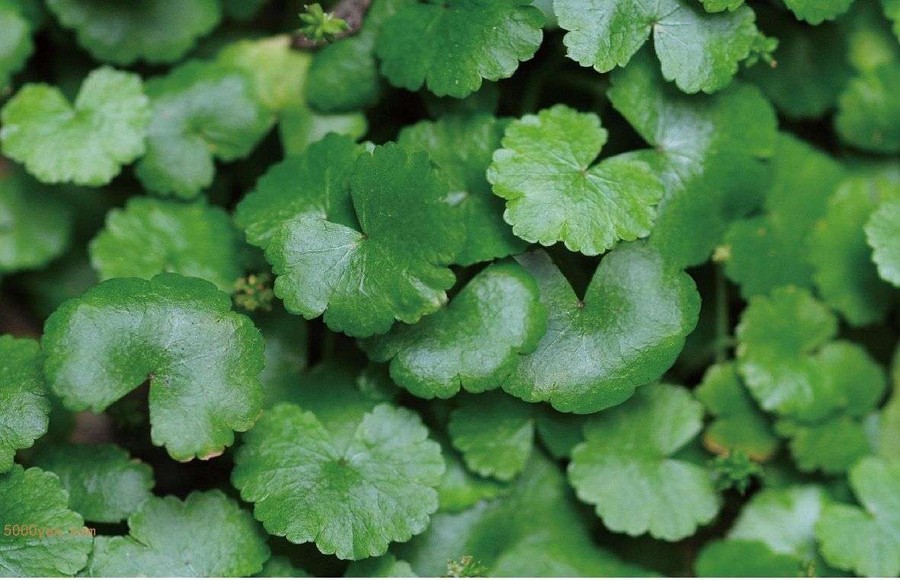
Perennial herb with a distinctive odor. Stems slender, creeping, spreading flat over the ground forming mats. Roots arise from nodes; leaves alternate; leaf blades thin, round-kidney-shaped to suborbicular, 0.5-1.5 cm long, 0.8-2.5 cm wide, base cordate, entire or 3-7-lobed, lobes broadly ovate, margin with obtuse teeth, glabrous on upper surface, sparsely white pubescent on lower surface and petiole apex; stipules somewhat semicircular, entire or slightly lobed. Umbels opposite the leaves, solitary at nodes; peduncles slender, 0.5-3 cm long; involucral bracteoles ovate to ovate-lanceolate, with yellow transparent glandular dots; umbellules with 5-18 flowers; petals ovate, greenish-white, with glandular dots. Stamens 5, ovary inferior. Schizocarp somewhat cordate, 1-1.4 mm long, 1.2-2 mm wide, laterally compressed, median ribs prominently raised at maturity, with purple spots when ripe. Flowering and fruiting period: April to September.
Habitat and Distribution
Born in moist roadsides, grasslands, ditch edges, and under forests. Distributed in Southwest China and Shaanxi, Jiangsu, Anhui, Zhejiang, Jiangxi, Fujian, Taiwan, Hunan, Hubei, Guangdong, Guangxi, and other regions.
Harvesting and Processing
Harvest the whole plant in summer and autumn, wash clean, and use fresh or sun-dry.
Chemical Constituents
This product contains quercetin, isorhamnetin, quercetin-3-galactoside, l-sesamin, stigmasterol, and other components.
Pharmacology
Anti-pathogenic microorganisms; has significant hypoglycemic effects in normal and diabetic rats.
Properties and Channel Entry
Acrid, slightly bitter, cool.
Functions and Indications
Clears Heat and eliminates Dampness, resolves toxicity and reduces swelling
Dosage and Administration
Internal use: decoction, 9-15 g, fresh product 30-60 g; or pounded to extract juice
Prescriptions
1. For hepatitis and cholecystitis: 60 g fresh Hydrocotyle sibthorpioides. Decoction in water, adjust with rock sugar and take. (Fujian Materia Medica) 2. For urinary stone: 60 g fresh Hydrocotyle sibthorpioides, 30 g Lygodium japonicum stem and leaf. Decoction in water, take 1 dose daily. (Hubei Chinese Herbal Medicine) 3. For whooping cough: 15-30 g fresh Hydrocotyle sibthorpioides. Mash and extract juice, mix with honey or rock sugar, stew and take warm. (Fujian Materia Medica) 4. For urticaria: 30-60 g Hydrocotyle sibthorpioides. Extract juice and take with boiling water. (Fujian Chinese Herbal Medicine) 5. For venomous snake bite: 60 g each of Hydrocotyle sibthorpioides and Glechoma longituba (both fresh). Mash and extract juice for oral administration, and apply the residue to the wound. (Hubei Chinese Herbal Medicine) 6. For snake-head furuncle: Fresh Hydrocotyle sibthorpioides mixed with cold rice, brown sugar, or a small amount of realgar. Mash and apply to the affected area. (Fujian Materia Medica)