Pinyin: Guanghuoxiang
Aliases
Huoxiang, Haihuoxiang.
Source
Plant of the Lamiaceae family, *Pogostemon cablin*Pogostemon cablinDried aerial parts of (Blanco) Benth.
Botanical Description
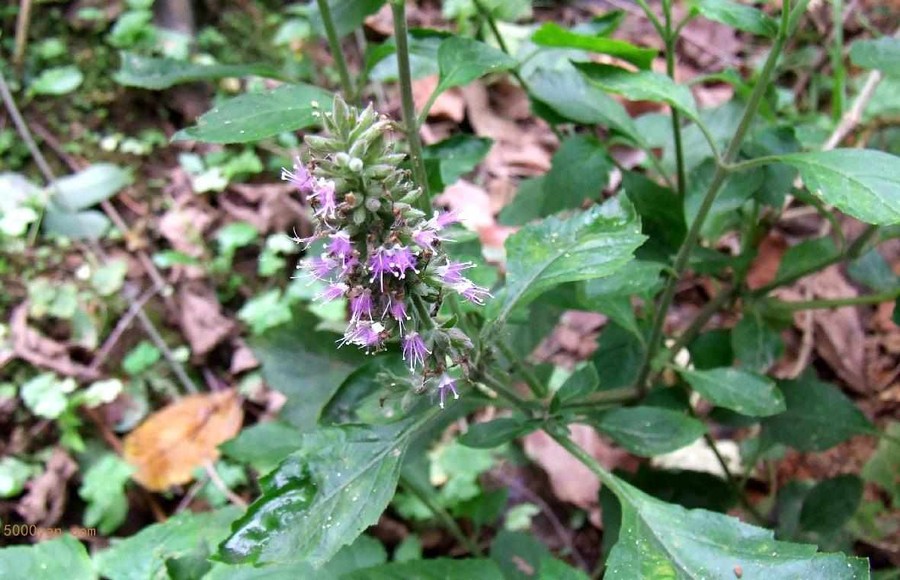
An annual herb, 30-60 cm tall. Erect, branched, pubescent, with older stems externally corky. Leaves opposite; petiole 2-4 cm long, with a light, distinctive aroma when rubbed; leaf blade ovate or oblong-elliptic, 5-7-10 cm long, 4-7.5 cm wide, apex shortly acute or obtuse-rounded, base broad and obtuse or cuneate and slightly asymmetrical, margin irregularly coarsely blunt-toothed, both surfaces tomentose, more densely so beneath, veins raised beneath, slightly sunken above, some veins purplish-red; the interveinal leaf tissue slightly raised above, giving the leaf surface an uneven texture. Verticillasters dense, sometimes interrupted at the base, forming terminal and axillary spikes, 2-6 cm long, 1-1.5 cm in diameter, with a peduncle; bracts about 13 mm long; calyx tubular; corolla tube exserted from the calyx, limb sub-bilabiate, upper lip 3-lobed, lower lip entire; stamens 4, exserted, filaments bearded. Flowering in April. Specimens in China rarely flower.
Habitat and Distribution
It is cultivated in Fujian, Taiwan, Guangdong, Hainan, and Guangxi in China.
Harvesting and Processing
Harvest when the branches and leaves are lush, sun-dry and seal overnight, repeat until dry.
Chemical Constituents
This product contains patchouli alcohol, selinene,δPiper cubeba L. (bi cheng qie xi) and Patchouli alcohol (guang huo xiang er chun)α- Patchoulene,β- Patchouli alkene and other constituents.
Pharmacology
Has antibacterial and calcium antagonistic effects.
Properties and Channel Entry
Acrid, slightly warm. Enters the Spleen, Stomach, and Lung channels.
Functions and Indications
Aromatically transforms turbidity, harmonizes the Middle and stops vomiting, releases the exterior and resolves summerheat. Used for dampness-turbidity obstructing the Middle, epigastric fullness and vomiting, summerheat-dampness exterior pattern, early-stage damp-warm disease, fever with fatigue and lethargy, chest oppression and discomfort, cold-dampness obstructing summerheat, abdominal pain with vomiting and diarrhea, and nasal sinusitis with headache.
Dosage and Administration
Oral administration: decoction, 5-10 g, double the amount for fresh herb, do not decoct for a long time; or in pill or powder form. External application: appropriate amount, decoct in water for gargling, or soak the affected area, or grind into powder for topical application. Huoxiang leaf is more inclined to release the exterior, Huoxiang stem is more inclined to harmonize the Middle Jiao and stop vomiting.
Precautions and Contraindications
For those with Yin deficiency: contraindicated (do not administer).
Prescriptions
1. For summer heat vomiting and diarrhea: 60 g of talcum (stir-fried), 7.5 g of *Pogostemon cablin*, 1.5 g of clove. Grind into powder, take 3-6 g each time, mixed with rice-washed water. (From "Yu Jiang Shi Jing Yan Fang") 2. For fetal restlessness with qi not ascending or descending, and vomiting sour fluid: 6 g each of *Cyperus rotundus*, *Pogostemon cablin*, and licorice. Grind into powder, take 6 g each time, add a little salt, and mix with boiling water. (From "Sheng Hui Fang") 3. For upper respiratory tract infection with fever: 10 g of *Pogostemon cablin*, 6 g of *Mosla chinensis*, 15 g of *Chrysanthemum indicum*, 10 g of *Artemisia annua*. Prepare as granules, take 15 g every 6 hours, dissolved in boiling water. [From "Jiangsu Journal of Traditional Chinese Medicine" 1987, (7): 11] 4. For halitosis: Wash *Pogostemon cablin* clean, decoct in water, and frequently rinse the mouth. (From "Zhai Xuan Fang") 5. For diaphragm heat with oral ulcers and sore throat: 1.5 g each of *Pogostemon cablin* leaf, gypsum (refined with water), and gardenia fruit kernel, 3 g of licorice (honey-fried). Grind into very fine powder, mix with freshly drawn water. (From "Yang Ke Xuan Cui") 6. For tinea of hands and feet: 30 g of *Pogostemon cablin*, 12 g each of *Polygonatum sibiricum*, fresh ginger, and copperas. Soak the herbs in 1000 ml of rice vinegar for 7-8 days, then remove the dregs. Immerse the affected area in the medicinal liquid, 1-3 times daily, 20-30 minutes each time. The more frequent and longer the immersion, the better the effect. [From "Jiangsu Journal of Traditional Chinese Medicine" 1964 (5): 8]