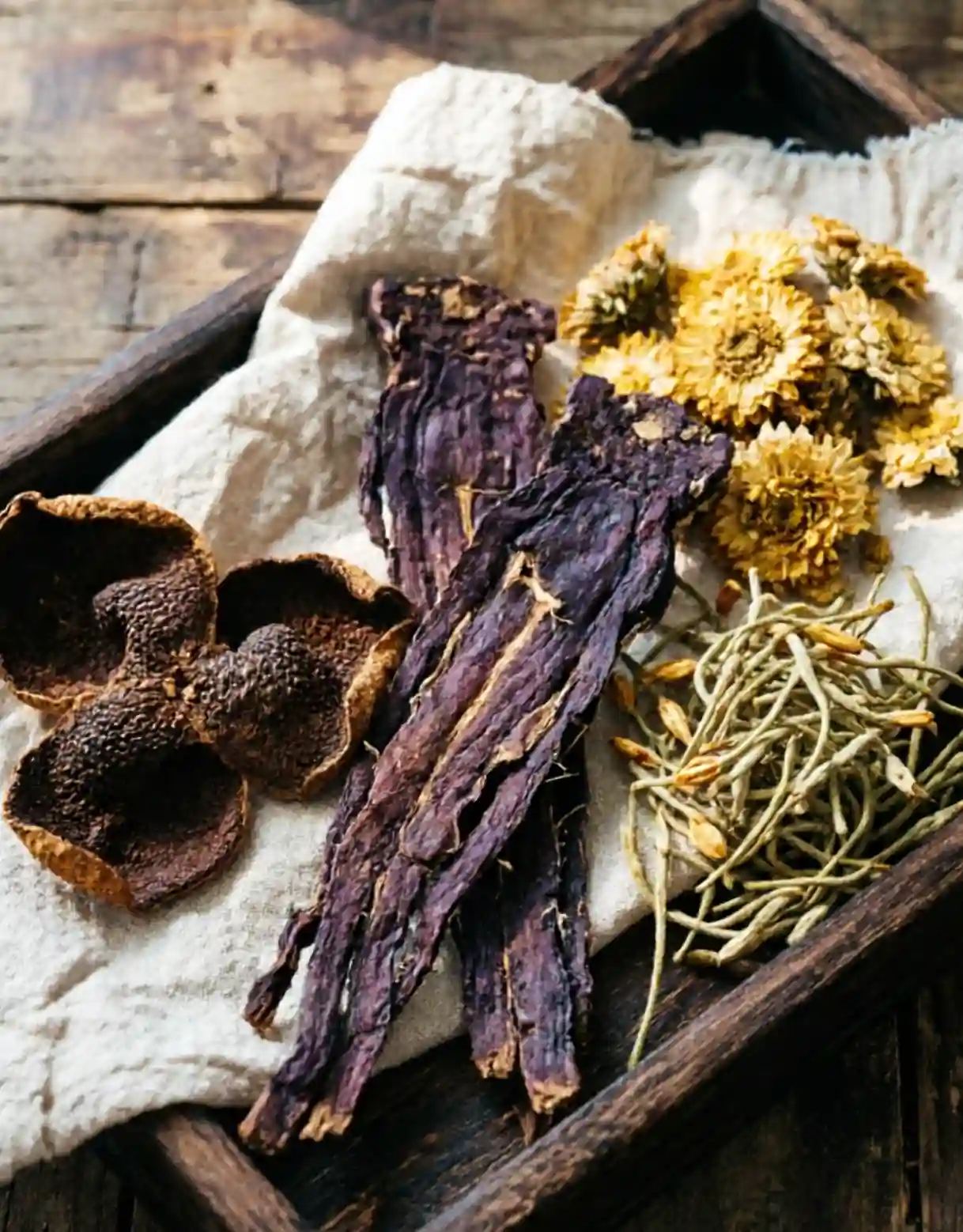
Pinyin: Tiexiancai
Aliases
Liuhecao, Xuejianchou, Penshuicao.
Source
Euphorbiaceae plant *Acalypha australis* L.Acalypha australisDried whole herb of L.
Plant
Botanical Description
Annual herb, 30-50 cm tall. Stem erect, branched, sparsely pubescent. Leaves alternate; petiole 2-5 cm long; leaf blade ovate-rhombic or ovate-elliptic, 2-7.5 cm long, 1.5-3.5 cm wide, apex acuminate, base cuneate or rounded, with 3 basal veins, margin bluntly serrate, both surfaces rough and glabrous. Spikes axillary; flowers unisexual, monoecious; male spikes very short, 2-10 mm long, enclosed in minute bracts; female spikes enclosed in leaf-like bracts; bracts reniform when expanded, 1-2 cm long, clam-like when closed, margin bluntly serrate, base cordate; calyx 4-lobed; petals absent; stamens 7-8; female flowers 3-5; ovary sparsely pubescent, 3-4-locular; style plumose, divided to base. Capsule small, triangular-semiorbicular, coarsely hairy; seeds ovoid, about 2 mm long, grayish-brown. Flowering May to July, fruiting July to October.
Habitat and Distribution
Born in open fields, hillsides, and relatively moist areas along roadsides
Harvesting and Processing
Harvested from May to July, remove soil, sun-dry or use fresh.
Chemical Constituents
This product mainly contains emodin,β- β-sitosterol, digitoxigenin, protocatechuic acid, bornyl acetate, cedranone, vanillic acid, and other constituents.
Pharmacology
Has antibacterial and anti-asthmatic effects.
Properties and Channel Entry
Bitter, astringent, and cool. Enters the Heart, Lung, Large Intestine, and Small Intestine channels.
Functions and Indications
Clears Heat and drains Dampness, cools Blood and resolves toxicity, reduces accumulation. Main indications: dysentery, diarrhea, hematemesis, epistaxis, hematuria, hemafecia, metrorrhagia and metrostaxis, infantile malnutrition, furuncles and ulcers, and skin eczema.
Dosage and Administration
Internal: decoct in water, 10-15 g; fresh product 30-60 g. External: appropriate amount, decoct in water for washing or mash for application.
Precautions and Contraindications
Use with caution in the elderly and those with Qi deficiency; contraindicated during pregnancy.
Prescriptions
1. Treat hematemesis: *Acalypha australis* 60 g, *Lophatherum gracile* 15 g. Decoct in water for oral administration. ("Jiangxi Herbal Medicine") 2. Treat hematemesis, hemafecia, and hematuria: *Acalypha australis* whole herb 30 g, decoct and take; or combine with *Sanguisorba officinalis* and *Glycyrrhiza uralensis* for more reliable efficacy. (Southern Medicine "Chinese Herbal Medicine") 3. Treat malnutrition with accumulation (gan ji): Fresh *Acalypha australis* whole herb 30-60 g, decoct and cook with pig liver for consumption. Or use fresh *Acalypha australis* 15 g, ginger and scallion 30 g each, pound into a paste, mix with duck egg white, apply externally to the sole of the foot for 1 night, once every 3 days, for 5-7 consecutive applications. For severe cases, combine internal administration and external application. ("New Compilation of Zhejiang Southern Materia Medica") 4. Treat venomous snake bite: *Acalypha australis*, *Lobelia chinensis*, and *Isatis indigotica* 30 g each. Decoct in water for oral administration. ("Jiangxi Herbal Medicine") 5. Treat eczema: Pound *Acalypha australis* into a felt-like mass, extract the juice, and apply externally. ("Guizhou Herbal Medicine") 6. Treat asthma with hemoptysis: *Acalypha australis* 60 g. Decoct in water for oral administration. ("Guizhou Herbal Medicine")

